

The Strange Career of Stieglitz's
`The Steerage' by Deborah Dash Moore
Director, The Frankel Center, and
Frederick G.L. Huetwell Professor of History
University of Michigan
In 1907 Alfred Stieglitz boarded a steamship
heading to Europe. He had already made a
name for himself as a talented photographer and
outspoken proponent of photography as an art
form. His gallery on Fifth Avenue in New York
City and his magazine Camera Work promoted
pictorialist photographs, noted for their soft
focus and dreamy qualities. Mist, snow, smoke,
and their effects appealed to pictorialists,
even when they pictured New York's dynamic
cityscape. Stieglitz had yet to proclaim his credo:
"I was born in Hoboken. I am an American.
Photography is my passion. The search for
truth my obsession." But at 43, with a wife and
daughter accompanying him, his trip back to
Europe, where he had first studied photography,
provided the setting for perhaps his most famous
photograph. "If all my photographs were lost,
and I would be remembered only for 'The
Steerage,'" he once said, "I would be satisfied."'
Stieglitz traveled first class, appropriate for
his station as a son of wealthy German Jewish
immigrants who supported his photographic
ambitions. But after a couple of days at sea, he
grew bored with the amusements available and
wandered away to peer at how less prosperous
passengers traveled. Looking down at the
steerage and across at other travelers on the
`tween deck, Stieglitz had an epiphany. His
epiphany had nothing to do with social class
differences or even immigration. As he later
recounted his experience, he saw "a new picture
of shapes, and underlying it, the new vision that
held me." Rushing back to his stateroom for
his camera, Stieglitz used the one unexposed
negative he had to capture a picture that, were
anyone to move, "would no longer exist."2
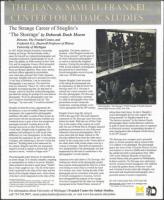
The photograph justly deserves its reputation as
an iconic image. It is visually complex, requiring
no manipulation to achieve its power. Stieglitz
often pointed to the man's round straw "boater"
hat as what caught his eye. The tilt of the man's
body contrasted to the slant of the stairs and the
thrust of the triangle-shaped mast, while echoes
of his hat's circle reappeared on the links of the
1 Quoted in Hans-Michael Koetzle, "The Steerage," in Photo Icons: The
Story Behind the Pictures, 1827-1926 (Köln: Taschen, 2002): 138.
2 Quoted in Joel Smith, "How Stieglitz Came to Photograph Cityscapes,"
History of Photography 20:4 (Winter 1996): 322.
gangplank. The photo captures a
moment—what Stieglitz would call
"the living moment" and the goal of
all of his subsequent photography—
as well as a historically freighted
situation. During the preceding year,
1906, record numbers of immigrants
had entered the United States;
Jewish immigration was at its peak,
with over 150,000 arriving.
Despite Stieglitz's later accounts
of the taking the photograph and
its importance, he did not print The
Steerage until 1911. Yet once it
entered into visual commerce with
his other photographs, The Steerage
occupied a critical place, pointing
to a shift in photography away from
pictorialism toward vernacular
modernism, marking perhaps a new
Alfred Stieglitz. "The Steerage" © 2010 Georgia O'Keeffe Museum/
vision appropriate for the 20th century. Artists Rights Society (ARS), New York
Stieglitz lived a long life, dying in
1946 at the age of 82. His most extensive
comments on The Steerage came four years
before his death. With the rise of New York
City as the center of the western art world
after the end of World War II, Stieglitz attained
posthumous prominence as one of the most
influential American photographers. But at
some point after his death, interest in The
Steerage shifted focus from the white straw
boater on the young man on the `tween deck to
the white shawl with a black stripe worn by a
woman in steerage. That shift accompanied a
new interpretation of the photograph, one that
emphasized its title and its connection to the
photographer's Jewish identity.
American Jews laid claim to The Steerage. Not
looking too closely at the photograph, people
have routine misrecognized the shawl as a tallit,
even failing to notice that it covered the head
of a woman, not a man. Noting the date of the
photograph and its correlation with peak years
of Jewish immigration to America, viewers
have disregarded the purpose of the voyage.
Jews have imagined that the ship was bringing
immigrants to the United States, instead of
taking them back home. In short, Stieglitz's
iconic photograph did not only capture "the
living moment" as Stieglitz termed it (or
"the decisive moment" as the famous French
photographer Henri Cartier-Bresson called it),
in spite of itself, the photo also came to represent
an historical moment, incapsulating decades of
mass immigration that reshaped Jewish history
in the 20 century.'
The Steerage now occupies such a powerful
place in Jewish narratives about America that
it is unlikely to be dislodged. The photograph
graces the cover of the Columbia History of Jews
and Judaism in America (2008) and it introduces
the exhibit devoted to immigration from 1880-
1945 in the National Museum of American
Jewish History that just opened in Philadelphia.
In these contexts, The Steerage now epitomizes
arrival: of pious Jewish immigrants who suffered
to reach the golden shores of the new world
and of talented Jewish artists like Stieglitz who
innovated and transformed photography into a
powerful means of creative expression.
It's not a bad career for a 103-year-old
photograph, but it sure is a strange one.
3 Conversation with Jonathan Boyarin.
For information about University of Michigan's Frankel Center for Judaic Studies,
call 734.763.9047, email judaicstudies@umich.edu , or visit www.lsa.umich.edujudaic.
UNIVERSrrY OF
MICHIGAN