

World
Saudi Arms Sale
Proposed administration deal spurs congressional concerns.
Special Report
I
n a demonstration of bipartisan-
ship, both the top Democrat and
Republican on the House Foreign
Affairs Committee are demanding
answers to concerns about the proposed
$60 billion Saudi arms deal, the largest
such arms sale in U.S. history.
U.S. Rep. Howard
Berman, D-Calif.,
current chair of
the Foreign Affairs
Committee, and Rep.
Ileana Ros-Lehtinen,
R-Fla., ranking mem-
ber and former chair
who is expected to
Rep. Berman
reclaim the top slot
of the committee in
the 112th Congress,
asked their colleagues
to cosign a letter to
Secretary of State
Hillary Clinton and
Defense Secretary
Rep. Ros-
Robert Gates raising
Lehtinen
misgivings about the
transfer of advanced
weaponry to Saudi Arabia.
The letter was released on Nov. 5, just
three days after the U.S. elections and
on the eve of Israeli Prime Minister
Benjamin Netanyahu's visit to the U.S.
The deal is part of a $123 billion arms
sale to the Persian Gulf states — justi-
fied as part of a coordinated response to
contain Iran.
The executive branch only notified
Congress of the sale three weeks ago,
when members of Congress were cam-
paigning in the mid-term elections.
Following review, Congress could
block or amend the deal. The letter was
sent to the White House last Friday
before members of the 111th Congress
reconvened this past Monday for its
final weeks. So the co-authors had to
scramble to get the letter signed during
the congressional recess.
Failed Vetting?
According to the Endowment for Middle
East Truth, the executive branch has
failed to do proper due diligence on how
arms sales to the Gulf countries affect
U.S. national security and has failed
18 November 18 • 2010
"What U.S. policy
goals and interests are
advanced by this sale
and have we placed
any conditions on it?
What is the threat or
threats that this sale is
intended to address?
Do the Saudis share
our assessment of those
threats, and will they
be amenable to, and
capable of carrying out
these missions?"
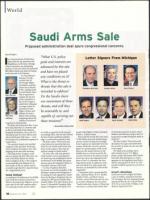
Letter Signers From Michigan
Thaddeus McCotter
Mike Rogers
Candice Miller
Fred Upton
Mark Schauer
Gary Peters
Dale Kildee
- Berman/Flos-Lehtinen letter
to certify, as reported by the General
Accounting Office, that the sale will not
threaten Israel's qualitative military
edge, a certification required by law.
The letter states, "We are also con-
cerned about the potential repercus-
sions for our friends and for our own
forces in the region in the event of
political change in Saudi Arabia."
The letter also calls into question
Saudi Arabia's role in stemming ter-
ror financing and proliferation and its
involvement in the Middle East peace
process, given the kingdom's failure to
normalize relations with Israel.
U.S. Rep. Thaddeus McCotter,
R-Livonia, was the first member of the
Michigan congressional delegation to
be among the early signatories. Others
from the Michigan delegation who are
among the 198 signers include: Reps.
Candice Miller, R-St. Clair Shores; Gary
Peters, D-Bloomfield Township; Mike
Rogers, R-Brighton; Fred Upton, R-St.
Joseph; Dale Kildee, D-Flint; and Mark
Schauer, D-Battle Creek.
Peters told the Jewish News last week,
"A $60 billion arms sale should always
warrant serious vetting and oversight
from Congress, but especially when the
country involved is in such a pivotal
player in a pivotal region of the world.
Moreover, the Saudis interests in the
Middle East on critical issues like the
security of Israel or the Iranian nuclear
threat are not in close alignment with
those of the U.S.; therefore, the State
Department needs to explain its ratio-
nale and which U.S. policy goals and
interests are furthered by a sale of this
magnitude."
A September effort, spearheaded by
Reps. Anthony Weiner, D-N.Y., Shelley
Berkley, D-Nev., and Chris Carney,
D-Penn., tried to block the sale. In a let-
ter to their colleagues, the trio noted:
"Saudi Arabia has a history of financing
terrorism, is a nation that teaches hate
of Christians and Jews to their school-
children and offered no help to the U.S.
as gas prices surged during the spike in
oil prices."
The letter added, "This deal would
destabilize the region and undermine
the security of Israel, our one true ally
in the region?'
The Saudi arms package report-
edly includes 84 new F-15 fighter
planes, nearly 200 Apache, Black Hawk
and Little Bird helicopters, as well as
upgrades to the kingdom's naval forces
and its existing fleet of 150 F-15s. The
transfer would be spread out over five to
10 years.
Israel's Advantage
Israel now receives roughly $3 billion
a year in military assistance from the
U.S. In August, the U.S. and Israel jointly
announced that the U.S. will sell Israel
20 F-35s at a cost of $2.75 billion, with
delivery expected in 2015.