

Arts & Entertainment
Outsider Art, From An Insider
Gary Shteyngart is still training his satiric gaze
on the immigrant experience, Jewish and otherwise.
Eric Herschthal
New York Jewish Week
I
don't feel any need to disassociate with
Jews," said Gary Shteyngart, the phe-
nomenally popular 38-year-old writer
whose third novel, Super Sad True Love
Story, is chock full of them.
You might expect a writer looking for a
wide audience to play down the Jewish par-
ticularity in his work, but not Shteyngart.
"These days',' he said, "the more tags you
have the better" — Russian, Jewish, black,
Dominican, whatever.
Despite winning a National Jewish Book
Award for his debut novel, The Russian
Debutante's Handbook, in 2002, Shteyngart
still populates his books with Jewish
characters that are either thin guises of
himself or the people he knows best. The
protagonist this time is Lenny Abramov, the
39-year-old son of Russian Jewish immi-
grants living on Long Island. And like the
real Shteyngart, he has fallen in love with a
much younger Korean woman.
But all around Lenny are Jews: Joshie
Goldmann, Lenny's youth-obsessed boss
at a company searching for a cure to death
(the novel is a satire); Noah Weinberg,
Lenny's best friend from NYU, and his
girlfriend, Amy Greenberg. Then there's the
United States defense secretary, known only
as Rubenstein, who's turned the country
into a quasi-dictatorship (the novel is also
dystopian, like a much funnier 1984). And
last, there are Lenny's parents, Boris and
Galya Abramov, who foist an American flag
and another for "SecurityState Israel" on
their porch with equal pride.
While all the Jewish material might
have hindered a novel's success a genera-
tion or two ago, that is no longer the case,
Shteyngart noted. "The Anglo-Saxons are
the minority now:' he said, only half kid-
ding. "By belonging to a small minority,
everybody is part of the majority"
Shteyngart was born in Leningrad in
1972 but immigrated with his family to New
York seven years later. He spent eight years
at a Jewish day school in Queens before
transferring to Stuyvesant High School, but
those eight years had a big impact.
"These were very, very difficult years',' he
says, without much humor. "In the end, the
effect it had on me was that I was not reli-
gious" — he stressed the "not" — "though I
still deeply identify as Jewish."
But his day school experiences also
became fodder for some of his new novel's
most arresting, insightful passages.
Shteyngart describes a Korean Bible
session at Madison Square Garden,
hosted by the equally alluring and repul-
sive Reverend Suk. Lenny attends at the
bequest of his girlfriend, Eunice Park,
whose mother is a devout Christian. Suk,
Shteyngart writes, "was a dapper man
with a deceptively kind face ... He seemed
like the perfect preacher for citizens of
an insecure, rapidly developing nation, a
nation that Korea had recently been."
But after Suk delivers a fire-and-brim-
stone sermon, beseeching his congregants
to "not accept their thoughts:' and instead
to "accept the world of Christ;' Lenny
begins to fume. He imagines how he might
respond, what he wants to say to Eunice's
mother who, throughout the novel, justifies
the beatings by her abusive
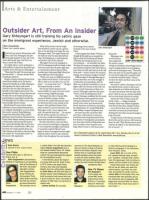
Gary Shteyngart
husband in the name of Jesus
Christ.
Lenny imagines his rebuke: "We Jews, we
thing else?
thought all this stuff up, we invented the
Shteyngart, who
.TORY
Big Lie which all Christianity, all Western
is well versed in
civilization, has sprung, because we too
these arguments
CARY SW1TYNO4RT
were ashamed.... Do not believe the Judeo-
(he teaches creative
Christian lie! Accept your thoughts! Accept
writing at Columbia), acknowledges that he
your desires! Accept the truth! And if there is
may be making matters worse by playing
more than one truth, then learn to do the dif- up his Jewish immigrant roots. "The Soviet
ficult work — learn to choose. You are good
Jews came and sort of upset the apple cart,"
enough, you are human enough, to choose!"
he says. But he adds that it would be futile
Oddly enough, it's through Shteyngart's
to avoid this world for fodder: "They're
Korean characters, new to the struggle of
not from the shtetl, and their vision of the
acculturation and assimilation, that the
world is insane'
older story of Jewish assimilation is cast in
Plus, humor matters. Shteyngart said that
higher relief. The Koreans in the book "see
the explicit Jewish content is only in part
Jews as a kind of precursor of their own
what makes his work distinctively Jewish.
success," Shteyngart said about this point.
"It's [also] this humor from the edge of the
"There's a kind of identification there."
grave which he sees as a Jewish sensibility,
After Shteyngart published his first novel, and one that deeply informs his writing.
Jewish literary critics greeted his arrival
Anyway, the work of other young-ish
with great enthusiasm. Here was a young
Jewish writers — Allegra Goodman,
Jewish writer whose work teemed with
Jonathan Safran Foer, Nathan Englander,
Jewish characters and themes, channeling
Amy Bloom, Dara Horn, Michael Chabon
the ribald humor of a young Philip Roth,
— are so diverse that, even if he sets the
while adding a unique immigrant story.
clock back on American Jewish fiction's
But some were also concerned: after
development, the others are good enough to
more than a half-century of American
push it forward.
Jewish literature being dominated by the
"A huge amount of Jewishness permeates
twin themes of immigration and assimila-
their books and yet everyone still consumes
tion, from Henry Roth to Philip Roth, here
them',' he said. "Why? Because they're good."
was yet another writer doing the same
And that, he added, "is the ultimate barom-
thing. Wasn't it time to write about some-
eter of success."
❑
Gary Shteyngart appears at the Jewish Book Fair 7 p.m. Monday, Nov. 8, at the
Jewish Community Center in West Bloomfield. www.jccdet.org .
ews
Nate Bloom
cm Special to the Jewish News
1 12
New Flicks
Several films open in Detroit on
Friday, Oct. 8.
mow Davis Guggenheim's documentary
Waiting for Superman is a hard hitting
look at the failures of
the inner city public-
(111)
education system.
Like Guggenheim's
Oscar-winning An
Inconvenient Truth,
about global warming,
this film has stirred
Davis
up much discussion.
Guggenheim
The (secular) son of
a)
w
48 October 7 • 2010
-
a Jewish father (the late documentary
maker Charles Guggenheim) and a
non-Jewish mother, Davis, 47, visited
Israel on a government-sponsored
cultural trip and expressed his support
for the embattled country.
In Secretariat, about the legend-
ary horse that won the Triple Crown
in 1973, Diane Lane plays Penny
Chenery, who took over Meadow
Stables from her ailing father (played
by Scott Glenn, 69) with the help of a
veteran trainer (John Malkovich), then
bred Secretariat and turned him into
a great racehorse. Glenn converted to
Judaism in 1967 when he married his
Jewish wife.
Andrew Garfield, 27, currently
onscreen in The Social Network, co-
stars as Tommy in Never Let Me Go,
based on the Kazuo Ishiguro novel.
Tommy lives in a seemingly idyllic
English boarding school, but when
he and two other students (Keira
Knightley and Carey Mulligan) leave the
school, the truth of their terrible fate is
revealed to them.
New TV Shows
Ben
Rappaport
Ben Rappaport
is the young star
of the NBC series
Outsourced, airing
8:30 p.m. Thursdays,
about an American
running a call center
in India. Ben's parents belong to a
Reform synagogue in his hometown
near Houston, Texas.
Lucas Neff, 24, a co-star of the
Fox comedy Raising Hope, airing 8
p.m. Tuesdays, recently told a home-
town Chicago paper that his father is
Jewish and his mother Irish Catholic.
I hope these guys' new shows are
still on the air when you read this;
unfortunately, Lone Star, the criti-
cally acclaimed Fox series starring
James Wolk of Farmington Hills, was
canceled after two episodes due to
low ratings (it was on opposite ABC
juggernaut Dancing With the Stars).
You'd think they would have given it
more time. ❑