

D
,
an 4 c ,
From the shores of the Red Sea to the modern sta from the sh% to the kibbutz, the role
of women in the development of Jewish dance will be explored in a multimedia presentation.
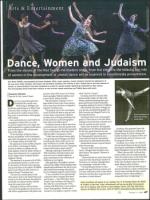
New Moon (2009), choreographed by Karen Goodman. With a lunar calendar, Jewish antiquity honored the appearance of
the new moon, Rosh Chodesh, with prayer and movement outside in the evening. It was a special day of rest and renewal for
women. In recent decades it has been reclaimed as a time for Jewish women's gatherings celebrated as they choose.
The choreography draws from these sources, as well as from Jewish mysticism and Yiddish dance and music.
portions of her DVD, Come Let Us Dance,
which spotlights Yiddish traditions and
actress-dancer Miriam Rochlin.
"My presentation is going to cover a
ance has moved through Karen
huge swath of time to give some perspec-
Goodman's life in many ways.
tive on how dance has been so integral to
While living in Michigan, she
Judaism': Goodman says.
studied the performing art at Wayne State
"I'm going to cover a few etymologies,
University. After moving to Los Angeles,
words in Jewish life that we may not real-
she advanced her studies and pursued a
ize have dance connections in Hebrew,
long career in performance, choreography
and then look at the big contribution that
and teaching.
Jewish performers and choreographers
Even membership in a small California
have made in the 20th century"
congregation enhanced her core inter-
Goodman's interest in dance dates back
est, and she stepped onto new stages. Her
rabbi inspired her to explore Jewish dance, to preschool years, when her parents took
her to a program at the Jewish Community
and she developed a film and presenta-
Center in Des Moines, where they lived
tions on the subject.
while her father was going to school.
"In the Footsteps of Miriam: Dance,
"I didn't have any dance lessons while
Women and Judaism" will be Goodman's
topic when she appears 2 p.m. Sunday, Oct. I was growing up in Michigan and didn't
actively pursue dance until I was in col-
17, at Temple Emanu-El in Oak Park.
Her appearance marks another program lege Goodman, 62, recalls. "My parents
were more interested in music. I had piano
in the Pearl A. and George M. Zeltzer
lessons and became a piano teacher:'
Lecture on Women in Judaism for the
Although majoring in humanities at
Cohn-Haddow Center for Judaic Studies at
WSU, Goodman minored in dance and
Wayne State University. It is co-sponsored
went on to earn a master's degree in
by the temple, where Goodman had her
dance performance at the University of
religious training.
"My intention is to present a bit of bibli- California at Los Angeles.
After graduation, she taught at a private
cal and talmudic history to set the scene
school and in college without forgoing chore-
for the history of Jewish women dancing
and go from there to the subject of Yiddish ography and performance. She was in a com-
pany and did some touring, which placed
dance in the 18th and 19th centuries in
her on a Broadway stage for a dance festival.
Eastern Europe Goodman says.
"I was co-founder of an experimental,
"I'll move on to Jewish dance in the
20th century, both in the United States and cooperative dance company that lasted
Israel, to see what role dance has played in several years — Eyes Wide Open Dance
Theatre': says Goodman, who danced in
Jewish life and culture and the contribu-
New York for a year during the 1970s,
tions that women have made
working with Rudy Perez, a post-modern
Although Goodman will not demon-
master choreographer. "Shortly after I
strate the choreography she discusses, her
talk will be supplemented with photos and returned to Los Angeles, I opened a studio,
Suzanne Chessler
Special to the Jewish News
D
which I had for 21 years."
Goodman, married to attorney Allen
Hyman and the mother of writer Andy
Hyman, continued producing dance pro-
grams and became involved with public
recognition initiatives for dance in California.
Also involved with dance writing proj-
ects, she has contributed biographies on
Bella Lewitzky and Margalit Oved to the
Encyclopedia Judaica.
Goodman's most recent choreography
project is Three Dances to the New Moon,
relating to the Jewish lunar calendar and a
time for women's rest and renewal.
Honors have included a choreography
fellowship from the National Endowment
for the Arts, grants from the city and
county of Los Angeles, a Vanguard Award
for Choreographic Innovation and a
Lester Horton Award for Outstanding •
Achievement in Individual Performance.
Jewish dance became a special interest
about 10 years ago.
"Because of the revival of klezmer
music, I thought there should be more
about dance': she explains."Klezmer is
dance music.
"I discovered that in recent times musi-
cians have been the primary teachers of
the dances. As a dancer, I thought there
was something I could add to that.
"I've had the great fortune to meet
people with great histories in dance, and
I've done oral history work to learn about
their lives and how they connected mod-
ern dance to Jewish themes:'
Karen Goodman in
Force Of Gravity,
circa 1990
Goodman, who graduated from Oak
Park High School and was confirmed at
Temple Emanu-El, will be visiting with
brother Dr. Robert Goodman of Novi and
extended family when she returns to do
her program in the area.
Goodman was a winner of a 2005 JCC
Detroit Jewish Women in the Arts Award
honoring her contribution to Yiddish dance
history through her Come Let Us Dance film.
"When I give my talk, I will note how
Jewish centers were very important plat-
forms for modern dance in the early 20th
century, not just for Jews but for every-
body:' says Goodman, whose free time is
spent taking in other art forms.
"I work, teach and write from the per-
spective that there is a deep-rooted human
need to dance and that the deep-rooted
tradition of dance within Judaism is
inseparable from its beginnings
Karen Goodman will appear 2 p.m. Sunday, Oct.17, at Temple Emanu-EI,14450
0/.10 Mile, in Oak Park. Light refreshments will be served after the presenta-
tion. $7 in advance with check to Cohn-Haddow Center, 2311 FAB, 656 Kirby,
Detroit, MI 48202; $10 at door. (313) 577-2679; www.judaicstudies.wayne.edu .
October 7 • 2010
47