

Arts & Entertainment
Artistic Immorality
A new documentary portrait of Veit Harlan, one of Nazi Germany's
most notorious filmmakers, discusses his legacy with his heirs.
Allison Hoffman
Special to the Jewish News
New York (Tablet)
I
n 1939, Joseph Goebbels commis-
sioned his favorite film director, Veit
Harlan, to make an entertainment
suitable for wartime. The result was Jew
Suss, a historical drama about the Jewish
banker Joseph Suss Oppenheimer, who
was hanged in 1738 on charges of treason
against a German duchy.
The choice of subject matter was
a retort to a British anti-Nazi movie
of the same title based on a novel
by the German-Jewish writer Lion
Feuchtwanger in which Oppenheimer
is depicted as a martyr. Harlan warped
the historical figure into a predator who
rapes both the public trust and a help-
less Aryan girl, played by Harlan's own
wife — his third — the Swedish inge-
nue Kristina Soderbaum, who was then
Germany's top-earning actress.
When the movie premiered in the fall
of 1940, 20 million Germans packed cin-
emas to see it. Audiences jeered lustily
at scenes of bedraggled Jews — actual
residents of the Prague ghetto compelled
to serve as extras — carting their pos-
sessions away after they are banished in
response to Oppenheimer's perfidy.
Goebbels, who wrote in his diaries
that Jew Sass was "the anti-Semitic film,"
ordered screenings for all SS units during
the winter lull in fighting. But after the
war, the victorious Allied forces proved
less impressed. Harlan found himself
charged with being an accessory to
crimes against humanity.
In court, Harlan claimed he had no
choice but to do Goebbels' bidding. He
was acquitted, but as he wrote in a draft
of his autobiography, the "the shadow of
Jew Sass will not vanish."
But the film did; it was removed from
public circulation under postwar de-
Nazification laws. Harlan returned to
filmmaking in the 1950s, but as a New
York Times correspondent wrote in 1951,
"the reek of the gas ovens is inseparably
associated with his name'
Harlan died in Capri in 1964 with-
out ever acknowledging the impact of
his work, despite the fact that his first
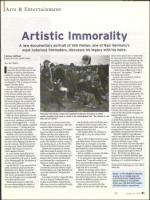
Filmmaker Veit Harlan, center, was acquitted of being an accessory to crimes
against humanity, but wrote in a draft of his autobiography that "the shadow of Jew
Siiss will not vanish."
marriage was to a Jewish actress, Dora
Gershon, who divorced him in 1924 and
was later killed at Auschwitz.
The task of grappling with Veit Harlan's
legacy has fallen to his children, their
children and their close relatives, the
subjects of Harlan: In the Shadow of Jew
Suss, a documentary by the German film-
maker Felix Moeller. It will be screened 2
p.m. Sunday, Aug. 22, at the Detroit Film
Theatre in the Detroit Institute of Arts.
Harlan's heirs represent an astound-
ingly broad range of opinion: from bor-
derline revisionism to a full embrace of
Jews and Judaism. Not surprisingly, they
disagree about whether the filmmaker
was motivated by a commitment to
Nazism or simple opportunism.
"War games and films are now spon-
sored by the American military:' argues
Kristian Harlan, one of the director's two
sons with Soderbaum. "Not much has
changed."
And while his brother Caspar describes
Veit as a "despotic" husband to their
mother, he nonetheless insists that his
father was coerced to make Jew Siiss and
did not believe in Nazi principles.
But for Moeller, what Veit Harlan actu-
ally believed doesn't much matter: The
point is, Harlan made a film, and its con-
sequences have been real.
Only Harlan's eldest son, Thomas, is
old enough to carry any real personal
guilt.
Born in 1929 to Harlan and his second
wife, Hilde Korber, Thomas joined the
Hitler Youth as a teenager. As an adult,
though, he publicly repudiated his father
and worked for a time researching Nazi
war crimes in Poland.
Still, his inability to convince his father
to recant continues to haunt him.
"I was prepared to take responsibility:'
Thomas says. "It was self-evident to me
that I was answerable along with him ...
but I don't know how he saw it. I think he
really took me as an enemy."
Thomas' two younger sisters, Maria
and Susanne, were only old enough to
know they needed to look smart when
their father's Nazi patrons came to visit.
Yet both, for different reasons, chose to
marry men with Jewish blood.
Maria, who at one point in the film
angrily recounts how her father and step-
mother were asked to leave a theater after
the war because the leading lady refused
to perform for them, nonetheless says she
felt impelled to become involved with a
man whose Jewish father had been killed
by the Nazis because she felt sorry for him.
"I said, has suffered, and we have
to help him:" she explains. "I thought I
was doing a good deed."
Susanne, who committed suicide in
1989, had other motives.
"My mother wanted away, away, away
from this history, from her father, from
everything it meant to her:' Susanne's
daughter, Jessica Jacoby, says in the film.
Susanne threw herself headlong into
Judaism after meeting Claude Jacoby, who
managed to flee from Germany to New
Orleans in 1938 but returned to his native
country as a journalist with the American
Army after the war. Claude Jacoby died in
1964 of a heart attack. In 1967, Susanne
left for Israel but ultimately returned
to Berlin, where Jessica Jacoby is now a
writer for the city's Jewish newspaper, the
Judische Allgemeine.
"I belong to a family that the Nazi peri-
od divided into perpetrators and victims,"
Jacoby says in the film. "You could say
that insofar as Jew Sass was a call to per-
secute and annihilate not just the Jews of
Germany but of Europe, it cost my other
grandfather and grandmother their lives."
Cinephiles might be especially inter-
ested in two other of the film's voices: the
children of Veit's brother Fritz Moritz.
Christiane Kubrick, a niece of Veit
Harlan, is the widow of Jewish filmmaker
Stanley Kubrick (she was his third wife,
whom he married in 1958 after casting
her as a young German girl in Paths of
Glory). Her brother, Jan Harlan, pro-
duced several of Stanley Kubrick's films
and was an executive producer for Steven
Spielberg's A.I.: Artificial Intelligence. E
(Reprinted from Tabletmag.com , a new read on
Jewish life.)
Harlan – In the Shadow of Jew Suss
screens 2 p.m. Sunday, Aug. 22,
at the Detroit Film Theatre in the
Detroit Institute of Arts. $6.50-
$7.50. Info: (313) 833-3237; tickets:
(313) 833-4005 or www.dia.org .
August 19 • 2010
51