

I
World
A Touching Evening
Former senator turned author reflects on President Lincoln
and the ideals of freedom.
Bill Carroll
Special to the Jewish News
T
he spark of fire and brimstone
was missing, but there was an
abundance of humor, charm and
intimacy in George McGovern's speech at
Temple Beth El in Bloomfield Township
on June 8.
The crowd of close to 1,000 might have
expected more forceful views on various
past issues and current affairs from the
staunch Democrat, especially considering
his record as a multi-decorated World
War II hero-turned anti-war activist, col-
lege professor, U.S. congressman and sen-
ator and presidential candidate. But the
soft-spoken McGovern, 87, preferred to
touch lightly on all of these experiences
and even sidestepped an opportunity to
heap praise on President Barack Obama's
performance so far.
Of course, McGovern's main mission
at the Temple Beth El appearance was to
discuss a book he wrote a few years ago
about Abraham Lincoln at the request
of his friend, Arthur Schlesinger, Jr., the
well-known historian, to fit an offering
of new short books on all of the U.S.
presidents. The book (Times Books; $22)
is an "easy-to-read 153 pages, not one
of those 950-pagers that people claim
to read completely, but never really do,"
McGovern quipped.
McGovern held a book-signing ses-
sion right after his presentation, with
many in the audience lining up to pay
$25 (the synagogue's price). He said all
proceeds from his books go to the Teresa
McGovern Alcohol Treatment Center in
Madison, Wis. That was his daughter, 45,
a lifelong alcoholic, who fell into a snow
bank while intoxicated in 1994 and died
of hypothermia. "You and your spouse
accept the fact that one of you will die
before the other, but not that one of your
children will die first:' he said. "You just
never get over something like that?'
McGovern's wife, Eleanor, died in 2007.
He has three other daughters and a son.
A disconcerting factor in McGovern's
speech was that it was difficult to hear
the first half of it because he was stand-
ing too far back from the microphone at
24
June 17 • 2010
iN
"Even with a lack of education, Lincoln was able
to overcome that handicap and become a great leader.
He had an excellent capacity to read and absorb,
and he was probably the best writer in the history
of our presidency."
—
the podium. Attendees were moving up
to closer rows in order to hear him better,
until Rabbi Daniel B. Syme intervened
and moved him closer to the mike, elicit-
ing applause and sighs of relief. "Don't
worry, I'm not going to start over and
repeat what I already said:' McGovern
mused.
"I loved what I heard him say, but
I wish he could have spoken louder:'
lamented Leah Tron of Southfield.
Rabbi Syme explained he convinced
McGovern to come to town after listening
to his eulogy of singer Mary Travers of
the noted musical trio of Peter, Paul and
Mary in Connecticut last year. A friend of
the trio, Rabbi Syme was the only clergy-
man to officiate at her funeral. "There
were four hours of eulogies by many
entertainment and political celebrities
and George McGovern's was the best:'
said Syme. "I knew then that we had to
have him at Temple Beth El."
On Politics
What some in the audience might have
missed in the first half was McGovern's
succinct and interesting views on a
variety of topics. He noted, "We've cer-
tainly had our share of calamities since
President Obama took office — a reces-
sion, the Haiti earthquake, the oil spill
in the gulf and a lot of other things he
didn't expect when he ran for office?'
Included with this was "Hurricane
Katrina and the virtual destruction of
New Orleans," he said, during the George
W. Bush years.
Later answering questions from the
audience, posed by the evening's co-
chairman, Barry Lepler of Huntington
Woods, McGovern was asked what cur-
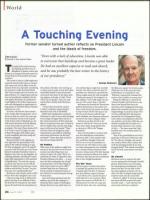
George McGovern
rent political figure might best resemble
Lincoln, who often is rated the best U.S.
president ever. McGovern conceded that
Obama might match the 16th president's
"intellectual capacity:' but dropped it at
that, adding "I can't really single out any-
one now who comes close to Lincoln?'
McGovern also decried the "destructive
political divisiveness in the nation now,
where rivals from both parties are always
trying to knock off the other guy. In my
18 years in the Senate, political oppo-
nents exhibited more harmony and never
resorted to the name calling of today?'
McGovern was first elected to the
Senate in 1962 by 597 votes and served
three terms before being defeated for
re-election in 1980 in the "Reagan
Revolution?'
Born in South Dakota to parents who
were firm Republican conservatives,
McGovern said, "I often wonder what
they would have thought if they had
lived to see me run for president as a
Democrat" (in 1972 when he won only
one state, Massachusetts, in a landslide
loss to Richard Nixon). McGovern had
become a Democrat in 1952 after hearing
eloquent speeches by Illinois Gov. Adlai
Stevenson, who then lost two presidential
bids to Gen. Dwight Eisenhower.
The War Years
McGovern gave a modest description
of perhaps his greatest feat: his role as
a bomber pilot who flew 35 missions
over Nazi military targets in Europe.
"I can't tell you I'm a pacifist because I
really believed in our country's efforts
against the enemies in World War II. I
volunteered to be in the air corps and
bomb the Nazis who were committing
the Holocaust against the Jewish people,
which was one of the worst atrocities
in the history of mankind," he said.
"However, I opposed the Vietnam War
and our other conflicts in recent years?'
Flying the difficult-to-control B-24
Liberator bomber, pilot McGovern was
shot at and almost shot down sev-
eral times, often bringing back burning
planes with wounded crewmen to make
tough landings on small air strips wher-
ever he could find them. His heroism
earned him the Distinguished Flying
Cross. Before returning home when the
war ended to see his first child who was
already 6 months old, he stayed on to
fly food relief missions to war victims
in Italy — "the same areas that I had
bombed only a few months earlier:' he
pointed out.
"One of my grandchildren once had a
good idea to end wars:' McGovern relat-
ed."He told me, 'Grandpa, why doesn't
one country tell the other country that
we'll stop dropping bombs if you stop
dropping them?' That sounds reasonable,
but it's too bad it just doesn't work that
way?'
On Lincoln
McGovern seem to surprise the audi-
ence by opining that he thought Lincoln's
greatest achievement was not issuing
the emancipation proclamation to end
slavery, but that "he was able to hold
the union together in the face of a ter-
rible Civil War; he helped bring back the
southern states into the union fold?'
McGovern added: "It was bad enough
that about 600,000 people died under
Lincoln's watch — more than the first
and second world wars combined.