

Arts & Entertainment
Anne Anew
A British production acclaimed as
the most-accurate-ever adaptation
of Anne Frank's diary airs on PBS.
Michael Fox
Special to the Jewish News
S
ixty-five years on, Anne Frank is
still a self-centered brat.
Or in contemporary par-
lance, a teenager, who attaches supreme
importance to her own whims and needs,
demands immediate satisfaction and
musters barely an iota of tolerance for
what she perceives as the stunted, compro-
mised world of adults.
As it unfolds, however, the British tele-
vision adaptation of The Diary of Anne
Frank increasingly and irresistibly frames
its subject's willfulness as a determina-
tion to establish an identity, and a place of
significance, in the soon-to-come postwar
world.
It is the pitiless snuffing of this poten-
tial — the dream destroyed when the
Gestapo breached her family's Amsterdam
refuge in 1944 after two long years in hid-
ing — that is, and has always been, the
piercing tragedy of Anne Frank's life.
Originally aired last year on the BBC
as a weeklong miniseries of five half-
hour episodes, the British-accented pro-
duction airs here in a seamless hour and
50 minutes. PBS's Masterpiece Classic
broadcasts The Diary of Anne Frank on
Holocaust Remembrance Day, Sunday,
April 11, at 9 p.m.
Solidly engrossing and vigorously
paced, The Diary of Anne Frank takes
place almost entirely (after the first five
minutes) in the secret annex above Otto
Frank's warehouse and office. It confines
itself to the events recorded by our unin-
tentional heroine, which is to say that
younger viewers unfamiliar with the Nazis'
systematic, continent-spanning imple-
mentation of the Final Solution aren't pro-
vided with a great deal of detail.
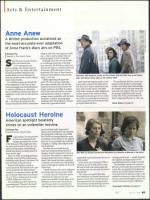
Newcomer Ellie Kendrick, center, as Anne Frank, with lain Glen, left, as her father,
Otto, and Tamsin Greig, right, as her mother, Edith
Anne Frank has long been both an icon
to Jews and a symbol of the Holocaust to
non-Jews, but I suspect mainstream audi-
ences will view this version a bit differ-
ently. In the current era, when children die
in every corner of the world and "ethnic
cleansing" has become part of our vocabu-
lary, Anne's story provokes associations of
racism, persecution and lost promise that
go beyond Nazis and Jews.
This production also has a more con-
temporary feel thanks to a shockingly
candid scene where Anne acknowledges
the changes in her body and admits her
confusion over puberty. This was one of
the passages regarding Anne's sexual-
ity that Otto Frank removed before the
diary's original publication in 1947, and
Anne Anew on page 51
Holocaust Heroine
American spotlight belatedly
shines on an unfamiliar heroine.
Michael Fox
Special to the Jewish News
F
or generations of American Jews,
an innocent, unformed Dutch
teenager personified the victims
of the Holocaust. What might have been
the repercussions had the story of a cou-
rageous young woman named Hannah
Senesh been widely circulated instead of
Anne Frank's saga?
That's one of the fascinating questions
implicitly raised by Roberta Grossman's
beautifully made Blessed is the Match: The
Life and Death of Hannah Senesh.
Honored with audience awards at
numerous Jewish film festivals and a spot
on the shortlist for the 2008 Academy
Award for Documentary Feature, the film
airs on Detroit Public Television-Channel
56 at 11:30 p.m. Sunday, April 18, as part
of PBS's Independent Lens series.
Born in Budapest in 1921, Senesh was
a promising poet ("Blessed Is the Match"
is the name of her last and most famous
poem) and playwright. Enamored of
Zionism and constrained by anti-Semitism,
she immigrated to Palestine when World
War II broke out, leaving behind her moth-
er, Catherine. Senesh thrived in her adopted
land, and it seems probable she would have
emerged as a leading cultural figure in the
new Jewish state.
But when the news broke that the
Nazis had commenced deportations in
Hungary, Senesh volunteered to return to
rescue Jews. She trained as a paratrooper
and parachuted into Eastern Europe in
March 1944. Senesh has been considered
a national icon in Israel since that ill-fated
mission, although her exploits are less well
known here.
"I think the reason she was so embraced
was because she was not an Anne Frank
— a victim character:' Grossman asserts.
"That kind of a character was com-
pletely unacceptable in Israel. Many of the
Holocaust survivors had a hard time in
Israel because there was somewhat of a
blaming-the-victim mentality. Senesh was
Merl Roth as Hannah and Marcela Nohynkova as Catherine in Blessed Is the Match
purposefully raised up because she was an
active heroine!'
In her movie, says, Grossman, "What I
wanted to do was to look at her as a per-
son, and to look at her relationship with
her mother, and why she made the choices
that she did."
The veteran Los Angeles filmmaker
drew extensively on Hannah's journals and
poems as well as other materials that have
been preserved over the ensuing decades.
In the absence of archival footage, however,
Grossman took the daunting step of re-
creating pivotal events — notably Hannah's
interrogation and imprisonment in the
same building where her mother was held.
The filmmaker was the rare American
girl who read Senesh's diary in junior-high
school. She was inspired to join Hashomer
Hatzair, the Socialist Zionist youth move-
ment, and to live in Israel for a time. It also
sparked an obsession to make a film about
Senesh, a pursuit that began in earnest the
moment Grossman became a filmmaker
Holocaust Heroine on page 51
April 8 2010
49