

Arts & Entertainment
Identity Crisis, Times Two
For filmmaker and subject, adolescence means self-evaluation.
George Robinson
Special to the Jewish News
Jewish Connections
A
dolescence is a miserably dif-
ficult time. That's about the
time that Nicole Opper decided
that she was going to be Jewish. That's
about the time that Avery Klein-Cloud,
the subject of Opper's first feature-length
film, Off and Running, began to struggle
with questions of her own identity, ques-
tions not unlike those the filmmaker had
wrestled with a decade or so before, only
much more complicated.
Off and Running, which screens at the
Michigan Theater in Ann Arbor 5 p.m.
Saturday, March 27, as part of the 48th
annual Ann Arbor Film Festival, deals with
those potentially painful issues of identity
with a considerable degree of intelligence
and some much-needed reticence. This
documentary profiles Klein-Cloud and her
unusual family constellation. Avery is an
African-American teenager, the adopted
daughter of Jewish lesbians Tova Klein and
Travis Cloud, and the sister of two more
adopted siblings, Rafi, a mixed-race young
man of considerable warmth and intelli-
gence, and Samuel Isaiah (nicknamed Zay-
Zay), a charming Korean-American boy
who is the youngest of the three.
Compared to Avery's situation, Opper's
was simple. Her mother, a Presbyterian
from Kansas, and her father, a Jew-
turned-Buddhist, had both become
atheists; but when Nicole attended a
synagogue service when she was 12, she
was transported by the music and mes-
merized. I knew that this was what I was
meant to be she says emphatically.
Opper recalls pursuing a Jewish educa-
tion on her own, having a bat mitzvah
ceremony and a Reform confirmation
and eventually going off to Israel for
a year's study before settling into the
Jewish arts scenes in New York and, more
recently, in her hometown of San Diego.
Significantly, it was while she was in
her late teens that the 29-year-old Opper
began to discover documentary film,
including the work of key figures like
Frederick Wiseman, the Maysles Brothers
and, later, Terry Zwigoff (Crumb).
"What a fascinating way to learn about
the world' she recalls thinking at the time.
And it was a way of imparting that knowl-
edge to other young people, as Opper began
teaching filmmaking to high-school stu-
Suzanne Chessler
Special to the Jewish News
film made in Ann Arbor and
very different from Off and
Running points to the scope
of the 48th annual Ann Arbor Film
Festival, where more than 170 films
from 20 countries will be shown March
23-28 based at the Michigan Theater,
located at 603 E. Liberty.
Gesturings, developed by Peter
Herwitz, will be screened with other
shorts 7:30 p.m. Friday, March 26. Its
images are abstract and silent, pre-
senting a series of designs painted
directly on the film.
"I worked on and off on Gesturings
for seven years," says Herwitz, 50,
who studied painting and filmmaking
at the Massachusetts College of Art
and has shown his work at New York
museums and festivals.
"When I moved into making films
in 1980, I continued a thread of pure
abstraction. I use inks and markers
and think of it as musical in structure."
Herwitz, who also has applied his
creativity to photography with semi-
abstract images, describes his cin-
ema approach as providing montage
effects.
While Herwitz's style makes no con-
nection with his Jewish background,
other screenings have explicitly reli-
gious links in very different ways.
Expansive Grounds, shown at 1 p.m.
Sunday, March 28, explores identity as
a German woman watches the building
of the Berlin Memorial to the Murdered
Jews of Europe. The structure leads
the filmmaker to reflect on her fami-
ly's role during the time of the Nazis
and the significance of collective guilt.
City of Borders, screened at 7 p.m.
Thursday, March 25, introduces Israelis
and Palestinians who frequent the only
gay bar in Jerusalem. Perspectives
and emotions come together as sto-
ries are revealed. H
A
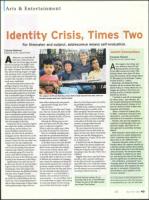
The subject of Off and Running, Avery Klein-Cloud (second from left), with her
Brooklyn-based observant Jewish family
dents while working on her own projects.
Appropriately enough, that is how
Nicole met Avery.
"She was in my first film class," Upper
says. "She was 12 years old. And our rela-
tionship turned into a friendship. So by
the time we finished the film, I'd known
her and her family for 10 years."
Although the filming process took
place over three years, the film, Upper
says, "is really just a snapshot:'
Which is what you might expect when
you distill 36 months into 76 minutes.
But it is a terrifically compelling snap-
shot, taken at a period when Avery was
going through the kind of turmoil that only
an adolescent can create or withstand.
At the film's outset, Avery has decided
to contact her biological mother in an
effort to learn more about her identity.
"I'm very new to black culture, and I
don't understand it," she says at one point
in the film. Her Jewish moms make every
conceivable effort to help Avery in a time
of difficult self-evaluation, but teenagers
have a knack for making most things dif-
ficult; and the questions she is facing are
genuinely complex and have no simple
answers. By the time the film ends, Avery
has been through enough adolescent
identity crises — as a track athlete, a
student, a Jew, an African-American, a
young woman — for several films. And it
is no small tribute to Upper's deft sorting
of events that despite its brief running
time, the film feels leisurely enough to
allow its central figure some very satisfy-
ing privileged moments.
The film is also a tribute to Avery Klein-
Cloud because she is co-author of the
film's screenplay. "We discovered she has
a real flair for this': Upper says. "It was a
natural and organic way of working since
she had once been my student. She began
as the subject of the film, but we quickly
reached a working method that was
informed by decisions she made."
The most important decision Avery
made, however, was one that shook up
Upper and the entire Klein-Cloud family.
About a year into the filming process,
Avery dropped out of sight, "off the plan-
et," as Upper puts it.
It doesn't hurt that the filmmaker had
a lot of faith in her former student and
longtime friend. "But I admit I was won-
dering how long this [soul-searching]
was going to take she says. "There was a
deadline."
Happily, when Avery came back home,
she did so with a renewed enthusiasm
for the film and work was completed in
April 2009. She is now a full-time student
at Delaware State on a track scholarship
but still makes it to an occasional festival
screening of Off and Running. Cl
Off and Running screens 5 p.m.
Saturday, March 27, at the Michigan
Theater as part of the 48th annual
Ann Arbor Film Festival.
For a full schedule of films and special events
at the 48th annual Ann Arbor Film Festival, go
to www.aafilmfest.org or call (734) 995 5356.
-
March 18 • 2010
43