

411111111111111111111110111111W
Arts & Entertainment
Getting Around
Grandma's Chicken Soup
In his third book, Jonathan Safran Foer compels us to take
a closer look at our dinner plates.
voices and structures, including a glos-
sary-like chapter called "Words/Meaning"
The Jewish Week
— Eating Animals is more verbal collage
than traditional argument. And yet the
ith his much-hyped new
disparate pieces seem, for the most part,
book, Eating Animals (Little,
to come together in the end — including
Brown and Co.; $25.99),
everything from a horrifying late-night
Jonathan Safran Foer has managed to do
visit to a "Concentrated Animal Feeding
something that my vegetarian husband
Operation:' in which live turkeys commin-
and daughter have been unable to pull off:
sworn me off meat, at least all convention- gle with dead ones, to a discussion of the
inordinate amount of untreated animal
ally raised meat.
feces that meat production unleashes on
I didn't open the book expecting to be
the environment, to an attempt to under-
converted. Instead, I was fairly certain
stand how Americans can lavish unprec-
that the best-selling, young, media-dar-
edented amounts of love and money upon
ling author of Everything is Illuminated
their
pets while at the same time demand
and Extremely Loud and Incredibly Close
that
meat
can be priced so low only by
would have nothing new to contribute to
treating
farm
animals as commodities.
this well-traveled topic other than an air
Probing
this
seeming paradox, Safran
of celebrity. But Eating Animals — which
Foer
—
who
has
a dog named George
graphically describes the suffering, public
—
even
makes
a
Swiftian
case for
health dangers and environmental devas-
eating
dogs,
noting
that
since
three
tation wreaked by industrialized agricul-
to
four
million
dogs
and
cats
are
ture and fishing practices — is surpris-
euthanized annually, "dogs are
ingly affecting and persuasive.
practically
begging to be eaten:'
Where many vegetarian manifestos
Repeatedly,
the book asks
alienate with self-righteousness and judg-
why,
when
it
would
be con-
mentalism, Eating Animals demonstrates
sidered
grotesque
to
torture
as much compassion for humans, particu-
animals
for
one's
sexual
larly the author's decidedly non-vegetarian
gratification or aesthetic
grandmother, as it does for animals.
pleasure, otherwise
Indeed, it is Safran Foer's Jewish,
moral, animal-loving
Holocaust-survivor grandma who is the
moral center of the book, the lens through people are willing to
have them tortured
which he explores the historical, cultural
at the hands of fac-
and psychological influences on our food
tory farmers and
decisions.
slaughterhouse
opens
and
closes
with
Eating Animals
workers
simply because
the grandmother, who "survived the War
meat
is
so
tasty?
barefoot, scavenging other people's ined-
And
why
do people who worry about
ibles: rotting potatoes, discarded scraps
their
carbon
footprints ignore the fact that
of meat, skins, and the bits that clung
factory-farmed
meat, not auto emissions,
to bones and pits" — and yet refused to
is the No. 1 source of greenhouse gases?
touch pork because "if nothing matters,
"I don't think this story [about vegetari-
there's nothing to save'
anism] has been told in the best ways':
Years later, when Safran Foer is a child,
Safran Foer says in an interview. "It's often
Grandma weighs her grandson before and
after each visit, teaches him to clip coupons, presented as either you're a vegetarian or
not, which is kind of like saying you're an
serves her signature dish of chicken and
environmentalist or not. Instead, we're
carrots, and hoards flour in her basement.
presented with all these choices: Prius or
Part journalism, part meditation, part
S'UV, big house or small house, recycle
memoir — and constructed in a mix of
Julie Wiener
W
or not, and it's not as if making one bad
choice totally undermines your caring
about the environment. Unfortunately,
meat is often talked about as if it were a
religion or a law ... it's more useful to think
about it as daily choices:'
Eating Animals — unlike a video called
"If This Is Kosher..." that Safran Foer
narrated a few years ago for the Web site
GoVeg.com — does not focus on kashrut
or Jewish food ethics. But Judaism makes
frequent appearances in the book.
The author repeatedly mentions that he
is Jewish and references famous Jewish
vegetarian writers Franz Kafka and Isaac
Bashevis Singer.
He notes that the founder of Niman
Ranch, which produces free-range pork,
is a "Jewish city boy:' the son of Russian
Jewish immigrants. When offered a
sample of ham during a visit to
a slaughterhouse, Safran
Foer is afraid he'll
offend by
turning it
down, so
lies and says,
"I'm kosher:'
In his "Words/
Meaning" chap-
ter, he includes
"kosher" as a term
to be defined, writ-
ing that while he grew
up learning in Hebrew
school that kosher meat
was more humane, he
now wonders if "the very
concept of kosher meat" has
become a "contradiction in
terms:'
In conversation, Safran Foer says that
while he has never kept kosher, as a veg-
etarian he is now "kosher by default:' (He
still eats dairy and eggs, but says he tries
to buy these only at Greenmarkets, from
small-scale farmers.)
He and his wife, novelist Nicole Krauss,
who live in Brooklyn's Park Slope with
their two sons, observe Judaism "some-
what, in our own esoteric ways. We do
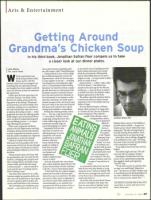
Jonathan Safran Foer
Shabbat dinner and go to Tot Shabbat at
my kid's nursery school — he goes to a
Jewish nursery school:' Safran Foer says,
adding that, "My idea of being Jewish is
basically learning about Judaism. That's
more important to me than practicing:'
Safran Foer, who is editing a Haggadah
to be published in 2011, says, "The thing
that most excites me about Jewish identity
is the connection to learning:'
So has Safran Foer's book won over his
bubbie?
The author laughs and says, "She still
eats meat. She's not going to change:'
Nonetheless Grandma has been sup-
portive of his vegetarianism, preparing
him eggplant salads and vegetarian
"chicken" soup.
"To ask such a person to reinvent chick-
en soup is no small thine Safran Foer
says. "I say that not as a joke. Chicken soup
is something her great-great-grandparents
ate; and in addition to conveying nutri-
ents, it conveys stories, culture, love:' I I
Julie Wiener, an associate editor at New York's
Jewish Week, is a former staff writer for the
Detroit Jewish News.
JINI
November 19 • 2009
47