

[Arts & Entertainment
Sephardic Star
Israeli singer-songwriter melds Ladino melodies
with the cadences of flamenco.
Suzanne Chessler
Special to the Jewish News
Ann Arbor
y
asmin Levy never knew her
father, but she came to know
his devotion to Sephardic music
and passes it along.
Levy, a singer-composer, revives the tra-
ditional pieces and offers her original num-
bers in the style preserved by Yitzhak Levy,
a composer, cantor and musicologist who
died when his daughter was an infant.
The Israeli entertainer, appearing Nov. 14
in a University Musical Society program at
Hill Auditorium in Ann Arbor, will perform
selections from her recording Mano Suave
("Gentle Hand") and explain the songs and
the history of the Ladino language as it
derives from the Jews of Spain.
"My program will be like discovering a
new world — a musical and historic world;'
says Levy, 33, who is accompanied by four
band members. "I tell the stories of the
songs and the history of the Jews who faced
expulsion from Spain 500 years ago."
While the new compositions have
sounds reminiscent of traditional flamen-
co music, the lyrics written by Levy bring
them into today's perspectives.
"Usually, I write about things that I
experience in my life or that I see people
I love experience Levy says. "Most of the
time, it's about sad or dramatic things.
"I sing traditional Sephardic songs with
great respect and feel great responsibility,
but with my own songs, I can have total
artistic freedom."
That freedom is shown in two tracks
about women known by Levy. "Una Noche
Mas" ("One More Night") tells about a
woman who had a longtime affair with
a younger man and then is jilted. "Por la
Mia" ("For Mia") relates the feelings of a
dancer who decides to become a single
mother and has a daughter, Mia.
"I can sit by the piano for a year without
composing success, and then I can go to
the supermarket to buy milk and come
back with milk and a song:' Levy says.
"There's no process. God brings a melody
to my head, and it's stuck there until I play
it on the piano."
Levy, who was born and grew up in
Jerusalem, tried to avoid a career in music
because her family had guided her toward
a more secure profession. Although trained
and launched in the healing approach of
reflexology, she wished for entertainment
work and changed her direction.
A longtime piano student, she had learned
Ladino songs as her mother, Kochava, sang
them at home for her and three siblings.
When she was 13 and invited to perform in
memory of her father, Levy understood
the importance of music to her life.
As the emerging entertainer pursued
concert and recording work, she completed
her first album when she was 24, the year
she met Ishay Amir, now her husband and
percussionist. After he encouraged her to
appear at a world music festival in Germany,
Levy experienced more opportunities.
"I'm very comfortable working and
being with Ishay 24-7," says Levy, married
for six years. "He's my best friend, and
we've found a point where everything is
balanced. I have more fire inside my heart,
and he's more logical.
"Religion is very important to me, and
it's important for me to keep the Shabbat
because it gives me rest and peace of
mind. I can be with my husband and have
a normal family day."
As her career has expanded, Levy has
performed throughout the world, travel-
ing to concerts and television programs
in places as distant as Australia, France,
Singapore and Sweden.
Voy" ("I Am Leaving"), a Levy corn-
position, won the 2008 USA Songwriting
Competition for best world-music song.
Levy has become an ambassador for
Children of Peace, working with Israeli
and Palestinian children to steer them
away from hatred. The charity, based in
the United Kingdom, will feature Levy in
upcoming workshops to talk about her
career and the unity brought through music.
Reading, particularly books about his-
tory and biography, is a favorite pastime.
While touring 10 American cities to
promote Mano Suave, her third album,
Levy has another new release, Sentir ("To
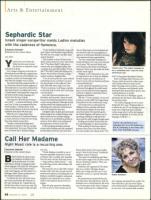
Yasmin Levy: "The Ladino language for
me is something holy," says the rising
world-music star.
Feel"), being played throughout Europe.
These recordings follow Romance and
Yasmin, which focused on Ladino music
with Turkish influences based on her
father's heritage, and La Juderia, a combi-
nation of flamenco and Sephardic styles
developed after the performer spent a year
studying flamenco in Seville.
Levy has one tie to Michigan: a great
admiration for the bravery and defiance of
the late Rosa Parks.
"The Ladino language for me is some-
thing holy,' Levy says. "Singing Ladino is
a mission for me. If I can manage in some
small way to help keep these beautiful
Ladino songs alive, I will be the happiest
musician imaginable. If we don't use the
language, it will die."
Yasmin Levy performs 8 p.m.
Saturday, Nov.14, at Hill Auditorium,
825 N. University, in Ann Arbor. $10-
$40. (734) 764-2538; ums.org .
Call Her Madame
Night Music role is a recurring one.
Suzanne Chessler
Special to the Jewish News
B
obbie Steinbach, about to por-
tray Madame Armfeldt in her
fourth production of A Little
Night Music, already is hoping for addi-
tional stagings of the play. She will appear
Nov. 14-22 at the Detroit Opera House
with Leslie Uggams and Ron Raines in a
Michigan Opera Theatre production of
the Stephen Sondheim classic.
"I would do the part 100 more times,
and I just may because the character is
80:' says Steinbach, 66. "I played her for
the first time when I was in my early 50s,
and I've always used great wigs and aged
52
November 12 2009
my voice.
"I think Madame Armfeldt is one of
the most enjoyable characters in musi-
cal theater. She is wealthy and venerable.
Over the years, she has had many lovers
— kings, princes, dukes, barons — and
has had some serious relationships with
them as well."
The musical is set in early 20th-century
Sweden with a plot that unravels several
intertwined romances (including those of
Madame Armfeldt's daughter and grand-
daughter) and culminates at a country
estate as the audience learns if love tri-
umphs.
When the play opened on Broadway
in 1973, it won six Tony Awards and six
Drama Desk Awards. The most notable
song is "Send in the Clowns." Steinbach's
signature song is "Liaisons."
"The music is breathtaking, and there
are five lieder singers who are like a Greek
chorus," Steinbach explains. "They com-
ment on love a lot."
Steinbach, who appeared in The Music
Man in a northern Michigan theater,
didn't start acting until she was 35 and
had built a career as a special education
teacher.
Her performances launched after she
had taken disco dancing lessons with her
husband, now a retired attorney. She went
on to become part of the dance company.
"I later auditioned for a children's the-
Bobbie Steinbach
ater company and joiner she recalls. "Six
years after that, I got my Actors Equity
card and have been working pretty steadi-
ly ever since. I do musicals and recently a