

N
HOME
Helping
Counter
Aging
Design modifications
keep Boomers in their
homes longer.
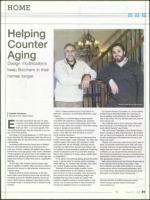
Richard and Bryan Cherkasky
Franklin Dohanyos
Special to the Jewish News
E
Most of these accidents occur in the kitchen or
bathroom, resulting in an estimated $36 billion a year
problem.
Cherkasky is a certified aging in place special-
very eight seconds for the next 18 years,
a member of the Baby Boomer generation
— the 78 million Americans born between
1946 and 1964 — will reach age 62. With
new medical advances, they are expected to live lon-
ger, as are their parents.
According to www.agingstats.gov, in 2010 there will
be an estimated 40 million people older than 65 and 5
million older than 85. By 2030, those numbers will rise
exponentially.
According to the American Association of Retired
Persons, about 80 percent of all Americans 55 or
older own a home, making it the highest rate of horn-
eownership of any age group in the country. Members
of this population group also tend to be healthier and
wealthier than previous generations of similar age and
expect their homes to reflect their active, independent
lifestyles.
As they age, their medical needs increase, espe-
cially in regards to mobility. Many will have to retool or
remodel their homes to meet physical, emotional and
medical needs.
ist (CAPS) with expertise in creating new solutions
and improved floor plans to help people stay in their
homes longer, rather than having to move into nursing
homes or assisted-living facilities.
Safe Home Solutions is a division of the Richard
Group, which has more than 35 years of custom
home building experience.
"There are many different ways to help people live
in their homes longer," says Cherkasky. "If a client has
mobility issues, then ramps, lifts, elevators or bath-
room grab bars can be installed, doorways can be
widened, and bathrooms, showers and kitchens can
be modified to accommodate a wheelchair. Carpeting
should be replaced by tile or a wood floor because
there is less resistance to shoes, canes, walkers and/
or wheelchairs."
"If the person has difficulty getting around the entire
home, it can be wired for remote control, including
Research done by Bryan Cherkasky of Franklin-
based Safe Home Solutions shows that slip-and-fall
better lighting, TV, cameras with monitors, door open-
ers, window shades, phones, fireplaces, etc.
"Basically, it's all about safety, comfort, conve-
nience, independence and the ability to function in
your home for as long as possible. There are several
new products and home remodeling designs now
accidents account for 300,000 disabling injuries per
year in North America, leading to decreased mobility
and lengthy stays in nursing homes or assisted-living
facilities.
available that can make it easier for people with
medical or disability needs to function better in their
homes. And it's less expensive to live at home than
moving into assisted living or a nursing facility."
Dr. Suzanne Parker of Charlotte, Vt., had an elderly
mother living in West Bloomfield who was becom-
ing increasingly overwhelmed by the challenges of
day-to-day living. Not only did she need care, but her
home did as well.
"My challenge was to find a contractor that under-
stand this type of remodeling and make her home
more elderly-friendly," says Parker.
"We met Richard Cherkasky of the Richard Group,
parent company to Safe Home Solutions. By working
with our family and caregivers, we were able to come
up with modifications that allowed her to stay in the
home she loved."
"People work hard their entire life and don't want to
leave a home they made their home. With new ways
to modify homes to accommodate individual mobility
needs, they don't have to," says Richard. "Every job
is different, so we consult with the homeowner and
their medical professional to provide a comprehensive
assessment of their current living situation to come up
with appropriate solutions."
Safe Home Solutions and the Richard Group belong
to the National Home Builders Association. Safe
Home Solutions provides CAPS solutions to private
residences as well as commercial businesses, such
as nursing homes and assisted-living facilities. Bryan
Cherkasky is a Certified Green Professional.
Safe Home Solutions is at 26000 Hawthorne, Franklin.
Franklin Dohanyos operates Oakland County-based
Franklin Publicity lnc.
August 20 • 2009
25