
World
Lining Up
At White House, U.S. Jews offer little resistance to Obama policy on settlements.
Ron Kampeas
Jewish Telegraphic Agency
Washington
T
op Jewish organizational leaders
expressed support for President
Obama's Middle East peace strat-
egies at a White House meeting last week
but said the president must do a better job
of showing he expects hard work from all
sides, not just Israel.
Obama's meeting July 13 with 16 Jewish
leaders from 14 groups comes after weeks
of tense exchanges between the Obama
administration and Israel's government
over freezing Jewish settlement construc-
tion in the West Bank, prompting expres-
sions of "concern" from some U.S. Jewish
organizational leaders.
"The view was expressed among the
organizations that at a minimum there
was concern about an imbalance in pres-
sures placed on Israel as opposed to on the
Palestinians and Arab states," said Alan
Solow, the chairman of the Conference
of Presidents of Major American Jewish
Organizations. "The president indicated he
had a sensitivity to the perception of that
imbalance and had to work harder to cor-
rect that perception:'
One participant quoted the president
as saying that "there's not a lot of courage
among the Arab states; not a lot of leader-
ship among the Palestinians."
The consensus was that on substance,
Obama had the support of the room when
it came to his peacemaking strategies
— or, at least, he did not face opposition.
The meeting comes as Obama faces
sharp criticism from Jewish conservatives
in the news media who claim the presi-
dent is bent on scaling back U.S. support
for Israel. In particular, critics have cited
the Obama administration's repeated calls
for an Israeli settlement freeze in the West
Bank.
At least two of the leaders of centrist
organizations who attended the White
House meeting — Abraham Foxman
of the Anti-Defamation League and
Malcolm Hoenlein of the Conference of
Presidents— have said they are increas-
ingly hearing from people who are wor-
ried about Obama's intentions, including
some who voted for him.
Liberal groups are rejecting such claims,
saying that the president and his approach
A22
July 23 2009
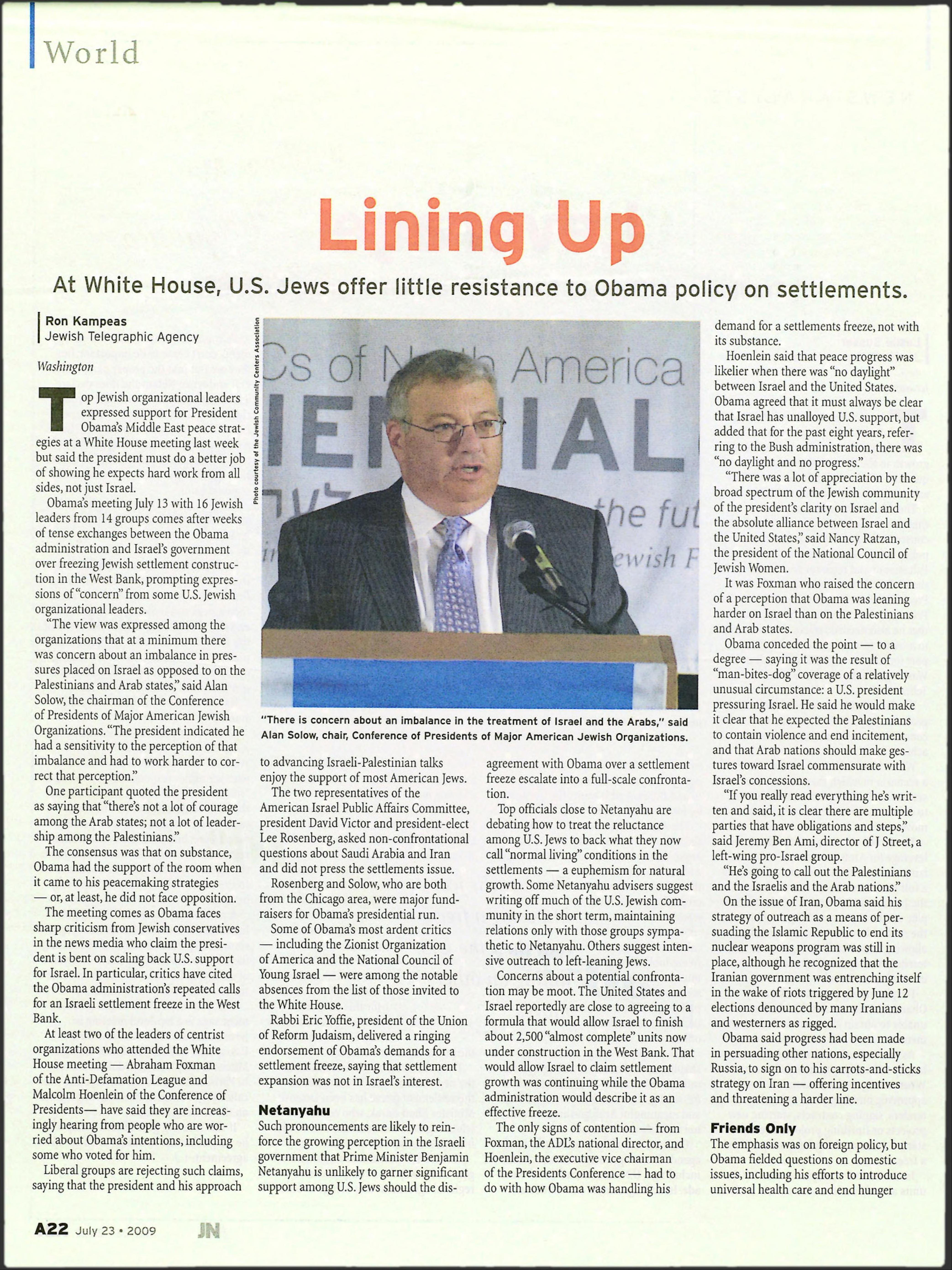
"There is concern about an imbalance in the treatment of Israel and the Arabs," said
Alan Solow, chair, Conference of Presidents of Major American Jewish Organizations.
to advancing Israeli-Palestinian talks
enjoy the support of most American Jews.
The two representatives of the
American Israel Public Affairs Committee,
president David Victor and president-elect
Lee Rosenberg, asked non-confrontational
questions about Saudi Arabia and Iran
and did not press the settlements issue.
Rosenberg and Solow, who are both
from the Chicago area, were major fund-
raisers for Obama's presidential run.
Some of Obama's most ardent critics
— including the Zionist Organization
of America and the National Council of
Young Israel — were among the notable
absences from the list of those invited to
the White House.
Rabbi Eric Yoffie, president of the Union
of Reform Judaism, delivered a ringing
endorsement of Obama's demands for a
settlement freeze, saying that settlement
expansion was not in Israel's interest.
Netanyahu
Such pronouncements are likely to rein-
force the growing perception in the Israeli
government that Prime Minister Benjamin
Netanyahu is unlikely to garner significant
support among U.S. Jews should the dis-
agreement with Obama over a settlement
freeze escalate into a full-scale confronta-
tion.
Top officials close to Netanyahu are
debating how to treat the reluctance
among U.S. Jews to back what they now
call "normal living" conditions in the
settlements — a euphemism for natural
growth. Some Netanyahu advisers suggest
writing off much of the U.S. Jewish com-
munity in the short term, maintaining
relations only with those groups sympa-
thetic to Netanyahu. Others suggest inten-
sive outreach to left-leaning Jews.
Concerns about a potential confronta-
tion may be moot. The United States and
Israel reportedly are close to agreeing to a
formula that would allow Israel to finish
about 2,500 "almost complete" units now
under construction in the West Bank. That
would allow Israel to claim settlement
growth was continuing while the Obama
administration would describe it as an
effective freeze.
The only signs of contention — from
Foxman, the ADI2s national director, and
Hoenlein, the executive vice chairman
of the Presidents Conference — had to
do with how Obama was handling his
demand for a settlements freeze, not with
its substance.
Hoenlein said that peace progress was
likelier when there was "no daylight"
between Israel and the United States.
Obama agreed that it must always be clear
that Israel has unalloyed U.S. support, but
added that for the past eight years, refer-
ring to the Bush administration, there was
"no daylight and no progress."
"There was a lot of appreciation by the
broad spectrum of the Jewish community
of the president's clarity on Israel and
the absolute alliance between Israel and
the United States," said Nancy Ratzan,
the president of the National Council of
Jewish Women.
It was Foxman who raised the concern
of a perception that Obama was leaning
harder on Israel than on the Palestinians
and Arab states.
Obama conceded the point — to a
degree — saying it was the result of
"man-bites-dog" coverage of a relatively
unusual circumstance: a U.S. president
pressuring Israel. He said he would make
it clear that he expected the Palestinians
to contain violence and end incitement,
and that Arab nations should make ges-
tures toward Israel commensurate with
Israel's concessions.
"If you really read everything he's writ-
ten and said, it is clear there are multiple
parties that have obligations and steps,"
said Jeremy Ben Ami, director of J Street, a
left-wing pro-Israel group.
"He's going to call out the Palestinians
and the Israelis and the Arab nations."
On the issue of Iran, Obama said his
strategy of outreach as a means of per-
suading the Islamic Republic to end its
nuclear weapons program was still in
place, although he recognized that the
Iranian government was entrenching itself
in the wake of riots triggered by June 12
elections denounced by many Iranians
and westerners as rigged.
Obama said progress had been made
in persuading other nations, especially
Russia, to sign on to his carrots-and-sticks
strategy on Iran — offering incentives
and threatening a harder line.
Friends Only
The emphasis was on foreign policy, but
Obama fielded questions on domestic
issues, including his efforts to introduce
universal health care and end hunger