

NEWS
Leverage
Photo by D in a Kra ft
Trading a settlement freeze for action on Iran, Arab ties.
Leslie Susser
Jewish Telegraphic Agency
Jerusalem
T
he fact that Israel and the United
States have yet to reach an
agreement on Jewish settlement
growth in the West Bank is as much a
question of wider Middle East concerns
as about the settlement issue itself.
The Americans have made clear
that they see a freeze on settlement
construction as a key instrument of
policy designed to jump-start Israeli-
Palestinian and regional peacemaking. In
their White House meeting in mid-May,
President Obama reportedly told Israeli
Prime Minister Benjamin Netanyahu
that he also needed Israel's commitment
to a freeze to secure international sup-
port for tougher policies against Iran if
Washington's diplomatic overtures to
Tehran fail.
The Israeli side agrees with both these
goals and apparently is prepared to make
concessions on the settlement issue to
achieve them.
What the Israelis fear, however, is
a scenario in which they impose the
settlement freeze but the Americans fail
to deliver on promised regional peace
moves.
The Israelis want to use the freeze as
leverage for Arab moves toward normal-
izing ties with the Jewish state. Imposing
a full settlement freeze is a strong card
the Israeli administration is reluctant to
play until it sees something tangible from
the Arab side, such as Arab countries
allowing Israeli civilian flights over their
territories or opening up economic inter-
est sections in Israel.
Despite strong personal efforts by
Obama, the Americans thus far have been
unable to obtain clear-cut Arab commit-
ments.
As for the settlements, the issue seems
largely to be a question of definition:
Where along the continuum — from
approving building plans to issuing
tenders, signing contracts, starting new
projects or finishing projects already
started — must things stop to qualify as
a freeze?
Israel wants to complete some 2,500
units already under construction. It also
11110ir'
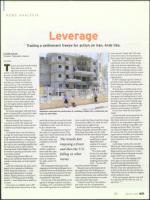
Schoolgirls walk past the construction of a building in Modiin Wit, a settlement just
inside the West Bank.
would like a freeze not to preclude build-
ing upward, to enable existing structures
to add floors. And it wants the freeze to
be for a limited time.
The Americans, however, are wary of
the notion of a temporary freeze. They
argue that to limit construction for only
a short time could cost
them their newly won
credibility in the Arab
world.
"It could make our
call for a settlement
freeze look like a gim-
mick rather than the
serious instrument of
policy it is meant to
be," said a senior U.S.
official.
The compromise that seems to be
shaping up is that Israel will agree to an
indefinite freeze on all building in return
for strong American assurances on Iran
and meaningful Arab gestures toward
normalization with Israel.
On Iran, one of the possibilities on the
agenda is stronger economic sanctions,
including a U.N.-sanctioned naval block-
ade. Israel's agreement to a settlement
freeze would help Obama build the strong
international coalition he needs for such
a strong measure against Iran.
In late May, after his meeting with
Obama, Netanyahu indicated that some-
thing along those lines is in the works.
Netanyahu told the Likud Party's Knesset
faction that Israel
would have to uproot
illegal West Bank
outposts if it wanted
America in its corner
on Iran.
"If we don't mobi-
lize the U.S. and other
nations of the world
for this purpose" —
stopping Iran's nuclear
drive – "no one
the prime minister declared.
The point man on the Israeli side in
the negotiations with Washington on
the settlement freeze has been Defense
Minister Ehud Barak, who confirmed the
wider regional considerations in a radio
interview earlier this month.
"I think it's clear that if an initiative
gets under way for a comprehensive
regional agreement that brings in other
The Israel is fear
imposing a freeze
and then t he U.S.
failing on other
moves.
Arab countries:' Barak said, "the settle-
ments don't cease to be important, but
they are put into the proper perspective."
If and when Netanyahu does declare
a settlement freeze, he will face strong
right-wing domestic opposition, espe-
cially from the settler movement. That is
partly why he and Barak need to be able
to show the Israeli public that the conces-
sion was made in return for substantial
regional gains.
In their campaign against a freeze of
any kind, settler leaders maintain that
Israel's sovereign decision-making capac-
ity is at stake.
"If in the face of mildly strong winds
from Washington, Netanyahu comes out
first in favor of a Palestinian state and
then agrees to a building freeze, it won't
end there," said Dani Dayan, chairman of
the Yesha Council settler umbrella orga-
nization."The pattern, in which the big
decisions are taken in Washington, will
continue until Jerusalem is divided."
It's not clear where the Israeli public
stands.
A mid-June poll commissioned by the
Ariel University Center in the Jewish
West Bank settlement of Ariel asked
whether or not respondents supported a
"full freeze:' including in Jerusalem and
the large settlement blocs. The result
was 56 percent against and 37 percent
for a freeze; but since most Israelis don't
regard eastern Jerusalem as a settlement,
the figure supporting a construction
freeze exclusively in the West Bank may
be larger.
A poll taken a week earlier and pub-
lished in the Yediot Achronot newspaper
showed 70 percent in favor of evacuating
illegal outposts and 56 percent in favor
of accepting Obama's demands on settle-
ments, which were not defined.
The next move in the ongoing settle-
ment saga is a top-level meeting in
Jerusalem between Netanyahu and
U.S. special Middle East envoy George
Mitchell. They were scheduled to meet
in Paris in late June, but the meeting was
called off because of insufficient progress
on the settlement issue.
If this meeting goes ahead, it may well
be a sign that the two sides are near an
agreement.
❑
July 23 * 2009
A21