

Special Report
REVISITED
'A Heavy Heart'
Emotions flood Detroiter who goes back "home" 70 years later.
Berl Falbaum
Special to the Jewish News
T
he unsolicited invitation to visit
Berlin came unexpectedly and
posed, for me, several soul-
wrenching moral, ethical, psychological
and emotional issues.
Under the Emigrants' Visitors Program
launched in 1969, the Berlin government
— its State Senate — has invited former
Berliners, who suffered directly or indi-
rectly from the Holocaust, back to the city.
I was invited because my parents fled
from Berlin to Shanghai in 1939 when I
was 9 months old. The family spent 91/2
horrific years in Shanghai before immi-
grating to the U.S. in 1948.
Thousands of former Berliners applied
for the trip after reading about the oppor-
tunity in the news media. I don't know
how I was put on the list since I had no
knowledge of the program.
Visiting Germany had never crossed my
mind. Never occurred to me. How could I
step on the soil of a country that was not
only stained but drenched with Jewish
blood?
More specifically, how could I visit the
very city where the Nazis planned their
unimaginable crime and carried out man's
all-time inhumanity to man, a crime that
is still difficult to comprehend some 70
years after the fact.
I was troubled by many questions,
among them: What was the implication
of the invitation? Was it an attempt at
wiedergutmachen (making good again).
The Nazis' cruelty and bestiality does not
lend themselves to wiedergutmachen. Not
possible.
What was the implication if I were to
accept? Was I offering forgiveness? The
issue of forgiveness has been the subject
of much debate, and I concluded that
— as has been written —the only ones
who can forgive are, regrettably, no longer
with us.
My moral dilemma led me to discuss
the issue with relatives, friends, writ-
ers, the clergy and others whose views I
respected. Surprisingly, all recommended
I accept. Their advice was incisive, sensi-
tive, understanding, reflective and corn-
passionate.
Of course, I knew many of the argu-
ments: This is a new generation. I should
LT2
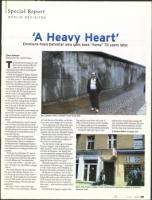
Berl Falbaum visits a remnant of the Berlin Wall.
not visit the sins of the father on the son.
It was time, not to forget, but to move on.
These arguments and others have been
summarized by W. Michael Blumenthal,
former President Carter's Secretary of the
Treasury who also was a Shanghai refugee.
He received much criticism when he
agreed to chair a committee to plan a new
Jewish museum in Berlin. In response to
the critics, he said (in part):
"So, my answer is that I go to Germany
because I support what is being done
there, because I want to look forward and
not back, and because I am hoping that
our internationally recognized institution
can be a focal point for helping today's
and tomorrow's Germans understand and
apply the lesson of their own past."
Although prepared to cancel up to the
last moment, I decided to go — admitted-
ly with a heavy heart, which throbbed as
the plane descended and landed in Berlin.
On the way to our hotel, I saw my first
police officer patrolling in a green-colored
fatigue-like uniform and reflected that in
1938, he could have shot me on the spot,
had me arrested, sent me to a concentra-
tion camp — and won the accolades of his
superiors.
I worked hard to suppress negative feel-
ings and discussed them with some of
other 27 former Berliners on the trip (May
5-12). Many understood my reservations,
but most reflected Blumenthal's philosophy.
During the eight-day trip, we were
addressed by several high-ranking offi-
cials, including Walter Momper, the presi-
dent of Germany's parliament. In their
remarks, they were extremely sensitive.
A Heavy Heart on page A10
Berl's wife, Phyllis, stands in front of the Berlin apartment building in which the
Falbaums lived.
u!
2009
A9