

Special Report
BER ❑ '
V SITED
A Heavy Heart from page A9
GELMAN, ZUKIN & STEELE, P.C.
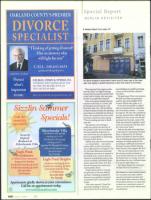
The Berlin building in which Berl's family lived 70 years ago; at the lower
ATTORNEYS AND COUNSELORS AT LAW
3001 WEST BIG BEAVER, SUITE 324
TROY, MICHIGAN 48084
right (not legible) is graffiti protesting a store that caters to neo-Nazis.
PRACTICE LIMITED TO MATRIMONIAL LAW
ere
Call for
monthly
specials!'
Specials!
Silverbmoke Villa
Security
Deposit
Reduced at
Silverbrooke Villa
Eagle Pond
ownhouse3
A Walled Lake community
designed for families
2 bedrooms starting @ $825
3 bedrooms starting @ $930
248-824-6600
Pet Friendly
3 bedrooni with garage
starting at $1,025
bedroom
with garage
2
starting at $870
SpaciousW Bloomfield homes
with private entrances
248-624-3388
Pet Friendly
Eagle Pond Heights
1 bedroom starting @ $540
2 bedrooms starting @ $690
Convenient mid-rise living
_
in Walled Lake
248-926-3900
Pet Friendly
Apartments gladly shown at your convenience.
Call for an appointment today.
A10
,
2009
They expressed deep regrets, under-
stood the "pain" we might be feeling,
stressed that Germany has worked hard
to deal with its history; and were grate-
ful that we accepted the invitation.
Some of our group thanked the gov-
ernment for the trip, its "candor" and
for facing the issues head-on. I dif-
fered from that view. I did not believe
we had to thank Germany for anything
and, indeed, an Orthodox Jew, living in
Berlin, who attended one of our social
functions, echoed my stance saying,
"There is nothing you have to thank
them for."
The speeches were moving; I
could not question the sincerity of
the speakers. And I was very pleased
that none asked for forgiveness or
even hinted that this new generation
bears no responsibility in addressing
Germany's black history.
Indeed, from what we saw, Germany
— or at least Berlin — has made a
zealous effort to deal with a history
some might prefer to be forgotten. The
city has many Holocaust memorials.
A Holocaust curriculum is required in
the schools. It is a crime to deny the
Holocaust. Israeli leaders such as Ben-
Gurion and Rabin (and others) have
streets named after them. It is clear
that the Germans have made some
commendable efforts.
Despite all the advice I received,
the speeches by Germany officials
and their welcoming, sympathetic
demeanor, my questions remained
unanswered and I continually felt
uneasy.
After some research, I found the
apartment building in which my
parents lived. On the wall of the apart-
ment building was graffiti protesting
a store on the street that catered to
neo-Nazis.
The good news: There were protests.
The bad: neo-Nazis are growing in
number, fact acknowledged by the
German officials who spoke to us.
It was also not possible to judge if
what we experienced was representa-
tive of the entire country — or even
its majority. We were very insulated in
our trip, exposed only to officials and
Berliners we met on our own. We did
not learn how the entire country felt.
What about Munich, Frankfort, small
cities and rural areas? Did they share
the views of our hosts?
Only one day after returning home,
I read a piece in Commentary by Mark
Steyn, a columnist for the National
Review and author of America Alone,
who, in analyzing growing anti-Jewish
sentiment in Europe, observed that
according to a 2005 poll, 62 percent of
Germans "are sick of all the harping
about German crimes against the Jews."
That was not reassuring, nor were
the extreme security measures at
every Jewish institution we visited. So,
the bottom line is: I remain very con-
flicted about the trip. I still don't know
if it was the right thing to do.
But I have reached one conclusion:
Perhaps there are no answers. ❑
Berl Falbaum is a former political reporter.
He is an author and a public relations
executive who teaches journalism part-
time at Wayne State University in Detroit.
He has begun working on on a book about
his Berlin visit, collecting the stories of
others on the trip and their feelings about
revisiting Berlin.