

Spotlight
Papal Problems
Pope's visit to Israel fraught with potential minefields.
Ruth Ellen Gruber
Jewish Telegraphic Agency
Rome
T
he official Israeli government
Web site for Pope Benedict XVI's
upcoming trip to Israel and the
West Bank promotes the May 11-15 visit
as a "Bridge for Peace."
Others, however, describe it as a mine-
field where various factions may try to
exploit the pope's presence for political
gain.
"Both Jewish and Muslim ideologues
are determined to stop the pope cross-
ing that bridge," wrote Catholic religion
journalist Damian Thompson in his blog
for the U.K. Telegraph, "either by smear-
ing him as an anti-Semite or by making
his visit to a Palestinian refugee camp
look like a politically motivated reproach
to Israel."
The German-born pontiff leaves for
the Middle East on May 8; he will spend
three days in Jordan before flying to
Israel.
The trip is the first by a pope to Israel
since the 2000 pilgrimage by Benedict's
predecessor, Pope John Paul II. John Paul
was a historic trailblazer who made pro-
moting Vatican-Jewish relations a central
policy goal.
Inevitably, Benedict's words and
actions are sure to be compared — and
contrasted — with John Paul's.
"It's unfair, but John Paul's warmth
will be compared to the theological
coldness of Benedict:' said Israeli politi-
cal scientist Shlomo Avineri. "The fact
that he was in the Hitler Youth, though
involuntarily, will make everyone look at
every move and turn of phrase."
Several issues have strained Vatican-
Jewish ties in recent months. There is
ongoing controversy over wartime Pope
Pius XII's role in the Holocaust, and
Jewish groups erupted in January when
Benedict lifted a 20-year-old excom-
munication order against a traditional
bishop who turned out to be a Holocaust
denier.
In Rome, Lisa Palmieri-Billig, the
American Jewish Committee's liaison
with the Vatican, said both sides were
striving to minimize lingering problems
ahead of the papal trip.
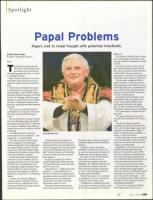
Pope Benedict XVI
"All the problems that might have
loomed on the horizon before the pon-
tiff announced his trip are being muted
within the perspective of the importance
of the visit for bilateral relations:' she
said. "Both the Israelis and world Jewry
are aware of this and want to nourish
good relations."
On April 12, Benedict, 82, said he
would "emphatically" bring a message
of "justice and truth, mercy, forgiveness
and love" on his trip.
"Reconciliation — difficult but indis-
pensable — is a precondition for a
future of overall security and peaceful
coexistence, and it can only be achieved
through renewed, persevering and
sincere efforts to resolve the Israeli-
Palestinian conflict:' he said.
The pope's itinerary mixes prayer,
politics and pastoral teaching to local
Christians with an attempt to improve
interfaith relations with both Muslims
and Jews.
It includes stops in Jerusalem,
Bethlehem and Nazareth. There will
be open-air masses and meetings with
Muslim and Jewish religious leaders.
The pope will visit the Yad Vashem
Holocaust memorial and the al-
Aida Palestinian refugee camp near
Bethlehem. He will hold meetings with
Israeli President Shimon Peres and
Prime Minister Benjamin Netanyahu,
as well as with Palestinian Authority
President Mahmoud Abbas.
Official Vatican policy is to maintain
an equilibrium of sorts in its relations
with Israel and the Arab world.
"Its diplomacy is different from that
of other states because it is always aware
of the Christian populations," Palmieri-
Billig said.
In Jerusalem, Oded Ben-Hur, a former
Israeli ambassador to the Vatican, said
the pope would be welcomed as a friend
of Israel.
The visit, he told reporters, is proof
that "relations between Israel and the
Holy See are strong and solid." Ben-Hur
said Benedict "has never missed an
opportunity to reiterate his commitment
to dialogue and to relations with Israel"
The two states formalized full dip-
lomatic relations in 1994. But years of
fitful negotiations have failed to resolve
several lingering issues, including fiscal
status and tax issues regarding church
property in Israel and visa restrictions
on Arab Christian priests.
Meanwhile, Arab and Muslim senti-
ment ahead of the visit appears to be
mixed. One possible problem could
be the pope's last day in the region,
May 15, which coincides with the day
Palestinians commemorate as the Nakba
— the "catastrophe" of Israel's birth in
May 1948.
"The pope's Palestinian hosts will
certainly (instrumentalize' this," Avineri
said.
Already the Latin patriarch of
Jerusalem, Fouad Twal, said Benedict's
visit to the al-Aida refugee camp would
symbolize the Palestinians' "right of
return" to the holy land, according to a
report on Israel's Ynet News.
Israeli media reports also said officials
were concerned that security and other
infrastructure for the visit were not yet
in place in the West Bank.
Pamphlets in some Arab towns have
called for protests against the pope
because of remarks he made in 2006
that were construed as insulting Islam.
At the time, the remarks sparked pro-
tests in the West Bank and Gaza Strip, as
well as elsewhere in the Arab world.
In Nazareth near the Church of the
Annunciation, which the pope is to visit,
radical Muslims have hung a banner
apparently aimed at Benedict that quotes
a passage from the Koran: "Those who
harm God and His Messenger — God
has cursed them in this world and in the
hereafter, and has prepared for them a
humiliating punishment."
"Everyone is crossing their fingers"
that things go well, Avineri said.
May 7 2009
C29