

I
World
Preparedness
Simulation trains groups to handle a Mumbai-style attack.
Eric Fingerhut
Jewish Telegraphic Agency
Washington
A
merican Jewish groups have
been preparing for terrorist
attacks similar to the one that
struck Mumbai.
The leaders of more than 30 Jewish
organizations gathered early last month
in New York for a "tabletop exercise" that
simulated coordinated attacks on Jewish
community institutions in multiple loca-
tions throughout the United States.
"It was amazingly prescient for what
occurred" in Mumbai, said Malcolm
Hoenlein, the executive vice chairman
of the Conference of Presidents of Major
American Jewish Organizations and co-
chairman of the Jewish group that spon-
sored the meeting, the Secure Community
Network.
Established in 2005, the Secure
Community Network coordinates security
within the organized Jewish community,
disseminating and sharing informa-
tion among organizations and with law
enforcement officials.
Doron Horowitz, the director of com-
munity security for the Jewish Federation
of Toronto, said the attacks in India con-
firmed and corroborated the importance
of being prepared for such attacks.
The three-hour simulation last month
provided community leaders with some
key tips on how to respond to such an
attack. The group watched as mock
newscasts reported on multiple attacks: a
firebombing at one synagogue, a machine-
gun attack at another and a bomb at a
New York Jewish institution. Participants
had to formulate a response plan, and the
exercise facilitator pointed out vulner-
abilities.
"OK, they've just entered your institu-
tion and they're on the first floor," the
moderator said, according to one partici-
pant. "What do you have in your facility to
stop this attack? What don't you have?"
In Touch
Among the guidelines for action were
drawing up contingency plans, having key
phone numbers available and ensuring
that staff members are aware of what to
do in an emergency in case the person
A22
December 11 • 2008
responsible for security is not on the
premises.
"We're challenging them to react to real-
time situations:' said Paul Goldenberg,
the national director of the Secure
Community Network.
The idea is to take that knowledge
back to their institutions, along with the
procedures recommended by the security
experts.
Security experts say simulations are
critical to maintain preparedness.
"Anybody can read a manual:' said
Rabbi Gary Moskowitz, a former New
York City police officer whose Tzedek
Task Force on Counterterrorism offers a
50-hour course for religious organizations
that includes security drills. "You have
to have a performance drill. If you don't
practice it, it's worthless:'
Allan Finkelstein, the president of the
Jewish Community- Centers Association,
said he will share what he learned in the
exercise with his 360 member institutions.
"The key thing is how to help our local
agencies go though that kind of training
experience Finkelstein said. "They need
to look at this locally."
A Look Back
In August 1999, a gunman burst into the
Los Angeles JCC and opened fire, wound-
ing five people before fleeing. The man, a
white suprema-
cist, later mur-
dered a mail
carrier before
surrendering to
the authorities.
More recently,
in July 2006,
a Pakistani
Muslim gun-
man opened
fire at the Jewish federation building in
Seattle, killing one woman and wounding
five.
Goldenberg said the American Jewish
community isn't facing any specific threat
now, but there is a "heightened state of
concern" owing to the targeting of Jews
in the Mumbai attacks. He also suggested
that the economic crisis may fuel white
supremacists and hate groups to target
Jews.
In the meantime, the Mumbai attacks
have spurred community leaders to action.
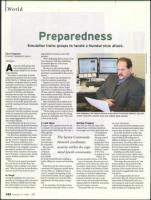
Paul Goldenberg, the national director of the Secure Community Network, says the
Jewish community could be much more vigilant about security.
Getting Prepped
Since Nov. 28, when the siege of the
Chabad House in Mumbai ended and
the hostages were found dead, more than
170 people have
downloaded a
200-page manual
on emergency
preparedness from
the Web site of the
Jewish Community
Relations Council
of New York,
according to David
Pollock, the
associate executive director of the JCRC.
Secure Community Network sent out a
notification on the afternoon of Nov. 28 to
its member organizations confirming the
facts of the attack at the Mumbai Chabad
House and issuing several security recom-
mendations. It included implementing
a surveillance detection or awareness
program to identify and report suspi-
cious activity, and reviewing and testing
response plans for lockdowns, evacuations
and active shooter scenarios.
The group's Web site, www.scnus.org,
The Secure Community
Network coordinates
security within the orga-
nized Jewish community.
has more information.
North American Jewish institutions have
become more prepared and vigilant about
security since the attacks of Sept. 11, 2001.
Since 2005, hundreds of Jewish orga-
nizations, synagogues and schools have
received federal aid totaling tens of
millions of dollars to pay for security
improvements. The money, doled out in
increments of less than $100,000, comes
from the Department of Homeland
Security's nonprofit grant program.
Goldenberg said the Jewish commu-
nity could be much more vigilant about
security and that there is a proper balance
between security and "overload:'
"We're better than we used to be said
Stephen Hoffman, the president of the
Jewish federation of Cleveland and co-
chairman of the security network. But he
said security is significantly below where
it should be.
In the coming months, the Secure
Community Network will partner with the
Department of Homeland Security in a
new program to train Jewish community
professionals throughout the country on
understanding and mitigating threats.
❑