

World
Uneasy Truce
Conflict strains ties between Russian and Georgian Jews.
Grant Slater
Jewish Telegraphic Agency
Igoeti, Georgia
T
he Russian soldier took the
last drag of his Marlboro Light,
scanned the crowd of Georgian
police huddling about 20 yards away and
threw the butt in their direction.
He slung his rifle over his shoulder and
jogged back toward an armored vehicle,
with a reporter right beside him.
"We're not going to Tbilisi. I want to go
home the soldier told JTA.
But as Russian troops pushed within
30 minutes of the Georgian capital on
Monday, it was unclear whether any of the
higher-ups agreed with him.
Over the weekend, Russian forces dug
in on either side of the main road leading
from the capital Tbilisi to the embattled
city of Gori and farther west. They set
up sniper positions on hills, hid armored
vehicles on the side of the road beneath
piles of tree branches and operated with
impunity on Georgia's main highway.
The Georgian forces — outmanned and
seeking to avoid confrontation — could
only look on powerless.
They stared across the line with one
question on their mind: "How long will
they stay?"
A flurry of diplomacy by European
Union and American officials has sought
a resolution to the situation and to press
Russian troops to leave Georgia. Russian
President Dmitry Medvedev said Russia
would pull its troops out but gave no time-
table for withdrawal.
The Jewish Impact
For the Georgians, the anxiety is pervasive.
For Russians, the self-assuredness is abso-
lute. These attitudes reach into the Jewish
communities of both countries.
The normally close relations between
Russian-speaking Jews — manifested in
congresses and charities meant to bring
them together — have been strained by
nationalism and propaganda wars during
the last week.
Georgians view the Russian troops
on their soil as no less than a full-scale
occupation of their country, akin to
Czechoslovakia in 1968 when Russian
tanks rumbled into Prague. A photo exhi-
bition in front of the Parliament building
in Tbilisi compares the invasions.
Georgian hopes still lay in diplomatic
pressure from the West. European Union
flags fly alongside the red-and-white
crosses of the Georgian one in front of
most storefronts in the capital.
"The Russians understand that what
they're doing is a crime said Temur
Yakobshvili, Georgia's reintegration minis-
ter and one of several high-ranking Jewish
officials in the Georgian government.
"They're starting to realize that this crime
can not last unpunished!"
His responsibility was to reunite
Georgia with its breakaway republics,
Abkhazia and South Ossetia. When border
skirmishes erupted last week and threat-
ened to explode into all-out war, he trav-
eled to the Ossetian capital Tskhinvali but
could not alter the course of the conflict.
Now, with Russian troops at his door-
step, he said all Georgia could do was to
wait and see. Any advance or retaliation
against Russian troops could provide the
impetus for a broader conflict or a fuller
invasion.
Differing Perspectives
On Saturday night, he unwound in a cor-
ner office of his ministry, fondling a string
of worry beads and shuffling through a
game of computer solitaire. He said the
terms of the current cease-fire make it
clear that the Russians need to leave and
quickly.
"Immediate means now; he told JTA.
"Unfortunately, we don't have any indica-
tions that the Russians understand what
is now:'
The Russians may understand but they
have little reason to leave.
Behind their front lines, news reports
suggest that they are dismantling key
parts of the Georgian military and civilian
infrastructure.
At the same time, irregular troops from
the Caucasus republics and South Ossetia
have been looting ethnic Georgian vil-
lages.
The ease with which Russia exerted its
will in the last week has emboldened the
country.
Many Jewish groups and leaders from
Russia have lined up behind the war effort
and against Georgian President Mikheil
Saakashvili.
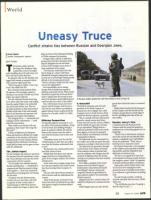
A Russian soldier guards the road from Tbilisi to Gori on Aug. 16.
A Genocide?
The boldest statement came from the
president of the World Congress of
Russian Jews, Boris Shpigel, who called
Georgia's attack on South Ossetia, which
ignited the Russian response, a genocide.
"We, as a people who have experienced
genocide, cannot remain aloof when
armed men kill innocent women, children
and the elderly. We agree that evil must
not go unpunished; Shpigel said in a
statement published in full by the Jewish
News Agency, a wire service operated
by the Chabad-run Federation of Jewish
Communities of Russia.
The federation has not commented on
the conflict and could not speak about the
statement, according to their press service.
The federation has operations through-
out the former Soviet Union; and many
of the countries where it operates have
stood in solidarity with Georgia since the
outbreak of fighting earlier this month,
creating cross-purposes that have strained
relationships.
Ze'ev Elkin, a member of the Israeli
Knesset and of the World Congress'
Parliamentary Club, distanced himself
from Shpigel's rhetoric, saying such
congresses should not get involved in
"geo-political conflicts," the Israeli daily
Ha'aretz reported.
Shpigel declined to comment when JTA
called his cell phone for comment late last
week.
While Shpigel spoke out, other Jewish
groups have skirted the issue or remained
silent.
Moshe Kantor heads both the European
Jewish Congress and the Russian Jewish
Congress, groups that are closely aligned
but are straddling both sides of the cur-
rent conflict.
Russian Jewry's View
A spokesman for the Russian Jewish
Congress said the group had prepared a
statement but was awaiting approval by its
leadership.
"There's a lot of information coming in
and to the end it's not sure that this infor-
mation is completely true said Mikhail
Savin, the spokesman. "That's why we
haven't put out a statement sooner!'
But Evgeny Satanovsky, a vice president
of the congress and a specialist in Middle
East politics, said that Saakashvili had
fallen into an American trap.
The war is an outgrowth of American
encroachment on Russia, he said. America
has sought to create a "collar" of countries
in Russia's traditional sphere of influence.
Satanovsky said the United States went
too far and now is reaping the conse-
quences because it has little moral author-
ity or influence to goad Russia into pulling
back.
He said Georgia was like a small lap
dog that constantly bites its owner, 10,000
times over.
"The 10,000 plus one time, I'm going to
beat the doe he said.
❑
iN
August 21 • 2008
A29