

My
Metrc
ON THE COVER
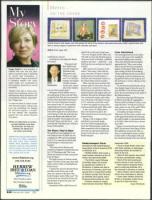
Kirsten Grosz's quilt square, left, also graces the cover of her family's book about the quilts. Other squares show chil-
dren in various stages of departure with suitcases and tears.
Stitch from page A13
small suitcase with us:'
Peggy Daitch is vice president of
Hebrew Free Loan and vice presi-
dent of corporate sales & marketing
for Conde Nast Publications. A
dynamic leader, Peggy is instrumental
in bolstering Hebrew Free Loan's
public image and modernizing its
loan programs, especially for women
borrowers.
"Hebrew Free loan is doing every-
thing it can to empower women who
are frequently left by themselves with
overwhelming financial responsibili-
ties," Peggy says.
To meet the needs of Jewish women
with financial burdens, Hebrew Free
Loan has established the Building
My Tomorrow program, a no-inter-
est loan initiative with substantial
support from the Jewish Women's
Foundation.
When we make loans to women,
we help stabilize more than
the borrower: we help her
children, her family and
our entire community.
Hebrew Free Loan provides interest-
free loans for tuition assistance.
rent and many other financial
needs: living expenses. medical
expenses, training. small business
start-up costs, and much more. If
you or someone you know needs
help, please click or call.
www.hfldetroit.org
248.723.8184
HEBREW
FREE *LOAN
hfldetroit.org
We Provide Loans.
We Promise Dignity.
NJ Jewish
WE'RE
Al4
4 OF
*4'4'
February 28 • 2008
iN
And many, he said, depict the family
left behind.
'All parents told
their children this
was only temporary:'
Weinmann said.
"My parents said,
`We'll see you again
soon! I was already a
teenager and realized
Rabbi
what the situation
Rosenzveig
was for Jews. Almost
none of the children
ever saw their parents again."
Weinmann and his brother were in
the small group of those who did. They
reunited in New York and soon moved to
Detroit, where their father had learned
there was work. Weinmann remained
here, served in the U.S. Army, studied
engineering and became a registered
professional engineer, working as an
automotive engineer for General Motors
until retiring in 1986. His quilt selection
honors the family with whom he lived
while in London. On his square, he wrote
the words "Fanny and Abe Davis ... who
saved my life" with fabric pen covered in
bronze-colored glitter.
The Places They've Been
The quilts have been displayed in sev-
eral countries since the third one was
completed in 1999 and were exhibited
in the U.S. in connection with the play
Kindertransport, written by Diane
Samuels.
"They were used at lectures and
reunions in England, Czechoslovakia and
the U.S.," Weinmann said. "But it was
always the intention to find a permanent
home for them."
The quilts' journey to Detroit actually
began in Florida 10 years ago, when quilt
collector Merry Silber of Southfield met
Kirsten Grosz.
"I opened the Sarasota Herald-Tribune
and there on the front cover in full
color was a picture of the first of the
Kindertransport quilts," Silber said. "The
article said it was owned by Kirsten and
that she lived in Siesta Key, only a few
minutes from us:'
Immediately, Silber called Grosz and
asked if she could come to her home.
"That visit changed my life Silber said.
"She told me about the Kindertransport.
I had never heard of it before. I called 40
people to my house — all Jewish — and
told them, but not one had ever heard of
it either."
Silber made it her mission to tell
others. "Since then, I have told the
story more than 70 times to Jewish
people and non-Jewish people, in
churches and community centers, in
the United States and in Canada."
Silber, who has been involved with
antique quilts for more than 50 years,
has served as curator of 32 major
North American quilt shows and has
appraised quilts and judged quilt com-
petitions. She and her husband, Albert,
own a renowned antique quilt collec-
tion, with many of the pieces on loan
to U.S. embassies around the world
"to show the original art form of the
American patchwork quilt:' Silber said.
In the course of telling others
about the Kindertransport, the
Silber family learned something that
stunned them.
During a visit to England, Albert
and Merry's non-Jewish daugh-
ter-in-law told her English parents
about the Kindertransport quilts. Her
father responded with the staggering
news that, not only had he been born
Jewish, but that he was a child of the
Kindertransport.
Kindertransport Facts
According to the Kindertransport
Association of North America (KTA)
in Hicksville, N.Y.:
•10,000 children were saved, a
small number compared to the 1.5
million who died during WWII.
•The British Jewish Refugee
Committee began the process
by appealing to members of
Parliament. A debate was held in
the House of Commons, and it was
agreed that an unspecified number
of children younger than 18 would
be admitted into England, with a
50-pound bond posted per child.
•Children traveled in sealed
trains between December 1938 and
Lives Intertwined
One morning between lectures, Silber
was in a craft room of the Southfield
apartment building where she lives,
when artist Gail Rosenbloom Kaplan
approached her. "Merry was sewing
when I met her that day',' remembers
Kaplan of Farmington Hills, who had
been visiting a friend in the building.
"Merry explained that she was involved
in setting up a club for residents to sew
lap quilts for babies in the hospital, and
she invited us to see her collection in her
apartment."
The two became quick friends, and in
time, Kaplan began to drive the now 93-
year-old Silber to the lectures and slide
shows she was presenting on the quilts of
the Kindertransport.
About three years ago, following one
of Silber's local talks at Congregation
Shaarey Zedek in Oakland County, a man
raised his hand. "He told me he had cre-
ated a square on one of the quilts:' Silber
said. The man was Hans Weinmann.
A friendship developed between
Weinmann and the women, and he even-
tually approached Kaplan about having
the quilts brought to a permanent home
at the HMC, where he has been a docent
since 1986.
Kaplan, too, had involvement with the
HMC. She and artist Dani Katsir of West
Bloomfield had overseen the 2005 cre-
ation of a stained glass mosaic. Created
by Eden Adler of Farmington Hills and
her friends and family at her bat mitzvah
September 1939.
•Once in Great Britain, they lived
with foster families, in orphanages
and group homes and worked on
farms in the U.K.
•Most of their parents were killed
in German concentration camps.
•Most of the kids became pro-
ductive citizens in new countries.
•Most stayed in England; others
went to Israel and Australia. Very
few returned to Germany or Austria.
•Many children were treated well;
others were mistreated or abused.
•Some older children joined the
British or Australian armed forces
at age 18 to fight the Nazis.
- Source: KTA Web site