
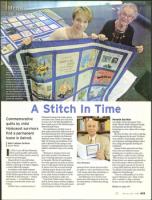

'St Gail Kapl n and quilt
or Merry Silber with
one
quilts
,.1477„A'
he Kindertransport,
the Holocaust
Memoria Center. The square • A.,
-;
in the top left corner was
made by the project's 4ato
Kirsten Grosz and depicts a
synagogue window shattered
during Kristallnacht. The
square next to it was mad
by Hans Weinmann of We
Bloomfield to honor the f
ly
who sheltered him in Engla nd
during the Holocaust.
A Stitch n Time
Commemorative
quilts by child
Holocaust survivors
find a permanent
home in Detroit.
Shelli Liebman Dorfman
Senior Writer
I
n 1939, 13-year-old Hans Weinmann
bid his parents goodbye and boarded
a train from Vienna, Austria, unsure he
would ever see them again.
Along with his 16-year-old brother,
Ernest, young Hans traveled to a port in
Holland, continuing on by ship to England,
a country filled with strangers.
As members of the Kindertransport
rescue mission, the brothers were among
10,000 children spared Nazi horrors during
World War II, after being sent — without
their parents — to Great Britain from
Germany, Czechoslovakia, Austria and
Poland.
A lifetime late, a commemoration of
Weinmann's journey has found a perma-
nent home in the Detroit area in the form
of a piece of art the West Bloomfield resi-
dent created as part of the Kindertransport
Memorial Quilt Project.
His contribution is stitched to one of
three quilts produced by child survivors of
the Kindertransport that will be displayed
as a permanent exhibit in the Holocaust
Memorial Center (HMC) in Farmington
Hills. The framing and installation of the
quilts is planned for late spring or early
summer. A coordinating interactive audio
exhibit is scheduled to open a few months
later.
Weinmann is among survivors and
their family members who illustrated
heart-wrenching experiences on squares
for the quilts. The first 60 contributions
have been organized into quilts by Kirsten
Grosz of Indianapolis, whose late husband,
Dr. Hanus Grosz, also was saved through
a Kindertransport. Kirsten Grosz hand-
stitched the blocks in place and arranged
for an Amish woman in Indiana to do the
quilting. A fourth quilt is under way.
In the book, Kindertransport Memory
Quilt by Kirsten, Hanus and their daughter,
Anita Grosz, are photos of the quilt squares
and descriptions written by those who
Hans Weinmann
submitted them. Kirsten Grosz describes
the quilts as a way to provide the survivors
"with avenues other than oral histories to
express and share their experiences."
Said Weinmann, "A lot of them wrote
books about what happened to them, but
this allowed them to submit their feelings
pictorially"
Parental Sacrifice
According to Grosz, the squares "show
deeply what the 'kinder' had gone through,
leaving family and friends behind and
being alone in a new culture with a strange
language."
She chose the blue color of the Israeli flag
as the background for the quilt. The blocks
were created in varied designs, materials
and techniques, including quilting, embroi-
dery, collage, photography, drawing and
needlepoint.
Squares include memorials and depic-
tions of fear and childhood trauma,
including one of a mother in tears, waiv-
ing goodbye to a child. Another is labeled,
"The last time I saw my parents:" One of
Kirsten Grosz's own squares, reproduced on
the Kindertransport Memory Quilt book's
front cover, shows suitcases by the door of
a young child's bedroom, above the words,
"In memory of the parents who saved their
children by letting them go."
"There is a commonality in a lot of the
squares," Weinmann said. "Many of them
show a railroad or a ship or suitcases
because we were only allowed to bring a
Stitch on page A14
February 28 p 2 08
A13