
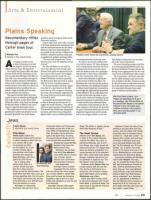

Photo by Alex Cohn i1 2007 Real Peace Productions Inc courtesy Sony Pictures Classics. All Rights Reserved.
Arts & Entertainment
Plains Speaking
Documentary riffles
through pages of
Carter book tour.
Michael Fox
Special to the Jewish News
A
ccording to Jimmy Carter,
extreme frustration provided
the impetus for his 21st book,
2006's Palestine: Peace Not Apartheid.
Not a single day of peace talks took place
between Israel and the Palestinians in the
first six years after Bill Clinton left office, he
says with a mix of incredulity and anger in
director Jonathan Demme's (Philadelphia,
Silence of the Lambs) straightforward docu-
mentary Jimmy Carter Man From Plains. So,
essentially, the former president felt com-
pelled to single-handedly push the issue
into the national consciousness.
That same frustration likely drove him
to give his tome an attention-grabbing title.
But we get the sense, as Man From Plains
follows the author on his book tour through
the fall and winter of 2006-07, that Carter
comes to regret his provocative choice.
The media hones in on the controversy
generated by Carter's sensationalist use of
the word "apartheid" and avoids deeper
questions about the urgency of the Israeli-
Palestinian situation.
Indeed, while Carter comes off as scornful
of the Bush administration and disappointed
with the Israeli government, the film subtly
holds two other semi-interested parties
accountable for the sad state of affairs in the
Mideast: a simplistic American media and
an uninformed, apathetic American public.
"The issue isn't debated here:' Carter
laments at one stop. "It's debated nonstop
in Israel:'
The film will likely not win back for
Carter the affection of the Jewish estab-
lishment that spoke out against his book.
But it does set the record a bit straighter
by clarifying where he stands: He con-
demns Palestinian terrorism repeatedly,
but flatly asserts that only Israel is respon-
sible for the lack of political progress.
The former president dismisses sugges-
tions that he is anti-Israel, and the film
backs him up with a sequence revisiting
the events surrounding his negotiation of
the Camp David Accords between Egypt
and Israel in 1978.
As journalist Yaron Deckel tells Carter
as they sit down for an interview in Los
Angeles for Israel's Channel 1, "You forever
will be an important part of Israeli history."
That doesn't stop Deckel from asking hard
questions, and Carter from pushing back
against what he sees as misinterpretations
President Jimmy Carter, left, and Director Jonathan Demme
or misrepresentations of what he wrote.
The same is true for his satellite inter-
view with Al-Jazeera TV. These dialogues
with correspondents who know the issue
backward and forward cast into sharp
relief the shallow, smiley-face exchanges
that the likes of Terry Gross, Wolf Blitzer
and Tavis Smiley have with Carter.
Carter's talk at Brandeis comprises the
juiciest section of Man From Plains. The
filmmaker first visits Harvard law professor
Alan Dershowitz, who fruitlessly attempted
to debate Carter. Dershowitz is presented as
surprisingly fair; informed that somewhere
Carter referred to "the so-called Holocaust"
he seeks out the video clip online to ascer-
tain the exact context and wording, then dis-
misses the remark as an unfortunate choice
of words devoid of any malevolent intent.
At Brandeis, Carter quickly has the stu-
dents eating out of his hand. He describes
the pain of personal attacks that the book
engendered against him and his family,
and he encourages students to visit the
West Bank for themselves and see what
life is like for the Palestinians.
The most frustrating passage in the film
is an evening meeting between Carter and
the Board of Rabbis of Greater Phoenix fol-
lowing a book signing notable for the vocif-
erous Jewish and Palestinian rallies outside.
We are primed for a lively give-and-take,
but the rabbis declined to give permission
to be included in the film. Demme uses this
ill-advised decision to make them look bad
but, more importantly, viewers are deprived
of a conversation between Carter and a
group of American Jewish leaders.
❑
Man From Plains screens 7 p.m.
Fridays and Saturdays and 4 and 7
p.m. Sundays, Jan.11-13 and 18-20, at
the Detroit Film Theatre in the Detroit
Institute of Arts. For tickets and a
complete schedule of this season's
films, go to www.dia.org/dft or call
(313) 833-4005.
ews
Protestant family. He first became
well known as the star of the sur-
prise 1996 hit Trainspotting. Since
1:11 Film Notes
then, McGregor has co-starred in
Woody Allen's latest film,
quite a few good films, including
Cassandra's Dream (which opened
the musical Moulin Rouge, but his
in select theaters in New York and
international fame emanated from
41, L.A. on Dec. 28) is, like
playing the young Obi-Wan
his previous two films,
Kenobi in the three Star
set in England. It's a sort
Wars prequel films.
of black comedy about
McGregor, 36, has been
two working-class English
married to Eve Makvaris
brothers: Ian, played by
since 1995. She is a French
Ewan McGregor, and Terry,
Jew of Greek Jewish
played by Colin Farrell.
descent and a prominent
Ian is a fairly solid
film production designer.
Eve Makva ris and
citizen while Terry is a
Last September,
Ewan McG regor
chronic drinker and gam-
McGregor told a Scottish
bler. For a time, however,
newspaper that he and his
things go well for both brothers. The
wife are raising their three daugh-
good times end when Terry runs up a ters in their mother's Jewish faith.
serious gambling debt. His rich uncle
Ewan and Eve have two biological
may step in and rescue him, but the
daughters, ages 5 and 11; in April
uncle demands a very difficult favor
2006, they adopted a 4-year-old girl
from the brothers in return.
from Mongolia.
McGregor is a handsome
McGregor told the same paper
Scotsman who was born into a
that he has been to Israel several
Nate Bloom
Ors
Special to the Jewish News
times: "My family is Jewish, and we
went there because of that."
The Small Screen
Veteran actor Tom Bosley, 80,
co-stars in the original Hallmark
Channel film When You Listen. It
premieres Saturday, Jan. 5, at 9
p.m. Bosley, who is best known for
playing the dad on TV's Happy Days,
plays the beloved grandfather of a
young teenage girl in the Hallmark
film. After a near-fatal heart attack,
Bosley's character decides to turn
his attention to repairing the "bro-
ken hearts" in his own family.
Producer-writer Darren Star had
a huge success with Sex and the
City, but he is still looking for a
second hit. (His romantic comedy
series Miss Match, starring Alicia
Silverstone, was a flop.)
Star's new ABC-TV show, which
he executive produces with creator
Kevin Wade, is Cashmere Mafia. The
quasi-clone of Sex and the City pre-
mieres this month.
Cashmere follows the lives of four
ambitious and sexy New York City
women, who have been best friends
since their days in business school,
as they try — what else is new? — to
balance their careers and love lives.
University of Michigan grad Lucy
Liu is the most famous cast mem-
ber. The first episode airs 10-11 p.m.
Sunday, Jan. 6, before the series
moves to its regular time slot of 10-
11 p.m. Wednesdays as a mid-season
replacement for Dirty Sexy Money.
See psychic intuitive and Michigan
native Char Margolis Thursday,
Jan.10, on both the Today show on
NBC and Entertainment Tonight on
ABC. She'll be promoting her new
book, Discover Your Inner Wisdom:
Using Intuition, Logic and Common
Sense to Make Your Best Choices,
before a planned 2 p.m. Saturday,
Jan.12, appearance at Borders in
Novi (wristbands will be handed out
beginning at 8 a.m. that day.) For
an in-depth interview with Char, see
next week's Jewish News.
❑
January 3 2008
C3