

Spirituality
Search For Wholeness
Rabbi Steinsaltz tackles real-life problems via 18th-century text.
Gabriella Burman
Special to the Jewish News
A
diverse mix of Detroit's Jewish community
filled the gymnasium of the Jewish Community
Center in Oak Park on Nov. 11 to glean wis-
dom from Rabbi Adin Steinsaltz, whom Time magazine
describes as a "once-in-a-millennium scholar."
His visit, a highlight of the 56th annual Jewish Book
Fair held at the JCCs in Oak Park and West Bloomfield,
coincided with the publication of his latest book,
Understanding the Tanya, but the topic of his lecture
— man's search for wholeness — was timeless.
"Everyone has had a mishap in his past that can make
him feel less than a complete person': he said. "Real-life
problems trouble us, and we ask ourselves, how can we
live? How can we reach a position in life where we are not
tempted?"
Despite the proliferation of today's self-help books, he
said, the answer is that "there is no final answer."
As described in the Tanya — an 18th-century docu-
ment of morals and instruc-
tions written by Rabbi
Schneur Zalman (first rebbe
of Chabad-Lubavitch) — man
will never achieve permanent
stillness of the mind and
completeness. "As long as you
live, from birth until your last
breath, there will always be
the possibility of temptation':
Steinsaltz said.
He added, however, that the
Rabbi Steinsaltz
Tanya is, ultimately, a book of
"courage and optimism:' in
that it teaches adherents that despite not achieving a feel-
ing of certitude in life, one can come closer to it through
study, and the filtering out of "phantom pains" that may
be obscuring the real existential questions in the life of
man.
The book, which he described as "basic training" for
later study of the Kabbalah, or Jewish mysticism, is not
an easy book to read, even for those with knowledge of
Jewish literature.
"It's not a book you fall in love with on first sight:' said
the Jerusalem-born Steinsaltz, who, at 71, retains a youth-
ful openness to the world and a free-spirited sense of
humor that disarms observers of a man of his stature.
"It's like a classic painting — clear cut, unadorned and
precise. But the more time you spend with it, the more
attached you grow to it."
Ken Kohn of West Bloomfield has been reading the
Tanya regularly for the last 10 years. "It's a difficult book
to read on your own, and never have I heard a rabbi talk
about it like literature the way Rabbi Steinsaltz did': he
said, after the talk. "That helped a lot of non-religious
people in the audience relate to it!'
Steinsaltz, who has written more than 60 books and
100 articles on subjects ranging from theology to zoology,
said that in his commentary on the Tanya, he tried "not
to spoil its spirit': but rather to help people enter into its
depiction of life as "constant movement from one internal
adventure to the next!'
Torah Alive!
Shir Tikvah welcomes the woman who will write its new Torah scroll.
Photo b Will Friedman
Shelli Liebman Dorfman
Senior Writer
I
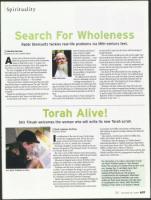
Jen Taylor Friedman at work.
n celebration of the start of a new Torah being
written for Congregation Shir Tikvah, the syna-
gogue will host the Torah's scribe, Jen Taylor
Friedman, at a 10 a.m., Sunday, Dec. 9 program.
Friedman, thought to be the only woman in her pro-
fession, will speak on "One Woman's Torah: The Journey
of a Female Torah Scribe."
Her visit is part of Shir Tikvah's Torah Alive! project,
which will conclude in December 2008 with the Torah's
completion and dedication at the synagogue.
Educated in England and in Israel, Friedman holds
a degree in mathematics and studied Talmud at the
graduate level. She also is a skillful calligrapher.
Friedman said she never actually set out to become
a scribe. "I just combined the things I was good at and
enjoyed;' she said, referring to her Jewish law and rigor-
ous mathematical training as "a jolly good foundation
for a relentless convoluted Talmudic reasoning."
Earlier this month, the Forward included Friedman in
their annual Forward 50 list of people making a differ-
ence in the American Jewish community.
Now living in New York, Friedman also writes mezu-
zot, ketubot and tefillin and teaches scribing classes
with relation to general scribing, Talmud and Halachah
(Jewish law).
She created a Jewish loan society for tefillin that,
unlike most others, lends to women.
Friedman is also the designer of "Tefillin Barbie,"
which she described as "Mattel's Halloween Hip Barbie
in a lovely frum, denim skirt." Hers dolls include a tallit,
tefillin, a siddur and a volume of Talmud.
The writing and dedication of the Torah scroll for Shir
Tikvah coincides with the congregation's yearlong 25th
anniversary celebration. E
For information or to make a reservation to hear
Jen Taylor Friedman speak on "One Woman's
Torah: The Journey of a Female Torah Scribe" at 10
a.m., Sunday, Dec. 9, call Rabbi Aaron Starr
at (248) 649-4418 or e-mail him at
rabbiaaron@shirtikvah.org . The program,
co-sponsored by the synagogue's Sisterhood
and Lifelong Learning Committee, and under-
written by Torah Alive! sponsors, will take place
at Congregation Shir Tikvah, 3900 Northfield
Parkway in Troy. There is no charge to attend.
„IN
November 22* 2007
A37