

Health & Fitness
Going
Blue
Israeli medical specialists
improve skills at U-M.
.
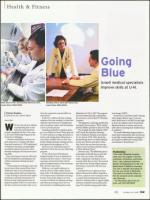
Mary Davis, Ph.D., and Amichay Meirovitz, M.D.,
Standing, Merav Akiva Ben-David, M.D.,
Israeli fellow 2002-2005.
Israeli fellow 2003-2006.
Ruthan Brodsky
Special to the Jewish News
Ann Arbor
W
ith his wife and four children
accompanying him to Ann
Arbor, Dr. Aron Popovtzer
recently completed his first of two years
in the Israeli Fellowship Program at the
University of Michigan.
A board-certified head and neck sur-
geon, Popovtzer is working with physi-
cians and scientists at U-M's Department
of Radiation Oncology, learning highly
specialized radiation protocols, cancer
research techniques and classroom teach-
ing skills.
Upon returning to Israel, he will be the
first Israeli physician specializing in the
radiation treatment of head and neck
tumors.
"I'm learning new techniques and work-
ing on more science research here than I
would have time to do in Israel because
of my large patient load;' says Popovtzer.
"I hope to bring to Israel the more sophis-
ticated and customized treatments I've
learned so that Israeli patients have an
improved quality of life as we treat them. I
also have a lab in Israel and I plan to con-
tinue the cooperative research effort we
started here
In the U.S., radiation therapy training
requires a four-year residency. A physician
typically treats between 150 patients per
year in academic centers and 300 patients
a year in private practice.
Training specifically in radiation thera-
py is very limited in Israel. Today, there are
12 active radiation oncology specialists in
Israel, each treating about 650 patients a
year. Only a handful of the 12 have com-
pleted radiation therapy training and five
participated in the program at U-M.
Each year, two Israeli physicians are
invited to U-M for the two-year fellowship
program.
Dr. Iris Gluck, from Tel Hashomer
Hospital outside Tel Aviv, is interested in
stomach and liver cancers. "I have some
experience in Israel, but little with the
physical implementation of the treatment
like I do here says Gluck.
While on a six-month sabbatical in
Israel in 1992, Dr. Allen Lichter, former
dean of the U-M Medical School and chair
of the Department of Radiation Oncology,
became aware of the disparity in train-
ing and overall lack of radiation oncology
specialists practicing in Israel. He was
instrumental in establishing the Israeli
fellowship at U-M in 1993. The program
has been enthusiastically continued by
his successor, current chair Dr. Theodore
Lawrence.
"The program is achieving exactly what
we hoped;' says Lawrence. "We've tracked
previous fellows and they've done very well.
"For example, Dr. Marc Wygoda (1995-
1997) heads the Radiation Oncology
Unit of Hadassah Hospital in Jerusalem.
Dr. Zvi Symon (1999-2001) heads the
Brachytherapy Service at Sheba Medical
Center near Tel Aviv, and Merav Akiva
Ben-David, who was here last year, spe-
cializes in the treatment of breast cancer
at Sheba Medical Center."
Lawrence says, "The fellowship places
participants in the lab for one year and
in the clinic for another. The fellows
make a significant contribution to our
research while they are here. The work of
past fellows has already helped improve
treatments of cancers for the liver and
pancreas."
Included this year is physics trainee
Nathan Shtraus from Ichilov Hospital in
Tel Aviv, a physicist with training in nucle-
ar engineering and biomedical aspects.
Shtraus is learning skills to support highly
technical treatment and treatment plan-
ning. This includes image guided radia-
tion therapy (IGRT).
He returns to Israel this month. `Among
other things;' Shtraus says, "I can now
teach others how to use IGRT so that high-
er doses of radiation can be focused and
delivered directly to tumors and cancer
cells without exposing more healthy tissue
to radiation."
The Israeli Fellowship Program helps to
assure that Israeli patients have local access
to specially trained radiation oncologists. It
also supports collaborative research proj-
ects between U-M and Israel. II
Fundraising
"The Israeli Fellowship Program
relies upon the support of private
individuals, institutions and founda-
tions," says Lawrence Ghannam,
director of development for the U-M
Department of Radiation Oncology.
The cost to educate each fellow for
the two-year period is $200,000.
"Our goal is to raise $2 million so
that the program can be endowed,"
says Ghannam.
For information about the pro-
gram, call (734) 615-0899.
October 18 • 2007
15C