

Focus
NEWS ANALYSIS
Deterrem
Was Israeli strike in Syria a repeat of 1981 Osirak hit?
Leslie Susser
Jewish Telegraphic Agency
Jerusalem
W
ith Israel still refusing to
discuss the apparent airstrike
two weeks ago against Syria,
observers have begun to suggest that a
major event may have taken place.
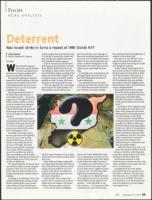
The apparent bombing run may have
been akin to Israel's bombing of the Iraqi
nuclear reactor at Osirak, Iraq, in 1981,
if international media reports are to be
believed. For once, no one in the Israeli
establishment is talking.
Based on government sources in
the United States and elsewhere —
some of them named — the reports
suggest that on the night of Sept. 5-6,
Israeli warplanes attacked a nuclear
facility in northern Syria storing or
processing nuclear materials pro-
vided by North Korea. The presumed
nuclear target would explain the
secrecy shrouding the alleged Israeli
operation.
It also would explain the rumors
of impending war between Israel and
Syria earlier in the year, and the fail-
ure of the two countries to launch a
peace process despite public expres-
sions of willingness to do so.
According to the foreign reports,
the story goes back to the beginning
of the year and a secret meeting
between North Korean and Syrian
officials in the remote Korean bor-
der town of Ch'ongjin. The North
Koreans, having agreed to dismantle
their nuclear weapons program in
return for normalized ties with the
West, were looking to sell off nuclear
technology and materials the Syrians were
only too willing to buy. The key material
on offer was plutonium.
The reports imply that the Syrians long
had wanted to acquire a nuclear weapons
program of their own and, with North
Korean help, they built a facility for plu-
tonium processing and eventual weapons
building.
According to the Washington Post, in the
spring President Bush's national security
adviser, Stephen Hadley, was presented
with evidence of Syrian-North Korean
nuclear cooperation. It included dramatic
satellite imagery from Israel that led some
U.S. officials to conclude the Syrians had
built a facility that could be used to pro-
duce material for nuclear weapons.
At about the same time, Mossad chief
Meir Dagan presented evidence to Israeli
Prime Minister Ehud Olmert that Syria
was seeking to acquire nuclear know-how
from North Korea. Dagan, according to the
reports, feared the Syrians might be able
to produce nuclear devices that could be
installed on Scud-C rockets, which have
the range to reach most points in Israel.
"This was supposed to be a devastating
Syrian surprise for Israel," Sunday's U.K.
Times quoted an Israeli official as say-
gave the politicians a clear message: If
there were no political negotiations with
Syria soon, war was likely in the summer.
Olmert set up a special ministerial com-
mittee to monitor developments on the
Syrian front. The United States, however,
refused to give a green light for peace
talks.
In hindsight, some commentators now
are suggesting the reason for this may
have been Washington's awareness of
Syria's nuclear plans.
The immediate spur for the Israeli
attack may have been the arrival on Sept.
3 of a North Korean vessel at the Syrian
port of Tartous. According to foreign
ing. Had it gone through, Syria in a single
stroke would have attained strategic parity
with Israel.
While Hadley and Olmert supposedly
were digesting the dramatic new informa-
tion, Israeli and Syrian politicians started
talking up the possibility of war in the
summer. At the time, it was difficult to
understand what had triggered the sud-
den threat of hostilities.
Analysts spoke about rising tension
between the two countries, but could not
explain what was behind it. The nuclear
evidence theory provides a rationale.
In June, Israel's military intelligence
sources, the Israelis believed the vessel
was carrying nuclear materials and this
is what dictated the timing of the alleged
Israeli strike on the night in question.
According to the London Observer, the
strike was carried out by eight Israeli
aircraft. Other reports suggested ground
troops also were involved, along with a
high-flying reconnaissance plane.
Last week, two U.S. officials indicated
there might be some truth to the nuclear
theory. Asked about the alleged Israeli
airstrike — Israel still refuses to con-
firm or deny it — U.S. Secretary of State
Condoleezza Rice said, "We have long
been concerned about the proliferation of
weapons of mass destruction:'
Rice went on to say, "We have to have
policies that prevent the world's most
dangerous people from having the world's
most dangerous weapons."
Andrew Semmel, acting deputy assis-
tant secretary of state for nuclear non-pro-
liferation policy, told journalists in Rome
last Friday that Syria, a state sponsor of
terror, was on America's nuclear "watch
list." He added that Syria may well have
had contacts with secret suppliers, possi-
bly North Korea. There are North Koreans
in Syria, Semmel declared.
Syria and North Korea have strongly
denied the nuclear cooperation story.
In an interview with Newsweek, Syria's
ambassador to the United States
described the reports as "absolutely,
totally, fundamentally ridiculous and
untrue:'
According to Syria's original account
of the incident, the Israeli planes were
driven off by Syrian anti-aircraft fire,
fleeing hastily and dumping ammuni-
tion and fuel tanks in open fields.
Israeli journalists, including those
writing for foreign news organizations,
are subject to a military censor and
have been reduced to piecing together
foreign news reports. In an appearance
Sunday before the Knesset's Foreign
Affairs and Defense Committee, mili-
tary intelligence chief Maj.-Gen. Amos
Yadlin was asked by the committee
chairman, Tsachi Hanegbi of the
Kadima Party, not to comment on the
Syria story. Yadlin obliged.
Yadlin did, however, have a lot to say
about Iran's nuclear ambitions. He said
Iran has no intention of aborting plans
to produce a nuclear bomb. Iran has three
messages for the West, Yadlin said:
Iran already knows how to make
nuclear devices; economic sanctions won't
work; and military action against Iran will
exact a very heavy price.
Assuming the Israeli strike against
Syria did take place, the question now is
what effect it will have on the Iran issue.
Does this make a U.S.-led military strike
on Iran more or less likely? The answer
to that question could well determine the
historical significance of Israel's alleged
action against Syria. ri
September 20 • 2007
59