

I
Spirituality
Have Voice,
Will Travel
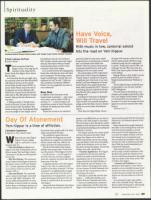
Cantorial Soloist Bryant Frank confers with Temple Israel Cantor Michael Smolash.
Shelli Liebman Dorfman
Senior Writer
T
here's no question that Yom
Kippur can be a very long day for
members of the clergy. But for
Bryant Frank, Yom Kippur day is almost
like two days.
As he has done for the past eight years,
the cantorial soloist from West Bloomfield
will help lead services at the eastside
Grosse Pointe Jewish Council (GPJC) in
Grosse Pointe Woods. And at the end of
the daytime service he officiates with
Rabbi Ernst Conrad, Frank will head 40
miles back to West Bloomfield to Temple
Israel to help run the late afternoon ser-
vice there.
A lifelong member of Temple Israel,
Frank, for the past 15 years, has been a
part of what he calls "the bullpen" that
assists its clergy team. He frequently helps
out at the temple on Yom Kippur and on
the Shabbatot when he isn't needed at
GPJC. Frank's eastside connection began
when his friend Steve Weiss at Temple
Israel introduced him to GPJC's ritual
committee chair, Renee Siegan.
As he travels between the congregations,
Frank takes with him his music and other
service materials. "It's like being a minor
league baseball player; nobody takes my
equipment for me:' he said. "I shlep my
robe, and keep everything in different
binders. I'm very organized; my music is
cross-referenced!'
Busy, Busy
In addition to the time spent on the
bimah, Frank, an attorney, — who is mar-
ried to Mary and the father of Will, 18,
and Alex, 15 — is senior mergers and
acquisitions counsel at Soave Enterprises
in Detroit. His family join him at both
congregations.
"Bryant has served as our substitute
Day of Atonement
Yom Kippur is a time of affliction.
Elizabeth Applebaum
Special to the Jewish News
W
hen: This year, Yom Kippur
begins 7:14 p.m., Friday,
Sept. 21, and ends 8:13 p.m.,
Saturday, Sept. 22.
• What the Holiday Is About: Yom
Kippur is the Day of Atonement (yom in
Hebrew means "day," and kippur means
"atonement"), the day we seek expiation
for our sins.
• Why We Celebrate: The command-
ment to observe Yom Kippur is found in
the Torah: Leviticus 16:29, and Numbers
29:7. Further expansion on the holiday
is in Leviticus 16:30-34, 23:26-32, and
Numbers 29:8-11.
• Rites and Rituals: The command-
ment to observe Yom Kippur states that
the Jews shall "afflict" themselves. The
ancient rabbis interpreted this to mean
five things: no food or drink, no wearing
leather shoes, no bathing for pleasure, no
marital relations, no anointing with oils
(in ancient times, people used oil to clean,
soften and perfume the skin).
The prohibition against food and
drink includes chewing gum and smok-
ing. Persons on a regimen of medication
should consult with their rabbi for the
proper procedure for taking medicine.
Like all Jewish holidays, Yom Kippur
includes extra prayers and a Torah read-
ing. The prayers of Yom Kippur, however
— for all services — are the longest of
any day in the year. In many congrega-
tions, the recitation of prayers takes up the
better part of the day.
A significant feature of the Yom Kippur
liturgy is the vidui, or confession. This
consists of two parts: Ashamnu ("We have
trespassed"), an alphabetically arranged
list of sins, and Al Chet ("For the sin"), a
long inventory of transgressions, accom-
panied by beating of the breast. The con-
fession is recited at all of the services of
Yom Kippur.
Along with Rosh Hashanah, Yom Kippur
is the only day we prostrate ourselves in
With music in tow, cantorial soloist
hits the road on Yom Kippur.
cantorial soloist for many years simply
because he loves it and because we needed
him;' said Temple Israel Rabbi Paul
Yedwab."When the Grosse Pointe Jewish
community needed him, he took up the
challenge for the very same reason!'
The membership at GPJC understands
that Frank is able to share his allegiance.
"Despite being a `westsider; he has given
a significant part of his heart to our com-
munity;' said Janet Weingarten of Grosse
Pointe Woods, who, along with her hus-
band, Jeffrey, founded the GPJC. "Bryant is
a charming, altruistic individual who has
been blessed with a gorgeous, spiritually
uplifting voice!'
A graduate of University of Michigan's
Honors College and U-M Law School,
Frank studied voice privately throughout
college and in New York, where he worked
briefly as an actor before attending law
school.
These days, his High Holiday rehears-
als begin mid-summer; earlier if he also
will be chanting Torah. Mostly, he sings
traditional songs that the congregation
is used to. "People don't seem to like a lot
of change,' he said. "But every once in a
while, I run across a piece of music that is
worth adding."
Singing without a choir, Frank is accom-
panied on piano by Andrea Trivax at
Temple Israel and Kemmer Weinhaus at
GPJC.
"He has helped bring a wonderful aura
of spirituality to our services:' said the
GPJC's Weingarten.
"Over the years, he has built up a con-
stituency of worshipers who flock to hear
him',' said Temple Israel's Yedwab."Partly
it is his beautiful voice, but partly it is
because it is so clear how caring and intel-
ligent he is and how much he loves what
he does.
"We love it, too." 7
prayer, in a modified form, as was done in
the days of the Holy Temple in Jerusalem.
The prostration is done during the cantor's
repetition of the Musaf service. Prostration
is performed by kneeling and touching the
forehead to the floor.
Yom Kippur includes two unique prayer
services: the famous Kol Nidre, which
begins Yom Kippur and in which we
nullify all personal vows for the coming
year, and Neilah, which closes the holiday.
Unlike Rosh Hashanah, we do not blow
the shofar during Yom Kippur. Instead, the
holiday ends with a shofar blast.
• Thematic Significance: Yom Kippur
is regarded the day that God seals the
decision He made on Rosh Hashanah
regarding the fate of every person. The
image created for the High Holidays of
Rosh Hashanah and Yom Kippur is the
Book of Life in which appears the name
of every human. On Rosh Hashanah, God
decides the fate of each person; and on
Yom Kippur, He seals it.
Although it is generally said that Yom
Kippur — unlike other holidays such
Pesach, Shavuot, Chanukah and Purim
— does not commemorate a historical
event, traditionally, we believe that Yom
Kippur is the anniversary of God's forgiv-
ing the Jewish people their first disastrous,
national sin: the infamous episode of the
golden calf.
Moses chastised the people, destroyed
the tablets of the Torah given by God and
went back up the mountain a second
time to pray for God's forgiveness, and
to receive new tablets (Exodus 32:30-35).
He returned to the encampment, and
then ascended the mountain a third time
(Exodus 34). This is reckoned as the first
day of Elul, the month immediately pre-
ceding Rosh Hashanah.
Moses prayed for God to grant the
Jewish people complete atonement. After
40 days, God erased the collective sin of
the Jews and Moses returned to the people
with new tablets of the Torah on the 10th
of Tishrei, Yom Kippur.
• Customs and Traditions: It is tra-
ditional on Yom Kippur to wear white to
remind us of our mortality because burial
shrouds are white, and also as a symbol
of purity because we hope that God will
forgive our sins and restore us to lives of
virtue.
It is customary to greet one another
with: Gmar chatimah tovah ("May your
fate be sealed for the good"); some people
shorten the greeting to Gmar toy.
September 20 • 2007
29