

World
New Peace Push?
With Hamas out of West Bank government, Olmert sees clearer path to peace.
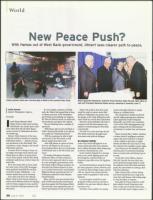
Hamas gunmen stand near a burning jeep in Rafah in the southern Gaza Strip.
Newly appointed Palestinian Authority Prime Minister Salam Fayyad, right, takes an
oath with President Mahmoud Abbas during a swearing-in ceremony June 17.
Leslie Susser
Jewish Telegraphic Agency
Jerusalem
I
sraeli Prime Minister Ehud
Olmert believes that Israel and the
Palestinians can resume peace talks
from where they left off when Hamas
swept to power in Palestinian elections
18 months ago.
Hamas' violent takeover of the Gaza
Strip last week has created two separate
Palestinian entities — radicals in Gaza
and moderates in the West Bank. That
constitutes a major change in the Israeli-
Palestinian equation.
It means those in charge in Gaza can
no longer encourage terror attacks and
blame them on others. It means Israel
can sit down quietly with the West Bank
moderates and discuss a better future for
both sides.
But it also means that in Gaza, Israel
has what critics of the 2005 disengage-
ment predicted would fill the vacuum
created by Israel's withdrawal — an
Iranian-backed base on its doorstep.
Soon after Gaza fell to the radicals,
Olmert made it clear that he intends to
evolve much different policies for dealing
with the Hamas regime in Gaza and the
more moderate Fatah government in the
West Bank.
20
June 21* 2007
It is not simply a question of divide
and rule. Olmert has argued that as long
as Hamas was part of the Palestinian
government, peacemaking was impossi-
ble. Now he believes Israel can work with
the moderates and ignore the radicals.
The new thinking raises a number of
questions:
• Will Hamas allow Israel and Fatah to
build a thriving West Bank as an alterna-
tive model for a Palestinian future?
• Will the moderates be able to hold
onto power in the West Bank, or will
Hamas topple them there, too?
• And with Hamas in control in Gaza,
how far will Olmert be able to go in
peacemaking efforts that once envisioned
a Palestinian state in the West Bank and
Gaza?
On Sunday, Palestinian President
Mahmoud Abbas of Fatah reinforced
the two-entity approach when he swore
in a new emergency government in the
West Bank without Hamas members. He
described the Hamas takeover in Gaza
as an "armed insurrection" and declared
illegal the Hamas government there of
Palestinian Authority Prime Minister
Ismail Haniyeh.
Abbas said the new government's first
goal would be getting the international
sanctions against the Palestinians lifted.
The sanctions were imposed because of
Hamas' participation in the government.
Olmert has made it clear that Israel
would be ready to release about $562
million in Palestinian tax money, since
the danger of the funds falling into mili-
tants' hands has mostly been eliminated.
Moreover, Israel probably will want to
cooperate with the international com-
munity in transforming the West Bank
economically.
The aim is to create new hope for the
West Bank moderates through major
investment and political dialogue.
An Enemy Entity
As for Gaza, Israel will regard it as an
enemy entity, and enforce an economic
and a military blockade while taking steps
to prevent a humanitarian crisis.
Israel would be blamed for a humani-
tarian crisis, while fighting terror and
preventing the continued influx of
weaponry, especially across the Egyptian
border.
An international force along the border
has been proposed. Hamas, however, said
it would not allow foreign troops, and the
odds are remote that potential partici-
pants would be prepared to take on the
militants.
A second option would be to beef
up Egypt's border presence, but that is
unlikely to be any more effective than it
has been so far.
Therefore, some analysts are saying,
Israel eventually will have to smash
Hamas as a military force.
The situation has Israelis on the left
and the right proposing new solutions.
Likud opposition leader Benjamin
Netanyahu, one of the most outspoken
critics of the 2005 disengagement, sug-
gests working with the international
community to weaken Iran and its prox-
ies.
Major General (Res.) Yaakov Amidror,
a former head of intelligence analysis,
argues that Israel will have to launch
a major military operation to topple
Hamas and then reoccupy Gaza to stop
the radicals from coming to power again.
Israel Hasson of the hawkish Yisrael
Beiteinu party recommends declaring
Gaza an enemy state and letting it go on
its own.
On the left, Carmi Gillon, a former
Shin Bet Security Services chief, says
Israel should encourage Fatah to crush
the militants in the West Bank and then
pacify the area further by cutting a deal
with the moderates.
Major General (Res.) Doron Almog
says Israel should discuss a long-term
cease-fire with Hamas while taking steps
to stop the influx of weapons.
Ironically, the Hamas takeover could
help stabilize Israeli-Palestinian rela-
tions. In the case of attacks from Gaza,
Israel could take much tougher action. fl