
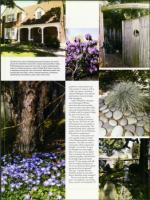

Clockwise from above: Strategically placed shrubbery and stones
provide the Woehrlens' home with a neatly manicured effect. Hardy
PJM rhododendron colors the front yard. A rustic weathered gate
opens to a shady sanctuary. A spray of Elijah Blue fescue rises like
a waterspout among the cool round stones. Meandering paths lead
through light and shade. Yellow-centered anemones, sometimes
called Grecian wind flowers, grow under a River birch.
peariwort. A stone lantern pro-
vides contrast in color, as well as
a taller focal point. And hosta,
perhaps Michigan's most popular
garden plant, is placed strategi-
cally throughout.
Arthur Woehrlen, who grew
up in Huntington Woods,
remembers his parents' garden,
where his father raised prize lilies,
roses and chrysanthemums, some
of which could be exposed to light
for only a few hours a day.
"At an early age, I was in
charge of covering and uncover-
ing," he says. "So when my wife
and I planned our own garden, it
had to be low maintenance. The
wonderful thing about a Japanese
garden is that it can be both beau-
tiful and low maintenance."
Of course, as Sara points out,
even a garden made up mostly
of non-blooming plants requires
attention. "You start out with a
master plan, which requires fore-
thought," says Arthur. "A place
you thought was sunny might,
after a few years, now be shady."
And to maintain the serenity of
a Japanese garden, each bed must
be carefully edged and bushes
pruned. "In late spring, seeds fall
from the maples and sprout, so
I'm on my hands and knees pluck-
ing sprouts from the ground,"
Sara says. "A garden like this
should be picked up and raked.
Stones should be nicely arranged."
But it's work that the couple
loves. "Its simplicity," says Arthur,
"gives us peace and tranquility" ❑