

ardening can be a challenge in Oakland County's older
suburbs. Enormous trees block out much of the sun,
while their roots suck up water and seeds that burrow
into the grass and take root.
Instead of fighting the environment, one Royal Oak couple
decided to work with it. Over the course of 30 years, Sara and Arthur
E. Woehrlen Jr. have used shapes and textures to create a modified
Japanese garden, resulting in an island of tranquility. Embodying
simplicity of form and structure, a Japanese garden seeks to re-create
the elements of nature on a small scale, relying on choice and place-
ment of plants to suggest the wildness of nature, a sense of motion
and the passage of time.
"A Japanese garden is a living metaphor," explains Sara, whose
father is a retired professor of landscape architecture and urban plan-
ning. "Depending on your point of view on a specific day, you can
make up the scenario. The mown grass areas represent a land mass,
or maybe water. Rocks can be islands or mountains. But in a classic
Japanese garden, flowers are almost incidental to the shape."
When the couple moved to their Royal Oak home in 1976, its
primary landscaping consisted of yews — four in the front of the
house and five in the back. At first, they planted a variety of peren-
nials and annuals. Although it was not too difficult to handle, it
was visually more involved than they liked. So in the late 1980s,
they worked with Alexander Nursery in Mt. Clemens to begin their
Japanese gardens. Like all gardens, theirs evolved over time.
Today, the Woehrlens' home integrates elements of Japanese
design in both front and back. Approaching the front door, a mean-
dering stream of yellow-green pearlwort separates the mown grass
from rocks and shrubs. In mid-spring, a PJM rhododendron — the
hardiest rhododendron for colder climates — adds color. "It must be
about 20 years old," Sara says. "It had gotten misshapen, so we cut it
back after it blooms."
Other early-spring bloomers include white bloodroot, purple
anemone, Dutchman's breeches, miniature iris and columbine. A fern
suggests a volcano. And in the back garden, spikes of Japanese
blood grass represent ocean waves. Craggy rocks rise over beds of
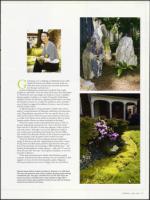
Opposite page: Visitors to Sara and Arthur E. Woehrlen Jr.'s 1936 Royal
Oak home are allowed a peek at their modified Japanese garden through
a weathered gate. This page, clockwise from top left: Sara enjoys the
fruits of her labors. Carefully chosen rocks represent craggy cliffs. A
mossy bed of yellow-green pearlwort divides the lawn and the flowering
shrubs at the entrance to the home.
plafillt1111 • APRIL 2007 •
27