

Ye
v I
Turning Points
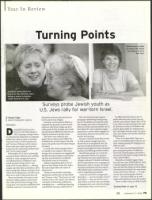
Philanthropist Andrea
Brontman was struck
and killed by a car in
New York.
ar le s Br on ( man
I
A mourner weeps during the
funeral for Pam Waechter, killed
during an attack on Seattle's
Jewish federation in July.
Surveys probe Jewish youth as
U.S. Jews rally for war-torn Israel.
Chanan Tigay
Jewish Telegraphic Agency
D
Philadelphia
wring Bill Clinton's success-
ful run for the White House in
1992, campaign strategist James
Carville famously impressed on campaign
staffers that, when it comes to reaching
American voters, "It's the economy, stu-
pid." For Jews, 5766 may well be remem-
bered as the year when American Jews
looked into the crystal ball and discovered
that, "It's the youth, stupid."
With leaders of U.S. Jewry increasingly
concerned about continuity and watching
fretfully as many younger Jews opt out
of traditional forms of affiliation, each
month seemed to bring with it a new
study of 18-25-year-old Jews — offering
insights into their likes and dislikes; where
they're doing their Judaism and spots from
which they're shying away; and what turns
them on, as well as what turns them off.
There was Brandeis University's study
of Jewish college students, which found
that, while proud of their heritage, these
young Jews were basically unaffiliated, had
relatively weak ties to Israel and Jewish
Still, with intermarriage rampant,
federations and were attracted more to
synagogue membership among young
Jewish culture than religion.
Jews on the decline and a general sense
And there was the study by Reboot, a
that younger Jews are less connected to
nonprofit that promotes creative Jewish
Judaism, Jewish communal leaders are on
initiatives, that found college-age Jews,
the lookout for ways to get the younger
while proud of their heritage, were avoid-
generation to connect and to engage in a
ing institutional affiliations and .were par-
conversation about Jewish identity, com-
ticularly interested in Jewish culture.
munity and meaning.
Then there were studies by soci-
But given what the recent slew of stud- .
ologist Steven Cohen and by Hillel: The
ies tells us about younger Jews, how
Foundation for Jewish Campus Life, that
found, well, pretty much the same thing as should this be accomplished? Over the
past year, Jewish professionals and lay
the others.
people increasingly have been asking this
As study after study emerged, observ-
question and debating possible answers.
ers started to see a pattern. That many
Should these groups try to meet the
younger Jews in America are engaging dif-
next generation where it's at, promot-
ferently than their forebears and express-
ing initiatives that cater specifically to a
ing their Jewish identities in different
younger audience? Or should traditional
ways,should come as no surprise.
Jewish organizations, from synagogues to
Indeed, extrapolating from a Feb. 27
federations, work to convince the youth
piece by Jane Kramer in the New Yorker,
that these institutions still have what to
this may simply reflect the nature of
° offer? Maybe some combination of the
democracies.
two? Or something else entirely?
"Democracies preclude contending
If you ask some of the young people
absolutisms and the dicta of fixed identi-
ties',' Kramer writes."They have to do with themselves — and, increasingly, some of
identity in flux, with culture, and cultures, their elders — they say that the way to
their hearts and minds and pocketbooks
constantly transforming, molting into
is through artistic and cultural exchange:
something new — something surprising
Jewish music, books, movies and art.
and different and open-ended and free."
"In 2006, there have been a slew of
studies that have pretty much come up
with the same answer. Maybe 2007 will be
a year when we stop investing in the stud-
ies and start to invest in the leaders and
projects that actually are making mean-
ing," said Roger Bennett, senior vice presi-
dent at the Andrea and Charles Bronfman
Philanthropies.
"There is no silver bullet. There are a
range of remarkable projects that are out
there making meaning for young Jews in
different ways."
To be sure, recent developments have
given young Jews plenty of outlets for
the Jewish cultural impulse, and seem to
demonstrate that there's a large market for
these cultural efforts.
Matisyahu, a Chasidic reggae singer,
has sold more than 500,000 albums. Heeb,
a Jewish magazine aimed at hip young
Jews, has been the subject of much chatter
and numerous articles in the mainstream
media. And Guilt & Pleasure — "A maga-
zine for Jews and the people who love
them"— has been selling out at news-
stands and bookstores across the country.
Times, in other words, are flush if you're
Turning Point on page 74
September 21 ' 2006
73