

Year In Review
CHANG'S LETTUCE WRAPS
Photo by Brian Hendler/JTA
Giving salad an
inferiority complex
since 1993.
Reservations Accepted
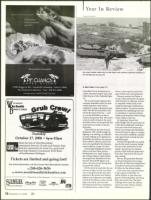
An Israeli soldier walks next to idle tanks with shelled Lebanese buildings in
the background on Aug. 27.
r MO
BISTRO
17905 Haggerty Rd. • Northville Township • 248-675-0066
The Somerset Collection • Troy • 248-816-8000
A New Dawn from page 72
pichangs.com or 1-866-PFCHANG (732-4264)
1158900
THE GREATER
Bloomfield
CHAMBER OF COMMERCE
Tues • ay
October 17, 2006 • 6pm-lOpm
Taste the best of West Bloomfield
restaurants between 14 mile and Pontiac Trail.
Join the community for some fun, great food
and help Gleaners Community Food Bank
of Southeastern Michigan
Tickets are limited and going fast!
For ticket information, call the Greater West Bloomfield Chamber
at
248-626-3636
or www.westbloomfieldchambencom
Thank Yon to Our Sponsors
1
A TRADmoN Or EXCFI i F NCE
Yeenritie
Medical Center
Cje;ile
, . 2X,e,
( K:50
MUM
Koran Vollay4inal Mompatal
x-w.,
NEWSPAPERS
.,.. .____.... ....._
72
September 21 - 2006
163890
Hezbollah's Beirut headquarters to
rubble, destroyed weapon stores and
killed dozens of elite Hezbollah fight-
ers.
But it soon became apparent that
incessant Hezbollah rocket fire from
mobile launchers could only be
stopped by a large-scale ground oper-
ation. This did not materialize until
the last few days of the war — and
as a result, Hezbollah was able to
continue firing more than 100 rockets
a day at Israeli civilians in the north
and claim victory on the grounds that
Israel had been unable to stop the
Katyushas.
United Nations Security Council
Resolution 1701, which brought the
fighting to an end Aug. 14, called for
an arms embargo to be imposed on
Hezbollah, the militia to be removed
from southern Lebanon and for the
area to be patrolled by the Lebanese
army, backed by a large U.N. force.
Increasingly beleaguered at home,
Olmert presented these postwar
developments as a major change in
the strategic balance. Israeli leaders
also argued that Hezbollah had lost
between 500 and 800 fighters and
taken a far more severe beating than
was generally realized.
But the mood in Israel after the war
was one of anger at what was widely
seen as the government's poor man-
agement of the ground war. Military
analysts and ex-generals were highly
critical of the failure to order an early
large-scale attack, and reservists
returning from the front complained
of confused orders, a lack of confi-
dence in their superiors and short-
ages of food, water and equipment.
Pressure mounted on Olmert to
set up a state commission of inquiry
with the power to subpoena witness-
es, impound evidence and recom-
mend the dismissal of political and
military leaders. The prime minister
responded by establishing three less-
er committees to examine political,
military and homefront shortcomings
in the conduct of the war.
By September, Olmert had
acknowledged that his grand plan for
a West Bank withdrawal would have
to be put on the back burner, and
Hamas was trying to get Palestinian
terrorist factions to agree to a tempo-
rary truce and to establish a national
unity government to break the inter-
national boycott.
Overall, 5766 generally was a good
year for the Israeli economy, though
the war in the north led to an esti-
mated 1 percent loss in economic
growth, which had been projected at
more than 4 percent for the second
year running.
The war also generated demands
on the government's purse strings:
More than $1 billion for rehabilitation
of northern Israel and an additional
$5 billion for the defense budget.
At the same time, a poverty report
in late August revealed that 1.6
million Israelis, or more than one-
quarter of the population, was living
below the poverty line. The fiscal
challenge was to meet the military
and social needs without creating
inflationary pressure. ❑