

TRAVEL
An American In
PE
A HOMETOWN GIRL
FINDS ANOTHER HOME
FOR YOM
71711117
\•,),..\\.\\\\\
tot
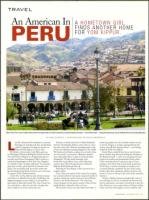
Above: Cuzco, Peru, was the capital of the ancient Inca empire; today, its Jewish community is comprised largely of travelers — most of them Israeli — visiting the nearby Incan ruin site of Machu Picchu in the Andes Mountains.
BY BREE KESSLER I PHOTOGRAPHY BY JULIE ZIMMERMAN
L
ast fall, a friend and I embarked on a journey
that began in Ecuador and, four months later,
ended in Argentina. During our travels, we
observed Yom Kippur in Cuzco, Peru.
My friend on the journey, Carly Efros, grew up
in Huntington Woods and Bingham Farms and now
lives and works in Boston as a hospital pharmacist. I
recently moved from Farmington Hills to work as a
medical anthropologist in New York City. Together,
we wanted to take a "pseudo sabbatical." Our primary
goal: time to relax, speak Spanish and discover new
places. Our secondary goal: secure free meals with
good-looking Jewish South American men we'd meet
at outposts of the Chabad network.
I knew that La Paz, Bolivia, had a Jewish commu-
nity (and at an altitude of more than 12,000 feet, the
highest synagogue in the world), so it seemed like a
good place to spend the Jewish New Year. I found out
via e-mail from a rabbi in Lima, Peru, though, that
there would be no services there that year.
Instead, we shared much of erev Rosh Hashanah
between Cochabamba, Bolivia, and La Paz on a bro-
ken-down bus with a Bolivian marching band, a keg
of beer and chickens awaiting slaughter at the market.
We barely arrived before sundown at our hotel, where
we were met by a procession of Bolivians dressed
all in white (they knew to dress in white for Rosh
Hashanah!). We also heard fireworks (with
shofar-like sound effects, if you will) celebrating
a patron saint. We had experienced a traditional
Bolivian Rosh Hashanah after all.
Planning for Yom Kippur in Peru proved to be a
tougher matter.
Cuzco, Peru, the capital of the ancient Inca empire,
has a transient Jewish community comprised mostly of
travelers visiting the nearby Incan ruin site of Machu
Picchu in the Andes Mountains. The rabbi from
Lima had given me the phone number of the Chabad
(spelled Jabad in Spanish) rabbi in Cuzco.
We arrived in Cuzco two days before Kol Nidre. I
found a pay phone, but the Chabad number was not
in service. I began to wonder, appropriately for the
season, what all these barriers meant — was I being
tested? It all felt very biblical.
Surely Moses wouldn't have let an out-of-service
phone number stop him from leading the Israelites to
the Promised Land — and I was not going to let my
people (my mother and grandmother) down either.
I then remembered from a previous trip to Cuzco
passing a street lined with several Israeli restaurants.
At the time, it seemed extremely out of place; now
it seemed, literally, a godsend. (In fact, many young
Israelis, after their mandatory military service is over,
travel to Cuzco to trek up to the ruins of the mountain
fortress.)
I found a falafel restaurant and asked the waiter if
he could help us. He was not Israeli but Peruvian and
had no information. Leaving, I turned back to shut the
door. Posted on it was a sign written in Hebrew telling
where and when Yom Kippur services would be held
JNPLATINUM • SEPTEMBER 2006 •
31