

p
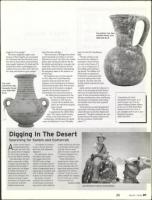
Clay pitcher: Iron Age,
Israelite Period, circa
1200-332 B.C.E.
longevity of our people."
The items, displayed in glass cases
because of their fragility, are surrounded
by wall panels that describe three excava-
tion sites in Israel where antiquities have
been sought. Sepphoris, Tel Anafa and Tel
Kedesh have drawn archaeologists and
students from Ann Arbor. There also will
be a map and timeline to give perspec-
Clay vase:
Late Bronze Age,
Canaanite Period,
circa 1550-1200
B.C.E.
live to the sites and digs.
"The University of Michigan has led the
way for hundreds of students to do their
field work in Israel," says Sklar, who credits
Jackier with coining up with the idea for
the exhibit and steering her to people who
could help. "What the explorers learned
about Israel and its history while looking
for antiquities relates to the artifacts we
are showing."
The Sepphoris site was first explored
in 1931, when Prof. Leroy Waterman
wanted to find out about the role of
Sepphoris in the development of Judaism
and Christianity. More than 30 years later,
a group went to Tel Anafa in a program
organized by the Kelsey Museum of
Archaeology with research focusing on
the multicultural populations at the
site. The third project in Israel,
launched in 1997 and con-
cerned with Tel Kedesh, also
had to do with diverse popula-
tions in Israel.
"We will be having programs
to supplement the exhibit," Sklar
says. "Uzi Leibner, Israeli visiting
scholar at the Kelsey Museuin of
Archaeology, will talk about the signifi-
cance of antiquities at 7 p.m. Thursday,
June 8, in the JCC's Handleman
Hall.
"We also will have a day
of activities for children in
elementary school. We have
set aside a time frame of 11
a.m.-4 p.m. Sunday, June 11, .
for making crafts and hear-
ing stories. The children will
have hands-on experiences
to help them understand what
went into making these kinds
of objects. The story time will
include related materials for back-
ground."
• Jackier advises would-be collectors to
check on the licensing of Israeli dealers,
who must be authorized by the govern-
ment. He also recommends asking for cer-
tificates of authenticity when considering
the purchase of antiquities and looking
into whether items have been repaired
over the years.
"Each item has an interesting history:'
says Jackier, who keeps much of his per-
sonal collection encased for display and
protection. "The glass antiquities are spec-
tacular because the patina attained over
the years produces unbelievable
colors." Li
"Unearthing Our Past:
Antiquities From Israel" is on
view through July 13 at the
Janice Charach Epstein Gallery
at the JCC in West Bloomfield.
Seasonal hours are 11 a.m.-4
p.m. Sundays and 10 a.m.-5 p.m.
Mondays Thursdays.
(248) 432-5579.
Digging In The Deser
Searching for Sodom and Gomorrah.
nyone curious about
archaeological digs
might very well "dig"
the Jewish host of Digging
for the Truth, a series air-
ing on the History Channel.
Josh Bernstein, 34, who
spent a good part of May
in Egypt, has searched for
remnants left by Sodom
and Gomorrah, the Queen
of Sheba, the Giants of
Patagonia and the lost
cities of the Amazon. The
drama he brings to each
adventure has helped make
his show the channel's
highest-rated series.
A
"The desert in southern
Israel is still my favorite,"
Bernstein told Hadassah
Magazine.,
The adventurer, whose
late father was Israeli,
has logged more than
100,000 miles to take
viewers to remote historic
sites around the earth. His
sense of exploration also is
expressed as president and
CEO of BOSS, the Boulder
Outdoor Survival School.
Bernstein, a Cornell
graduate who majored in
archaeology and psychol-
ogy, spent a year studying
Jewish mysticism and texts
in Jerusalem before begin-
ning his serious career
path. He now is sought for
TV shows looking for an
expert in survivalism.
Those interested in
searching for Sodom and
Gomorrah can watch at
11 a.m. Saturday, May 27,
when that episode will be
repeated by the History
Channel. To get the com-
plete schedule for Digging
for the Truth, go to www.
historychannel.com .
— Suzanne Chessler
Josh Bernstein: Explorer extraordinaire.
May 25 • 2006
87