
ceefairdm
Tradition!
Time can
Ted Roberts
conquer
ho doesn't cry at a Jewish wedding? Especially a
hearty, Chasidic hoedown where the ritual is as rich
as the Béarnaise sauce (margarine works as well as
butter, you know) over our kosher boneless rib steak. Even if
you're a sour cynic, God forbid, who sees lawyers instead of rab-
bis, courtrooms instead of chupahs, witnesses instead of brides-
maids, well, still there's food and drink.
And, of course, there is the usual joy of checking out old
friends who seem to have aged much worse than you.
What's not to like about a gala wedding? We sit at elegant
tables in the main ballroom of this old patrician hotel. Before us
is music and dancing and a meal that would tempt Elijah, during
his reclusive period, to flee his cave without a kitchen on Mount
Carmel.
Behind us, all the color of a traditional Chasidic marriage: the
bedeken veiling ceremony, the wild singing in the groom's room,
the kabbalat panim. And the ketubah reading and glass breaking.
Special to the Jewish News
W
a lot,
but not
everything.
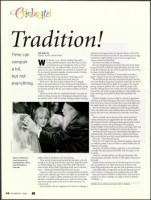
Shlomo Gottfried of
Judaea reborn in the heart of the United States.
These ancient rituals remind us that, like Abraham, we're still
strangers in a strange land. We have a past that clings like honey
on challah. Change your name to Hall from Hallevichevawitz,
move to Iowa, drive a Ford F-150 pickup truck, work at the feed
store — you're still Schmuel Hallevichevawitz, the Jew.
I mean, it is 2005, and we're still re-enacting Laban's deception
of Jacob three millennia ago. That's a box office run that beats My
Fair Lady by a couple of million performances. Here in this lav-
ish hotel, a tuxedoed Jewish groom peers under the veil to make
sure his marriage partner is his own true love, not some 21st-
century Leah.
And the bride's veil, now integrated into Christian weddings as
Israel blessing his
granddaughter, Sarah
Leah Golombek of
Colorado.
66
CELEBRATE • 2006
iN
well, protects the groom from the hypnotic beauty of the bride.
He should not be distracted from her inner beauty, say our sages.
A pretty face might work for a year or two, but a good soul
ensures eternal connubial bliss.
This bride owns both, I'm thinking.
But even though the groom is heavily distracted by the drum-
ming of his heart, he does not forget Jerusalem, the bride of all
Israel, the hometown of every Jew born and yet to be born, when
he stomps on that fragile glass.
The crowd shouts "mazel tov." ("If, next week, he breaks a
glass," I whisper to my wife, "she'll shout, 'Clumsy dummy!'")
The ketubah has not only been witnessed and signed, but has
been read aloud to the guests, a testimony to the legal and ethical
commitments of this heir of Jacob. It is a contract, the original
prenup, unique to Judaism. We're not called the people of the
book for nothing. We love the written word. Not shrill declara-
tions of love, but words on paper spelling out responsibility. And
guess who keeps the ketubah in the Jewish household? The
bride.
All these thoughts crowd my mind as I munch on appetizers
and listen to the band tuning up. This room is full of memories.
Here we held our fraternity socials. Here I danced all night with
the bubbie beside me. Here, a son and daughter were married.
Now here I attend the wedding of my friend's granddaughter.
Time, who defeats all except tradition, shows me his bony face. I
need to find one of my contemporaries who looks worse than
me.
They're certainly not on the dance floor, where yesterday's
waltzes and foxtrots are supplanted by the-day-before-yester-
day's frenetic Chasidic whirling and spinning and other acrobat-
ics designed to amuse and pay homage to the royal pair.
Modesty, highly recommended in Leviticus, still reigns. Boys and
girls dance separately. A handkerchief connects the dancers.
And later, the bride and groom chaired high, hold tightly to a
common hanky. That cloth connection is typical of the fences
that Jewish ethicists have built around prohibited relationships.
Fence No. 1: The Chumash says no.
Fence No. 2: No mixed dancing. Clutching, hugging, squeezing
can inflame passion. If you can't dance or touch, maybe you can
defeat the evil urging.
Fence No. 3: Even the wedding couple here in this public place
must filter the electricity between them with that square of cot-
ton cloth.
Fence No. 4: Besides all that, even the guys dancing for the
chatan (groom) and kallah (bride) are only lightly connected by
the hanky.
Judaism knows the human heart, like the lungs, has two cham-
bers: one good, one evil. That's why we have numerous rule-
books, like paving stones that map the road to goodness, not evil.
I am told by those stronger than me that the dancing went on
until 1 o'clock. A traditional Jewish wedding in the year 2006.
Tevye, the creation of Sholom Aleichem and a man who knew
a thing or two about weddings, was right on when he shouted,
"Tradition!" ❑
Ted Roberts is an attorney and humor writer in Alabama.
Scanned image of the page. Keyboard directions: use + to zoom in, - to zoom out, arrow keys to pan inside the viewer.
March 16, 2006 - Image 112
- Resource type:
- Text
- Publication:
- The Detroit Jewish News, 2006-03-16
Disclaimer: Computer generated plain text may have errors. Read more about this.