

e i
1
Quietly Devastating from page 37
Imre Kertesz penned the
screenplay for the film
adaptation of his novel
they're invisible.
Fateless is not an existential essay on
the indifference of God or the cruelty
of man. Nor, for that matter, is it an
emotional roller-coaster ride with
peaks and valleys. It is a film of small
gestures in which a slap in the face
becomes an act of shocking brutality
and a simple "thank you" is a sign that
civilized humanity isn't dead.
Cinematic Triumph
Lajos Koltai, a veteran cinematograph-
er (Sunshine, Max) making his directo-
rial debut, has created a film of brush
strokes and details, every one of which
is utterly convincing. He masterfully
blends drab realism with a strong aes-
thetic sense, draining the color out of
the film during the lengthy section in
the camps until it's a dusty, deathly
gray.
Ultimately, Koltai's triumph is pour-
ing beauty into every frame without
romanticizing the story or distracting
our attention from Gyuri's plight.
Needless to say, that's a dauntingly
narrow line to walk, but his decision to
use almost no music contributes enor-
mously.
Although the film spans less than
two years and never drags, it feels to us
as if five years or more have passed in
the lad's life. Certainly it seems that
way to Gyuri when he returns to
Budapest to look for his family.
Everyone who weathered the war in his
or her insular, airless apartment seems
to be stuck in amber — and alien to
him.
Or perhaps he's the alien, with no
one capable of helping him accept the
profound realization that life went on
while he was in the camps, and that the
world will continue on its way despite
what happened there. .
For Gyuri, it is a Mystery without an
explanation or solution. It is cause for
both comfort and sorrow. It is, finally,
what makes Fateless. so calmly and qui-
etly devastating. I
!
Fateless, in Hungarian and German
with English subtitles, screens 7
and 9:45 p.m. Friday and Saturday
and 4 p.m. Sunday, March 10-12, at
the Detroit Film Theatre in the
Detroit Institute of Arts. $6.50-
$7.50. (313) 833-3237 or
www.dia.org/dft
40
March 9 2006
Fatelessness (Fateless).
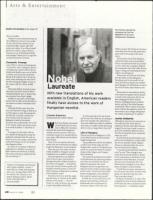
Laureate
With new translations of his work
available in English, American readers
finally have access to the work of
Hungarian novelist.
Sandee Brawarsky
Special to the Jewish News
hen Imre Kertesz was award-
ed the Nobel Prize for litera-
ture in 2002, few Americans
had read the work of the Hungarian
novelist, the first survivor of the con-
centration camps to be awarded the lit-
erary prize. (Elie Wiesel won the Nobel
Peace Prize).
Even in his own country, Kertesz's
works were not well known; his subject,
largely the Holocaust, was not popular.
Since the prize, his works are more
widely available in Hungary and new
translations are available in English.
Interviewing Kertesz, an eloquent
man of charm, grace and modesty,
through interpreter Zoltan Saringer in
New York, is triangular — but quickly
feels quite natural. Kertesz speaks, and
Saringer smoothly jumps in where he
infers commas, picking up the emotions
of the novelist's words.
In person, Kertesz is cheerful, outgo-
ing and funny, in contrast to the darker
persona of his novels — which he
insists are works of fiction, not memoir,
in spite of parallels with his life.
"A writer can only write out of pure
joy:' he said, "the whole joy of creating. It
gives one real hope. You really have to
overcome suffering in order to establish
real contact. It's quite evident that being
able to write is a huge liberty from life
Life In Hungary
Kertesz was born in Budapest in 1929.
In his Nobel lecture, he described his
family background:
"My grandparents still lit the Sabbath
candles every Friday night, but they
changed their name to a Hungarian one,
and it was natural for them to consider
Judaism their religion and Hungary
their homeland.
"My maternal grandparents perished
in the Holocaust; my paternal grandpar-
ents' lives were destroyed by Matyas
Rakosi's Communist rule, when
Budapest's Jewish old age home was
relocated to the northern border region
of the country. I think this brief family
history encapsulates and symbolizes
this country's modern-day travails."
In 1944, the 15-year-old Kertesz was
deported to Auschwitz, and then to
Buchenwald, and was liberated by
American troops in 1945. (He and
Nobel Laureate Elie Wiesel do not know
each other, but were on the same trans-
ports and in the camps at the same
time.)
Kertesz then returned to Budapest,
and his first jobs were in journalism,
but he was dismissed from his position
in 1951, when the newspaper adopted
the Communist Party line. After that, he
began writing and translating German
authors into Hungarian.
Kertesz has survived not only Hitler
but also Stalin and the Hungarian
Revolution and its aftermath. For 40
years, he had no passport and couldn't
leave Hungary, nor did he have access to
the work of many major Western writ-
ers.
Kertesz has an extraordinary facility
with words; he explains that he doesn't
so much create characters, but he cre-
ates a language for them. Andras
Koerner, a Hungarian-born architect,
author and fan of the Nobel laureate,
commented, "He's a master of the quo-
tation without the quotation marks. He
uses words as in a collage, taking from
one reality and placing it in another:'
Jewish Solidarity
Although he uses his own "memories as
raw material in his work, Kertesz
explained, "Fiction and reality become
tangled. By the time a book is ready to
go, I have completely different memo-
ries. You rid yourself of your memories
when you write."
He said that his Jewish identity is pri-
marily one of solidarity. As a boy before
the war, he attended weekly religious
classes in school, but after the war he
was not interested in religion.
"I considered and expressed myself as
a Jew," he said. "How strange it may
sound, but my Jewish identity is based
on my experiences of Auschwitz, on my
experience of the Holocaust. I am not
the only one in Europe like this. The
Holocaust has managed to tie an abun-
dance of people to Jewish identity.
"I think that in essence everyone is a
Jew. Everyone who writes. Everyone who
makes art is forced to become a Jew.
There's no other choice."
He thinks of himself as "a writer who
completely by chance has the Holocaust
as his topic, his source. It doesn't narrow
my perspective — it definitely makes