

Arts & Entertainment
AT THE MOVIES
Affectionate from page 55
Moreover, Dar notes, "He can-
not even eat food in my house,
because we don't keep kosher.
There are so many things he can't
do and so many things that
would create problems for him.
And normally the result is
that there is a complete separa-
tion. But there was enough love
between us that we didn't want
that to happen. We didn't see
each other every day; but when
we did, we were glad."
One day, after Dar helped
members of Rand's Breslov com-
munity film a charity event, the
two met for breakfast at a hotel
with a kosher kitchen. Dar sug-
gested they collaborate on a film.
He told Rand, "We'll work in a
framework that would enable you
to work!'
Good Fortune
-
He also told Rand an anecdote
that later
become central
to the film. He'd
bought a new
sukkah, intend-
ing to combine
it with an older
one. But some-
one, believing
he intended to
throw the old
one out, took it
for his own.
Rand liked
the idea and
came back with
a script about a
poor Breslau
Chasidic couple,
Moshe (Rand)
and MaHi (Shuli's real-life wife,
Michal Bat Sheva Rand)
Bellanga, who are penniless,
childless and prospect-less.
When a charity drops off an
anonymous $1,000, they see it as
perfect citron,
which will guar-
antee the birth
of a male child.
When an old
friend of
Moshe's from
his former and
very secular life
and his com-
panion show
up, they are
made welcome.
The film's
title, Ushpizin,
roughly trans-
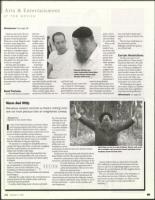
Director Gidi Dar and
lates from the
actor/screenwriter Shuli Rand
Aramaic as
remain friends despite their
lifestyle differences.
"honored, or
holy, guests:' a
a gift from God.
mitzvah during Sukkot.
More good fortune comes their
But although they don't men-
way. A friend of a friend appar-
tion it, the visitors are prisoners
ently has thrown out a perfectly
who did not return to their cells
good sukkah he can use. And
after a furlough. And Moshe
now he has the money to buy the apparently has a violent past he
tries very hard to forget and a
temper he tries very hard to con-
trol.
The two men wreak havoc in
the community and the
Bellangas consider the guests a
test of their faith.
Certain Restrictions
The film, Dar says, "is not
about politics; its about people."
Clearly, the film had to be made
with certain restrictions. There
was no filming on Shabbat, for
example. Since Rand couldn't
touch another woman, his wife,
who was not an actress, was cast
as his movie wife. Other non-
actor members of the Breslover
community were cast as well.
The filmmakers also agreed
not to show Ushpizin on Shabbat
in Israel. This was a significant
concession by the production
Affectionate on page 60
Warm And Witty
Marvelous Ushpizin reminds us there's nothing more
rare nor more precious than an enlightened comedy.
Michael Fox
Special to the Jewish News
five-year marriage.
Although they love
and respect each
n lieu of the bathroom humor, cartoonish villains
other, their inability
and strenuous slapstick that define modern joke-
to produce children
fests, Gidi Dar's Ushpizin brims with a uniquely
is a source of ten-
Jewish wistfulness and generosity of spirit that can be . sion.
traced to Sholem Aleichem and his forebears.
Shuli Rand, who
It is an unabashedly spiritual film, in part because it plays Moshe and
derives its humor from decent characters wrestling
wrote the screen-
with the difficulty of doing the right thing.
play, exudes like-
The premise is as simple and straightforward as a
ability and trust-
vintage Neil Simon play. When a financially struggling
worthiness, and his
Orthodox couple's prayers are answered on erev
performance earned him last year's Israeli Academy
Sukkot, their troubles really begin.
Award for best actor.
Miraculously blessed with a discarded, first-rate
Furthermore, the nonprofessional Michal Bat Sheva
sukkah, and an envelope filled with cash to buy an
Rand (Shuli's real-life wife) acquits herself just fine.
etrog, lulav, food and wine, Moshe and Mali couldn't
Beyond its entertainment value, Ushpizin makes an
be happier.
enormous contribution by deflating stereotypes of the
But a reprobate from Moshe's past shows
fervently Orthodox. The notion of the domi-
up, accompanied by a boorish pal, and a
REV IEW neering husband and acquiescent wife is
shadow is cast over the celebration. (Any
pretty well demolished. This is a love story
resemblance to David Cronenberg's A •
about two equal partners.
History of Violence is purely coincidental and infinitely
And although the power of prayer is acknowledged
more benign.)
at every turn, and the will of God is paramount, the
Although the couple embraces the commandment to observant Jews aren't portrayed as dogmatic automa-
welcome guests into the sukkah, Eliahu and Yossef
tons. It is still the individual's choice whether or not to
would test anyone's goodwill.
be kind and honest — and to rectify mistakes and
In reality, what's being tested is Moshe and Malli's
seek forgiveness.
I
e rbT November 17 . 2005
Shull Rand, as the fervently Orthodox Moshe, both wrote
the screenplay and earned the Israeli equivalent of the
Academy Award for Best Actor.
Indeed, Ushpizin slips in a dig at those who mask
their indifference toward the less fortunate with rote
advice to ask God for help. Being religious is not a jus-
tification for certain behavior, the film suggests, but an
impetus to behave better.
But you certainly don't have to be Orthodox or
even observant to enjoy Ushpizin. Like Eliahu
and Yossef, secular moviegoers are likely to find
this trip to Jerusalem not just pleasurable but
inspiring. ❑
59