
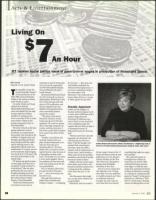

JET tackles social justic
Bill Carroll
Special to the Jewish News
he ensemble cast for the
Jewish Ensemble Theatre's
second production of the
2005-2006 season isn't Jewish.
Neither is the author on whose
book the play is based.
No matter. Nickel and Dimed,
adapted from Barbara
Ehrenreich's book of the same
name and adapted for the stage
by playwright Joan Holden,
should be a rousing success
when it runs Nov. 8-Dec. 4 at the
Aaron DeRoy Theatre in the
Jewish Community Center in
West Bloomfield.
The story is based on the fasci-
nating undercover work by
Ehrenreich, an inexperienced
homemaker who returned to the
workforce in disguise and went
through a grueling and darkly
funny odyssey amid the under-
side of working America. She
explored the ethical issues and
ramifications of trying to survive
on the minimum wage (ranging
from $4.50 to $7.35 an hour), like
one-third of all workers in the
United States.
JET leaders are quick to point
out their plays don't have to be
completely "Jewish-oriented" to
be performed. "Like our other
productions this year, this is a
thought-provoking issue that
raises our social awareness:' said
JET Artistic Director Evelyn
Orbach of West Bloomfield.
"Nickel and Dimed presents
social justice issues that are
T
56
important to, and of strong inter-
est to, the Jewish community,"
said West Bloomfield's Yolanda
(Lonnie) Fleischer, the play's
Jewish director.
Ehrenreich's Nickel and Dimed:
On (Not) Getting By in America
(Metropolitan Books/Henry Holt
& Co.; $23) has been well read
since its 2001 publication, and
the play adaptation by Joan
Holden is being performed at
many community theaters
around the country.
"[The play] is fast-paced,
humorous and has a certain
franticness about it:' Fleischer
explained. "It's a real eye-opener
about what large companies do
to plain working Americans. It
has drawn a great deal of support
from unions everywhere it's per-
formed."
"Frankly, I was dubious that
my book could be done as a
play:' admitted Ehrenreich in an
interview from her car in
Charlottesville, Va., "but Joan
Holden did a nice job in convert-
ing the book to a play. It's more of
a fictionalized version of the
book." The mother of a son who's
a writer and a daughter who's a
law professor, she was busy with
some baby-sitting chores for her
two grandchildren.
Born in Montana, Ehrenreich,
64, calls herself an "honorary
Jew" — since she formerly was
married to one.
Although Ehrenreich and
Holden both attended Reed
College in Oregon — overlapping
duction of Nicket417
by two years — they never met
until Holden undertook the
Nickel and Dimed play project. "I
served as a consultant and gave
her some advice," said
Ehrenreich. "She would call me to
bounce ideas off of me. I certain-
ly didn't oppose the play idea."
Friendly Argument
Holden, 66, the daughter of
Russian-Jewish immigrant moth-
er and a native Californian with a
master's degree from the
University of California, once
went to Paris to write novels but
never completed a page. She
counters that her three-act play is
a "dramatized version" of
Ehrenreich's book, not "fictional-
ized."
"Barbara and I have a friendly
argument over that point," she
said from her San Francisco
home. "I feel the changes were
minimal. But converting the
book into a play was really a
massive work of condensation. In
certain cases, I had to develop a
whole scene out of one incident;
sometimes, one kernel of an idea
became an entire incident:'
Holden, who has written three-
dozen plays, most of them with
humorous political content, loves
"writing about the workforce.
That's where the juice is," she
said.
Like Ehrenreich, she's single
now, and has three children and
one grandchild.
Ehrenreich, who has tackled a
Author Barbara Ehrenreich: (Nickel and Dimed] is a frightening look at
the lives of hard-working Americans just trying to make ends meet."
diverse range of issues in her 17
books and many articles in such
publications as Time, Harper's,
Atlantic Monthly and the New
York Times, has a doctorate in
biology from Rockefeller
University in New York.
She's at a loss to explain how
that helps her in her writing,
other than "I'm more proficient
at scientific research, and I have
an additional analytical
strength," she said. "I get my
story ideas from two sources:
something that makes me angry
and curiosity."
She used both reasons to
investigate how millions of
Americans can survive while
working full time for poverty-
level wages. In 1998, she went
undercover, moving from Florida
to Maine to Minnesota, working
as a waitress in a restaurant (dis-
guised as "Lenny's" in the play); a
salesclerk at a Wal-Mart ("Mall-
Mart"); a hotel maid; a cleaning
woman, scrubbing floors on her
November 3 . 2005
„TN