

Designing Buildin
That
Sin
Breaking Ground introduces
famed architect's iconic
approach to public space.
Sandee Brawarsky
Special to the Jewish News
t was in Poland's primeval
forests, where bison roamed
amidst labyrinths of poplar and
maple trees, Daniel Libeskind first
began to understand concepts of
land, space, shelter and natural
resources, themes that would be
the underpinnings of his career as
an architect.
In his recent
book, Breaking
Ground:
Adventures in
Life and
Architecture
(Riverhead:
$27.95), the
world-
renowned
architect who
designed the
master plan for
rebuilding the
World
Trade
ADVENTURES i ti t t f E
Center site,
AND ARCHITECTURE
describes his
early life in
Poland, Israel
and the Bronx,
and he speaks
with eloquence
and passion
about the ideas behind his "overtly
expressive" work. "There are many
worlds in my head" he writes, "and
I bring all of them to the projects I
work on."
Although the 59-year old
Libeskind has now built three
museums and has 35 projects
underway around the world, he
didn't actually build anything until
I
ni
October 27 2005
he was 52. Until then, as he writes,
he was mostly interested in
abstract concepts rather than the
utilitarian aspects of architecture.
Recently, this interviewer sat
down with the author in a confer-
ence room of Studio Daniel
Libeskind in lower Manhattan,
overlooking the Hudson. The back
wall is covered with architectural
renderings of the World Trade
Center project, and a windowsill is
filled with three-dimensional mod-
els along with a scaled-down
Statue of Liberty. Dressed in all
black but for a lapel pin — an
American flag draped over a New
York apple — with his signature
rectangular black glasses framing
his blue eyes, Libeskind is cheerful
and well-spoken, his Polish-
Yiddish roots evident in the sound
of his English, his New York identi-
ty present in his hard-to-keep-up-
with pace.
"My first introduction to
America," he says, "was through my
father giving an old pair of shoes
on a train platform in Russia"
Nachman Libeskind, who spent the
war years as a prisoner in the
Soviet Union, noticed a young
refugee sobbing after they had
been released from the gulag. It
was bitter winter and the man's
shoes had been stolen while he
slept; Libeskind gave him his spare
pair. The man got to America first,
and every year sent a package of
chocolates; toys and comic books
from Macy's to Poland. Through
copying the comics, Daniel
Libeskind learned to draw.
In 1957, when Libeskind was 11,
his family moved from Lodz to
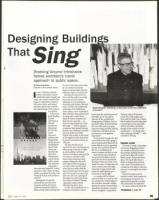
Daniel Libeskind: "Sometimes an idea comes to me from a light deep
in my heart."
Israel, from the overall grayness of
the Polish city to "the natural
splendor of the cornfields and
orange groves of Kibbutz Gvat" in
the Jezreel Valley. He loved kibbutz
life "even if the work was some-
times enervating and dull" shifting
swiftly from "city kid to serious
participant in a real agrarian
experiment"
For his mother though, who also
survived life in the Soviet gulag as
well as Communist Poland, the col-
lective lifestyle was less appealing,
and she soon moved the family to
Tel Aviv, re-establishing the
corsetry business she had in Lodz.
From the first days, Libeskind
was struck by the light in Israel, a
quality he has never experienced
elsewhere. "Even now, when I visit
Israel," he writes, "as others kiss the
earth, I stand in awe of the light.
Some days I suspect that's what
people are really fighting over —
not territory, but the light."
As a young child, he showed
advanced talent as a musician and
was considered a child prodigy on
the accordion. Awarded a scholar-
ship by the America-Israel Culture
Foundation, he played in recital in
Tel Aviv alongside a young Itzhak
Perlman, winner of the same
award. One of the judges, Isaac
Stern, told him that it was a shame
that he hadn't learned to play piano
as he had gone as far as possible
with the accordion. Libeskind
thought it was too late to switch
instruments — "my hands were
used to playing vertically" — and
switched to drawing.
Inside Look
The book is hardly a chronologi-
cal memoir. Biographical details
are revealed as Libeskind muses
about design, building elements,
sacred space, light and sound, a
distinct sense of place and other
ideas. "The book reflects how I
think. An independent network
with a unity. The hardest part of
writing was to be able to weave the
stories in a meaningful way, to have
a spirit."
Libeskind explains that he
decided a write a book, amidst his
many projects, because he was
approached frequently by people
who asked about his inspiration.
For many readers, the book will
Designing on page 66
65