

Id
LEGACY
from page 61
ty logo himself, melding the Torah
with a microscope and the university's
initials to visually represent the dual
emphasis on tradition and innova-
tion. A new university slogan —
"Bar-Ilan: The Jewish University for
the Modern Jewish Future" — makes
the same point.
Leila Stollman jokes that Bar-Ilan
University "sort of came with the
ketubah.''Long active on behalf of the
university and well versed in its history
and achievements, she says Phil "felt
that the Israelis were totally secular
'and didn't know their heritage or their
history. His goal wasn't to make them
religious, but to introduce them to
their heritage. He wanted the student
body 50/50 so they would get to
know each other and know that the
other is not the devil so they would
live with tolerance and respect. It is
still very much the goal."
Unique among Israeli universities,
Bar-Ilan students are required to com-
plete a core curriculum, the equivalent
of a minor, in basic Jewish heritage
courses. The university offers more
than 400 such courses, ranging from
religious studies to art, music, litera-
ture, history and archeology. Its Jewish
studies faculty is the largest in the
world, with more than 300 faculty
members teaching 1,500 courses in 33
research and teaching disciplines.
. In 1996, the International Center
for Jewish Identity was founded at
Bar-Ilan to tie technology and tradi-
tion together by giving university edu-
cators Internet,. fiber-optic and other
state-of-the-art means of communica-
tion to support dialogue between
Jewish youth of all origins and persua-
sions. An ongoing focus has been
equipping Jewish educators from
around the world with the means to
engage and teach future generations of
young Jews.
But expanding the horizons of the
Orthodox community was no less
important. By providing a setting
where observant Jews could satisfy
their religious obligations and pursue
studies in the same subjects offered at
other top universities, Bar-Ilan har-
nessed a tremendous amount of brain-
power for the common good.
Religious Jews needed more than a
religious education to contribute as
much as they could to the Jewish
future and to be part of the fabric of
Israeli society.
.
Why Detroit?
Rabbi Churgin got much more sup-
port for his idea in Detroit than any-
where else, and Detroiters were the
prime supporters and financial backers
for Bar-Ilan's first 15 years of exis-
tence.
"They couldn't raise any money in
New York," says Jerry Stollman. "They
wanted a yeshivah, not a college that
would teach secular subjects — they
thought [Rabbi . Churgin] was crazy."
But the Detroit Mizrachi thought
differently and hired Zvi Tomkiewicz
as Bar-Ilan's first fund-raiser in 1952.
In 1979, Les Goldstein, a former Bar-
Ilan student, took over for Tomkiewicz
and was named executive director of
the Midwest Friends of Bar-Ilan
University — a job he still holds.
Rabbi Churgin and Phil Stollman
traveled to Israel to locate a site for the
Who is Bar-Ilan?
Rabbi Churgin named the university
after his close friend Meir Bar-Ilan
(1880-1949), a leader of the pre-State
Mizrachi movement and son of Rabbi
Naphtali Zevi Judah Berlin, head of the
famous yeshivah in Volozhin, Russia,
where Rabbi Churgin studied as a
youth. Meir later Hebraized his name to
Bar-Ilan and represented the Mizrachi
movement at the Seventh Zionist
Congress (1905). He settled in
Jerusalem in 1926.
Jewish Agency for Israel
ITX
8/25
2005
62
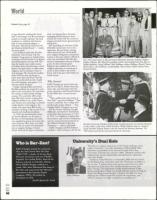
This 1951 photo taken in Abe and Laura Nusbaum's basement includes Professor
Pinkhos Churgin, Bar-Ilan's first president, seated Surrounding him, from left, are
Phillip Stollman, Irving Schlussel, Max Stollman, Arthur Gellman, David I. Berris,
Morris Berris, Abe Nusbaum, (unidentified), Morris Kaner, Rabbi Samuel Prero,
Daniel Temchin.
Bar-Ilan University President Rabbi Joseph Lookstein presents an honorary doctorate
to Max Fisher as Bar-Ilan's Global President Phillip Stollman looks on. Seated is
Israeli President Zalman Shazar, who also received an honorary doctorate. The
1967 honors were the first two presented by the university.
University's Dual Role
Alan Zekelman
"Bar-Ilan is a unique institution in the Israeli landscape of sec-
ondary education," says Alan Zekelman of Bloomfield Hills,
whoserves as president of the Detroit Friends of Bar-Ilan
University. Involved since the late 1980s, Zekelman and his wife
Linda donate annual scholarships and sponsored a classroom
with their family.
Zekelman visited Bar-Ilan in December 2000 and was struck
by the Ramat Gan university's dual role. The focus on Judaics is
key to him. "I realized there were just as many Jews over there
who know as little about their Jewish identity as many Jews
here," he says. "It's important to help Israelis because if they
have a strong idea of their own Jewish identity [not just living in
Israel, but doing Jewish things], I think it can spill over here.
Helping the university enriches Jewish life everywhere, and
Detroit continues to make a significant contribution."