

Narrowing The Gulf
Filmmaker builds bridge between sons and righteous Poles.
MICHAEL FOX
Special to the Jewish News
F
The Brooklyn
filmmaker frets
that his Jerusalem
yeshivah bucher
offspring have lost
touch with
and empathy for
the non-
Orthodox world.
or most documentary filmmakers, it's enough to
educate the world. Menachem Daum wants to
heal the world.
Daum's first collaboration with Oren Rudaysky, A Life
Apart: Hasidism in America, was a sensitive, layered por-
trait of a community that would prefer to remain unas-
similated and, perhaps, mysterious.
Their most recent documentary, Hiding and Seeking:
Faith and Tolerance After the Holocaust, is in some ways
even more ambitious. This deeply rewarding film chron-
icles Daum's modest campaign to narrow two gulfs —
between ultra-Orthodox Jews and the secular world, and
Holocaust survivors (and their descendents) and the
Polish people.
Hiding and Seeking debuts nationally Aug. 30 as part
of PBS's P.O. V. documentary series. It is scheduled to air
11:30 p.m. Sunday, Sept. 4, on Detroit Public
Television-Channel 56.
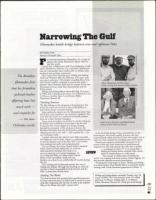
Akiva, Menachem and Tsui David
Daum, during their travels in Eastern Europe
Touching Reunion
The film belongs to the sub-genre of documentaries that
record the return of survivors or their adult children to
their prewar homes in Eastern Europe.
Since neither the subjects nor the filmmakers know what
they'll find, such expeditions are cinematic.crapshoots. For
every film that arrives at a profound emotional catharsis,
there are a dozen boring travelogues.
Daum raises the stakes even further by overtly setting up
his family's trip to Poland as an eye opener for his sons.
Concerned that "every religion is in danger of being
hijacked by extremists" at this moment in history, the
Brooklyn filmmaker frets that his Jerusalem yeshivah bucher
offspring have lost touch with — and empathy for — the
non-Orthodox world.
A deeply observant Jew who has never fully reconciled
the Holocaust with his faith, Daum is a philosophical seek-
er and the eloquent soul of the film. He's a true mentsh,
who routinely acts justly and compassionately.
Once in Poland, they locate Daum's father's boyhood
home, which has been replaced by an unmemo-
rable apartment building. After stops at an
overrun cemetery and a ruined synagogue, it's
on to Zdunska Wola, the village where Daum's
father-in-law was hidden, along with two
brothers, on a farm for an unbelievable 28 months during
the war.
This meeting and its aftermath provide the crux of
Hiding and Seeking. Although the touching yet awkward
reunion is clearly meaningful for both the Jews and the
Poles, it raises some thorny issues.
Healing The World
The three brothers had promised their guardians payment
for food and protection, but didn't send so much as a post-
card after emigrating after the war. So what is the responsi-
bility of the Daum clan, half a century later?
Polish saviors Honorata and Woitek Mucha
in font of their home in Poland
As for the Polish family, if they concealed the trio for
financial gain, they hardly qualify as heroes. But they
unquestionably risked execution if they were caught, and so
must have been inspired by something other than money.
Daum's sons experience discernible movement in the
course of this saga, from skepticism to good-humored
acceptance to eyes truly opened. But since this is real life
— as opposed to reality TV or an Aesop fable —
Hiding and Seeking doesn't conclude with a decla-
ration of transformation or a tidy moral.
The concept of tikkun olam, or healing the
world, is an ongoing and messy process, Daum suggests. It's
also one that requires everyone's participation.
If healing the world begins at home, Hiding and Seeking
is an ideal catalyst. This valuable film is a natural for family
viewing, with a lively discussion guaranteed to follow. ❑
Hiding and Seeking debuts nationally Tuesday, Aug. 30,
as part of PBS's P.O. V. documentary series. It is sched-
uled to air 11:30 p.m. Sunday, Sept. 4, on Detroit
Public Television-Channel 56. Check your local listings.
SIT
8/25
2005
41