

Arts Entertainment
On The Bookshelf
The `Jewish Carrie Bradshaw'
Natalie Krinsky pens first novel based on her Ivy League sex column.
JULIE WIENER
Special to the Jewish News
W
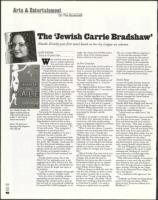
Top.- Natalie Krinsky: The
biggest similarity between
Chloe and herself, says the
author, is "our sense of
humor and sarcasm."
Above: The book cover
depicting Chloe draped in
only a fig leaf
6/30
2005
48
hat could be more mortify-
ing to a college sophomore
than receiving a phone call
from Mom and Dad about the essay
you published on oral sex?
Natalie Krinsky received just such a
call shortly after her witty but
raunchy sex columns for the Yale
Daily News began circulating on the
Web. And she hadn't yet broken the
news to her parents that she was the
Ivy League's Carrie Bradshaw.
"The power of the Internet is
unbelievable," says Krinsky as she
nurses a coffee at a hip bookstore cafe
in Manhattan's Soho, a few blocks
away from the "very small" apart-
ment she shares with friends. Less
than a year out of college, the olive-
skinned, auburn-curled Krinsky has
published Chloe Does Yale (Hyperion;
$19.95), a novel about — you
guessed it — a Yale sex columnist.
Fortunately for Krinsky, her parents,
former Israelis to whom the novel is dedi-
cated, soon recovered from the shock and
became remarkably good sports about
their daughter's extracurricular activity.
"They never told me to stop [writing].
It was more like, 'It's your decision,"' the
22-year-old recalls. "They recognized I
was good at it, and they're fine."
Now that their daughter is not just a
columnist, but also a novelist, the
Krinskys — in typical Jewish parent fash-
ion — are bragging about her to everyone
they know. Mrs. Krinsky, a fund-raiser for
the New York Jewish federation, made
sure her classmates in a professional devel-
opment course all read the book, while
Mr. Krinsky, an investment banker, is
pushing to have the book translated into
Hebrew.
Krinsky started writing "Sex in the
(Elm) City" her sophomore year, at the
suggestion of an editor friend at the Yale
Daily News. He gave her carte blanche, let-
ting her choose the length and topics of
her columns.
"I just did it how I thought other people
would like to read it," Krinsky recalls.
Soon, her clever, if rambling, columns
expounding on such issues as vibrator
shopping trips, drunken parties, pick-up
lines and oral sex were gaining a following
far beyond Yale's 5,000 undergrads. At its
height, the column had 350,000 readers
online. Many of the columns appear
almost verbatim in the novel.
In For Criticism
Although much of the novel's storyline is
fictional, the heroine and author share
more in common than their penchant for
writing about sex. Chloe has an Israeli
mother who constantly wants to know if
her daughter's romantic prospects are
"Jew-eesh," while the "first words out of
my mom's mouth always is, 'Is he Jew-
eesh?'" Krinsky says.
The biggest similarity between Chloe
and herself, Krinsky says, is "our sense of
humor and sarcasm."
So far, the book has gotten mixed
reviews. Booklist described it as a "sweet
and funny take on fledgling relationships
of all kinds," while the Houston Chronicle
slammed it as a "tired tale of a neurotic
coed sloshing through campus life," and
Publishers Weekly characterized it as "most-
ly a series of tired college party anecdotes,
punctuated by Krinsky's real-life
columns."
Krinsky is no stranger to criticism. "Sex
in the (Elm) City" generated its share of
controversy, with some people posting
angry or judgmental comments andletters
on the Yale Daily News Web site.
"When I wrote the column, I created a
character who was much more blase, more
confident than I was," Krinsky says.
"When people criticized the column, say-
ing things like 'How did you get into
Yale?' they didn't always realize they were
criticizing a 19-year-old girl with feelings.
I got a lot of criticism about me, not nec-
essarily the columns. At the end of the
day, it makes you stronger, but it hurts at
first."
Chloe is Krinsky's first novel and is actu-
ally her first piece of fiction longer than
25 pages. She pitched the novel to
Hyperion her junior year after a journal-
ism professor helped get her an appoint-
ment with a literary agent at the presti-
gious William Morris Agency.
With an advance in hand (she won't dis-
close the size), Krinsky sat down to write
over summer vacation. But it was slow
going at first. "It took a long time to fig-
ure out I was lonely," she recalls. "All my
friends were traveling or had jobs; where-
as, I had days by myself. I was used to
writing on a regular basis, but quickly.
This was a totally different experience."
By the time she returned to Yale's
Connecticut campus for fall semester,
she'd written only 60 pages, and the
• February deadline for the manuscript
loomed ominously. Fortunately, once
Krinsky was in the environment she was
writing about, the book fell into place
despite the competing pressures of school-
work, socializing and a senior thesis.
Israeli Roots
A native of Canada, Krinsky moved to
Manhattan's Upper East Side in high
school, when her father gave up an aca-
demic job in a sleepy town outside
Toronto to become an investment banker.
Krinsky, who is fluent in French as well as
Hebrew, attended the United Nations
International School.
Growing up with Israeli parents,
Krinsky didn't learn English until she was
4. Most of her relatives still live in the
Jewish state — mostly in Tel Aviv — and
Krinsky has visited frequently.
"I think Israelis are really funny," she
says fondly.
In fact, Krinsky/Chloe's views on Israelis
get a few lines in the novel: "Israelis are
loud and obnoxious and never stand in
lines," she writes. "They push at airports.
They yell but believe they are speaking at
normal volume. They tell you exactly what
they think, even if you never asked for
their opinion. Deep down inside, they are
generous, kind and funny, but I remind
you, these qualities are very deep."
Like most of her countrymen, Krinsky
describes herself as "pretty secular, but
with a strong [Jewish] cultural identity."
Her lack of religiosity will come as no
surprise to readers of the novel, in which
carousing and "hooking up" occur far
more frequently on Friday nights than,
say, services at the campus Hillel.
With Chloe done, Krinsky is turning her
attention to a new novel, this one about
three friends in their early 20s living in
New York. She's also become a columnist
again, writing a Web log for the Village
Voice on the adjustment from college cul-
ture to the big city.
"I'm a freshman at life right now," she
says.
"Suddenly, my friends are having dinner
parties with wine and cheese. What's
going on here? Everyone suddenly has a
Blackberry." U