

The Children's Hour
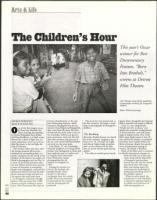
This year's Oscar
winner for Best
Documentary
Feature, "Born
Into Brothels,"
screens at Detroit
Film Theatre.
Left: Filmaker Zana Briski established
a photography workshop for Sonagachis
children.
Below: Briski and protege
GEORGE ROBINSON
Special to the Jewish News
0
ne of the first images we see
in Born Into Brothels, the
Oscar-winning documentary
by Jewish filmmakers Zana Briski
and Ross Kauffman, is a black screen
bisected by a slash of light that, on
closer inspection, turns out to be an
alley-like street in the red-light dis-
trict of Calcutta.
The tension within this shot, with
the human presence all but over-
whelmed by surrounding dark, is a
perfect metaphor for the world of the
children of the district, the subject of
Briski's photography and the film. In
a series of her black-and-white pho-
tos that follows shortly after, one has
a sense of humanity as something
fragile and endangered, a delicate but
threatened balance between the chil-
dren's innocent energy and the hos-
tile squalor that surrounds them.
In Sonagachi, Calcutta's red-light
district, there are more than 7,000
women and girls working as prosti-
tutes. Often forced into the trade by
3/10
2005
92
poverty, abandonment or the ram-
pant kidnapping business, which
transports young girls into the sex
industry from Nepal' and Bangladesh,
they come from all castes. But they
all descend the social scale to the sta-
tus of pariahs, without any govern-
ment protection. And only the chil-
dren who are born and grow up in
the rat- and vermin-infested brothels
are lower on the social scale.
Zana Briski, 37, the Cambridge-
educated daughter of an Iraqi Jewish
mother who immigrated to Israel and
later made her way to London and
an English father descended
from Polish Jews, began
photographing the sex
workers in Sonagachi in
1997.
Staying for months at a
time in the brothels, she
quickly became "Zana
Auntie" to the kids, a
touchstone from the outside
world. They were particular-
ly fascinated by her cameras
and the photographs she
produced.
The attraction was mutual and, as
the film recounts, she began a work-
shop in photography for Sonagachi's
children.
The Backdrop _
Born Into Brothels focuses on a hand-
ful of her students, ranging in age
from 10 to 14. The kids are bright
and almost frighteningly articulate.
And, on the evidence of the film,
they are pretty darned good photog-
raphers.
The odds are stacked pretty heavily
against them. Sonagachi's gravitational
field is powerful and escape is difficult.
Gour, 13, says emphatically,
"People here live in chaos," and
despite the ostensible modernization
of social attitudes, caste still looms
large in Indian society. One of the
film's more bleak ironies is that 10-
year-old Kochi's family is considered
somewhat more exalted within the
district because, despite four genera-
tions of prostitution among its
women, the family is Brahmin.
Much of the film's story is centered
on Briski's determined attempts to
break the kids out of the cycle
of sex work and the black hole
of Sonagachi, getting them
entered into the very few board-
ing schools that will accept
them and raising money for
continuing the workshops by
displaying and selling prints of
the children's photos.
When her prize pupil, the
mischievous 12-year-old Avijit,
is selected to represent India in
an exhibit and conference of
child photographers in