

Arts Life
Video Invasion
Ann Arbor Film Festival expands its scope of movies.
DON COHEN
Special to the Jewish News
Ann Arbor
W
4114
3/10
2005
90
hen the 43rd annual Ann
Arbor Film Festival opens
on March 15 for a six-day
run at the Michigan Theater in
downtown Ann Arbor, the second-
oldest film festival in the country will
show it has changed with the times.
For the first time, the festival has
accepted works on video in addition
to those on film. Last year, the festi-
val had about 300 entries, almost all
on 16 mm film. Organizers predicted
about 1,000 entries this year because
of the inclusion of video, but more
than 2,000 entries were received,
mostly on video or DVD. About 125
will be selected for exhibition during
festival week.
"We've seen an onslaught of sub-
mitted video work," says Dan
Marano, festival executive director.
"Today, anyone with access to a
computer can set up a blog or Web
site and become [his or her] own
journalist, and all you need is a video
camera and digital tape and you can
make movies," he explains. "It gives
people a whole new palette of tools to
work with."
As if to prove his point, one of this
year's jurors is 31-year-old gay Jewish
filmmaker Jonathan Caouette, whose
highly personal and widely acclaimed
2004 film, Tarnation, a documentary
memoir about his often hellish child-
hood cobbled together from home
movies, was made at home on his
Apple computer's iMovie program.
Marano, 35, and his fiancee moved
to Ann Arbor in 2002 from Taos,
N.M., where he headed the popular
and well-regarded Taos Talking
Pictures film festival. He became
director of the Ann Arbor festival in
November 2004.
Founded in 1963 at the University
of Michigan School of Art by film-
maker/artist George Manupelli —
who will return this year as judge
emeritus — the festival showcases all
categories of independent and experi-
mental film.
It includes free afternoon presenta-
tions where jurors screen and discuss
their own films, as well as seminars,
workshops, art installations, dancers,
musicians, performance artists and a
silent auction. A unique element of
the festival is that winners go on the
road, with theaters across the country
showing the top films.
"We provide a venue for truly
unique work with truly individual
voices," says Marano, likening experi-
mental film to the bark of a tree. "It's
always alive at the fringes. And what
is experimental now is deadwood
later.
"Sure, locally our audience includes
students and intellectual academic
types, but there is a huge audience of
people who trek to Ann Arbor
because it is one the best venues to
see the type of work we present."
But don't get scared away by the
term "experimental."
"The festival is a mix," Marano
says. "Much of what we show is
documentaries and other works on
important issues that are marginal-
ized by mainstream culture."
An example is The Future of Foot4 .
which Marano says deals with an
"issue of global significance and is
far more interesting and complex
than one would think." Another
certain to generate discussion is
Israeli Avi Mograbi's eight-minute
film Details, which the festival pro-
gram calls "a detail of a bigger pic-
ture:" It deals with a family's effort to
get a sick relative through an Israeli
checkpoint in the West Bank.
"The people who do the most with
cinema are those who have been mar-
ginalized," says Marano. "They usual-
ly have the most to say and the most
interesting stories.
"There has always been an overrep-
resentation of Jews in cinema, and
every year that I've curated a festival,
there has been a disproportionate
involvement of Jews, particularly with
documentaries and family histories,"
he says.
Marano also credits this to Jewish
history and culture and the tradition
of debating and dissecting Scripture.
"In our tradition, you argue with
people you respect," Marano says.
"You want to shift ideas and you are
raised to have strong beliefs. There
are other very educated people who
take a very different approach to con-
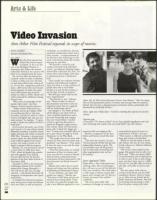
Above, left: A2 Film Festival Executive Director Dan Marano: "There has always
been an overrepresentation ofJews in cinema, • and every year that The curated a
festival, there has been a disproportionate involvement of Jews, particularly with
documentaries and family histories."
Above, right: Juror Shelly Silver: "I look for something that surprises me and has
artistry"
Opposite page:
A scene from "The Future of Food"• It's an "issue of global significance and is far
more interesting and complex than one would think," says Dan Marano.
versational life and religious life."
Marano is supportive of the Ann
Arbor and Detroit Jewish film festi-
vals.
"The more the merrier," he says.
"To have growth of film festivals and
independent theaters is great. We
can't possibly cover all the ground,
and we take pride in knowing that
other organizations exist and are
flourishing."
Juror Applauds Video
Shelly Silver, a New York-based artist
utilizing video, film and photogra-
phy, will serve as one of the festival's
three jury members. Her work spans
a wide range of subject matter and
genres and, though only 47, she is a
veteran innovator who exhibits
worldwide.
"My work often deals with
moments of change or tension, per-
sonal political point of view or a
combination of both," she says.
"This tension is reflected in both the
form and content of each film."
While her Jewish family is decid-
edly atheist, she sees its very strong
Jewish culture as a definite influence
on her work.
"My work is often based on lan-
guage. My people tend to talk a lot,"
Silver says. "There are always differ-
ent permutations and interpretations
to what is said. I like to pick things
apart and have them seen in a differ-
ent way. It's just like rabbi so-and-so
said this, and rabbi so-and-so said
that."
Her one major work with an
overtly Jewish theme was the 2001
installation Rooster, which is based
on an 18th-century Jewish tale by
Rabbi Nachman of Breslov. She will
be showing and discussing a video
from the piece, along with other