

Iraqi Ballots
Some Iraqi Israelis go to Jordan to cast their votes.
Jewish state, where optimism at the fall of Saddam
Hussein has been replaced with unease at seeing
Iraq descend into sectarian fighting and jihadi ter-
rorism.
"It may have been too early for us to have
declared the Eastern Front pacified," said a senior
Israeli official on condition of anonymity, refer-
ring to earlier assessments that with a peace deal
in place with Jordan and a U.S.-friendly adminis-
tration in Baghdad, Israel was no longer at risk of
invasion from the east.
Avigdor Lieberman, a lawmaker with the right-
wing
National Union bloc, has warned that a tri-
Jewish Telegraphic Agency
umph by Iraq's Shi'ite majority could link them to
Tel Aviv
anti-Israel coreligionists in Iran and the Lebanese
militia Hezbollah.
rag's first democratic election is over, but the
"We have to be prepared for an even greater
impact of the Iraqi vote on Israel remains to
strategic threat, a `Shi'ite belt' all the way from the
be seen.
gulf to the Mediterranean," Lieberman said at a
Jacky Hugi crossed borders, both international
security conference in Herzliya last month.
and cultural, to take part in Iraq's_ first democratic
But a veteran Arab affairs analyst gave a slightly
election.
rosier prediction for post-election Iraq.
But don't expect the Israeli journalist, who cast
"If day-after wisdom pre-
his absentee ballot in Amman,
vails, this could lead the
Jordan, to reveal which of the
majority Shi'ite parties to get
111 parties he backed in in the 8
over past hatreds and incor-
Jan. 30 landmark vote.
porate representatives of the
"I am very hopeful that this
Sunni minority in political
is a new day for Iraq and its
life," said Smadar Peri of
relations with Israel," said
Yediot Achronot. "If the
Hugi, the son of Iraqi Jewish
Sunnis are not brought in,
immigrants.
Iraq will not know a day of
"But I think it would be
quiet."
unwise at this point to go pub-
With Iraqis turning out to
lic with which government I,
vote despite an unprecedent-
an Israeli, want to see installed
ed wave of terror, at least one
in Baghdad. I don't want to
Israeli exulted. "Everything
prejudice any Iraqis against
seemed
like a particularly
this-or-that party even before
hallucinatory dream," said
the election is over," said the
Shahar Smooha of Ha'aretz,
Ma'ariv correspondent.
like Hugi an Iraqi expatriate
With their country still not
who cast a ballot in Amman.
officially recognized by Iraq,
"Only my black finger
only a handful of some
reminds me what a celebra-
244,000 eligible Israelis voted
tion of democracy I took part
as absentees, in Jordan, the
in a few hours ago," he said,
United States and Britain.
describing the indelible ink
But the election provoked
used to prevent voter fraud. 0
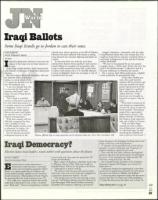
Election officials help an Iraqi expatriate cast his absentee ballot Jan. 28 in New Carrollton, Md.
widespread interest in the
DAN BARON
I
Iraqi Democracy?
Election leaves local leaders, noted author with questions about the future.
DON COHEN
Special to the Jewish News
33
lections do not make democracies —
democracies make elections," cautioned
author and investigative researcher Edwin
Black to an upbeat gathering of Chaldean and
Jewish leaders brought together by the American
Jewish Committee Metropolitan Detroit Chapter
the morning after the Iraqi elections on Jan. 30.
"The single most important feature that would
make Iraq a democracy is not a vote, it is plural-
ism," Black said. "There is a long history of intoler-
ance in that area. You name the generation, I'll
name the bloodbath."
Black, author of Banking in Baghdad: Inside Iraq's
7,000-year History of War, Profit and Conflict, is
hopeful history will not be the guide to the future
— although he is afraid it will be.
"My prayer is that the past will convince them
that now is the time to live with their neighbors in
a pluralistic democratic fashion," he said.
"Our people were not the ones dancing, at least
not yet," said Martin Manna, executive director of
the Farmington Hills-based Chaldean American
Chamber of Commerce, referring to pictures of
Iraqis dancing at the Southgate building where local
Iraqis could vote in the Iraq elections.
"A majority of the population has a wait-and-see
attitude," he said, noting that only 10 percent of
eligible Chaldeans registered and voted.
Even with the late notice, disarray and logistical
problems that hurt the local turnout, he had hoped
for more. "A lot of people are a little worried. We
still have a long way to go," he said.
But if Joseph Kassab, president of the Chaldean
National Congress of Michigan, was worried, he
didn't show it.
Calling the election the beginning of a new dem-
ocratic era, he joked that previously the only choice
for voters was "between Saddam and Saddam."
Comparing those oppressive times with the recent
election that had 111 slates and 7,000 candidates,
"it looks like democracy has taken root in Iraq," he
IRAQI DEMOCRAY?
on page 38
trn
2/ 3
2005
37