

A Great Need
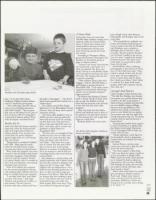
Brandon and Christopher play dreidel.
Sept. 14, the day before Rosh
Hashanah. Rabbis Jonathan Berkun
and Eric Yanoff also participated.
"They really began the New Year as
Jews; it was a beautiful experience,"
said Rabbi Krakoff. "They are great
kids, and we felt blessed to be a part of
their ceremony. We love seeing them
in stud and in Hebrew school. We've
really developed a wonderful bond."
Reality Sets In
Andy and Libby had always wanted to
adopt and, when the timing seemed
right, they began what became an
arduous process. They say they were
turned down by private adoption
agencies eight times in a row because
they were Jewish.
"Being Jewish is considered a liability,"
said Libby. "Many agencies would
rather have the kids remain in foster
care than place them in a Jewish home."
What made this adoption even more
unusual is that the Beiders had already
raised three daughters: Marla Bentley,
who lives with her husband, Newell,
in Canton; Rachel, who is a student in
New York; and Shoshana, who attends
Michigan State University.
None of the Beiders was prepared
for the emotional problems common
with adopting older children who have
been in multiple foster-care situations.
"I was their ninth 'dad,' and Libby
was their 12th 'mom,'" said Andy.
"Brittany had functioned, in effect, as
their mother. The best word to
describe what these children had been
through is `Maytagged' — like they'd
been tossed around and around as in a
clothes dryer.
The children attend West Maple
Elementary in the Birmingham School
District, where all three receive special
education services.
"Our three older daughters went to
Hillel, but that wasn't an option for
these kids because of all the catching
up they had to do. They had never
gone to the same school for even one
year," said Andy, who is a senior vice
president at Smith Barney in
Farmington Hills.
We were naive; we thought all they
needed was love, but we realize now
they need a lot more than that; they
don't even know what real love is,"
said Libby. "They know how to get
out of a home, but they don't know
how to stay in one, so the testing
behavior is constant. Everything they
do is an attempt to control their sur-
roundings because they never had any
control before."
Kay Tulupman, a social worker and
clinical supervisor with Catholic Social
Services who worked in adoption and
foster care for 16 years, said, "Older
children who are adopted have a very
difficult time forming attachments. As
Jews, we have survived in large part
because of our history. These kids have
no history, they have nothing to grab
on to. They believe that they must be
unlovable because even their own
birth mother didn't want them. They
are terrified of being rejected again."
3 )
Statistically, there are more than
100,000 older children waiting to be
adopted within the United States,
many of whom have serious emo-
tional problems because of their
early backgrounds and the years
spent bouncing around the foster
care system.
According to Tulupman, sibling
groups like Brittany, Christopher and
Brandon are the hardest group to
place in adoptive homes.
"Patience' and 'mercy' have become
my watchwords," said Andy. "Is it
what we expected? No, but is any-
thing? The key is to be flexible, adjust
your expectations and keep your sense
of humor. The capacity that love has
to stretch is amazing."
"Older children always come with
baggage," said Dr. Mitchell Parker, a
psychologist in private practice in
Bloomfield Hills. "They need a warm,
supportive environment with loving
parents, lots of patience and good
support services."
The Beiders also belong to Knesset
Israel in Petach Tikvah in Israel. They
plan to take the children to Israel
when Brittany becomes a bat mitzvah,
as they did with their three older
daughters.
Libby and Andy said that Marla,
Rachel and Shoshana were in favor of
the adoption, but they find it hard to
see their parents face such tough chal-
lenges on a daily basis.
Shoshana Beider was in her senior
The Beiders' older daughters, Shoshana,
Rachel and Marla
year of high school when Brittany,
Christopher and Brandon came to live
with them.
"The household was suddenly very
noisy, and I found myself going out
more to study or be with my friends,"
said Shoshana, now a student at
Michigan State University in East
Lansing. "But the situation also gave
me the boost I needed to get out on
my own more. I support my parents'
decision because I love them, and I
really hope we can provide a stable
home for the kids."
Rachel Beider, who is studying
photography at the School of Visual
Arts in New York City, said, "They
asked us ahead of time and, for the
most part, we were supportive. I
know it hasn't been easy for them,
but I look up to them. I don't think
I could do it; I don't think many
people could. But if anyone can do
this, they can."
Strength And Patience
Oldest daughter Marla Bentley said,
"The kids love Shabbat; they learned
the prayers very quickly because they
wanted to be able to participate. I
think of them as family, but more like
my own children than as siblings
because of the age difference. The
adoption has caused a tremendous
strain on our family, but our parents
have proven over and over again how
strong and patient they are. I'm always
amazed. And my dad has become a
better father."
Realizing they needed more support
in their household on a regular basis,
the Beiders hired Joseph Saperstein,
20, of Farmington Hills to help, pri-
marily with the boys.
"Joseph represents a male figure in
the household, which is desperately
needed when my husband isn't home,"
said Libby.
Jennine Powers, a private tutor,
comes over every day to help the chil-
dren with their homework.
"Do I have regrets?" asked Andy.
"Life is too short for regrets. Loyalty is
a very rare quality in people today.
When I give my word, I don't go back
on it. Instead I've had to adjust my
expectations. The tree that is flexible
lasts through the storm, the trees that
are unable to bend will break, and I
don't intend to break."
When asked what advice he would
give prospective adoptive parents,
Andy said, "Adjust your expecta-
tions, and don't look for your own
immediate fulfillment. You're not
doing this for yourself, you're doing
it for them." II
12/24
2004s
15