

The Swarming Dinner
Locusts are pests but also delicacies for Israelis.
Kosher Question
ARI Z. ZIVOTOFSKY
Special to the Jewish News
Jerusalem
ecent headlines reported a massive aeri-
al invasion from Egypt that Israel was
attempting to repel with five small
Piper Cub aircraft, just two weeks after Cyprus
had similarly been attacked.
Yet the only ones seriously concerned in Israel
by the invasian from North Africa were some
southern farmers and a panicked Ministry of
Agriculture.
In sharp juxtaposition was the eager anticipa-
tion of some Yemenite and Moroccan Jews and
non-Jewish Thai workers. The huge swarm of
locusts was swept by winds across the Sinai into
the southern Israeli city of Eilat and up the
Arava plains along the Jordan River.
Desert locusts (Scistocerca gregaria) evoke
strong, but conflicting reactions. The image
often evoked is that of devastation — after all,
the eighth of the 10 biblical plagues to strike the
Egyptians was locusts and the biblical book of
Joel describes an utterly destructive locust
plague. Devastating locust invasions have been
recorded throughout history. Normally, these
small insects live solitary, boring lives in parts of
northern Africa and the Arabian Peninsula. But
when conditions are right, they undergo a phys-
ical metamorphous that transforms them from
desert loners into swarming instruments of
destruction.
Each two-gram locust can eat its weight daily,
and a swarm can consist of millions or even bil-
lions of insects.
Contrast this image of destruction with the
pleasant associations evoked for many North
African and Yemenite Jews. The sight of the first
major Israeli locust plague since 1959 has rekin-
dled fond memories of a savored culinary treat.
Westerners don't usually think of grasshoppers
as part of a kosher diet; but along with animals
that chew their cud and have split hooves, fish
with fins and scales and certain birds, the Torah
identifies four distinct types of locusts that are
kosher and provides signs by which to recognize
them.
These are listed in the Talmud and include:
four walking legs, two additional jumping legs
and four wings that cover most of the body.
Later, in the 13th century, a new sign
appeared in writing in Yemen, although it most
likely existed earlier in oral form. The presence
of the Hebrew letter chet on the thorax of the
locust was considered a definitive sign that it
was the kosher species.
So why is locust salad not as familiar to
us as lamb chops? Because there is one
more requirement — in order to identify
a kosher locust there must exist an
unbroken tradition (mesorah) passed
from generation to generation regarding
the identity of the correct species.
Locusts share many features with fish:
They are pareve, there is no requirement
to ritually slaughter them and their
brachah is she'hakol. They are also an
excellent protein source.
It is absence of a mesorah that has pre-
vented most Ashkenazim from eating
locusts. Plagues were a regular feature in
the lives of non-Ashkenazik Jews, and
they successfully preserved the mesorah
until today. There is continuous evidence
in rabbinic writings attesting to the con-
sumption of locusts in all of the
Mediterranean countries throughout his-
tory. There is also evidence of this in
non-Jewish literature. For example, in
1694 a German scientist was interview-
ing inhabitants of the Middle East and
recorded that a Jew from Safed described
to him how the Jews know which are the
kosher locusts. In 1766, Rav Aharon
Perertz (d. 1766) of Djerba (Tunisia)
wrote: "And I thought that the whole
world ate it [locusts] ... And I too liked
eating them more than all other treats."
Ashkenazik authorities, on the other
hand, continually record a lack of a tra-
dition and no consumption of locusts.
With the ingathering of our exiles,
there are few Jews left in Eastern Europe
and North Africa/Yemen; members of
both communities now coexist in Israel.
This has raised both the question of
Ashkenazim eating locusts and the con-
cern that the mesorah that was carefully
guarded for millennia will now be lost.
R
12/ 3
2004
28
Unlocking The Mystery
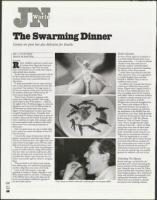
These locusts are kosher and with a culinary flair can be quite edible.
Several years ago, my friend Dr. Ari
Greenspan and I started researching the
history and laws of this unusual kosher
treat. Along the way, we met Dr. Zohar
Amar from Bar-Ilan University's Land of
Israel Studies program. He is of Yemenite
origin and had been systematically inter-
viewing older Yemenites and North
African Jews in an attempt to identify
and preserve the vanishing tradition.