
wish famili
Something To Sing A
A great new songbook can bring Jewish music to your family.
ELIZABETH APPLEBAUM
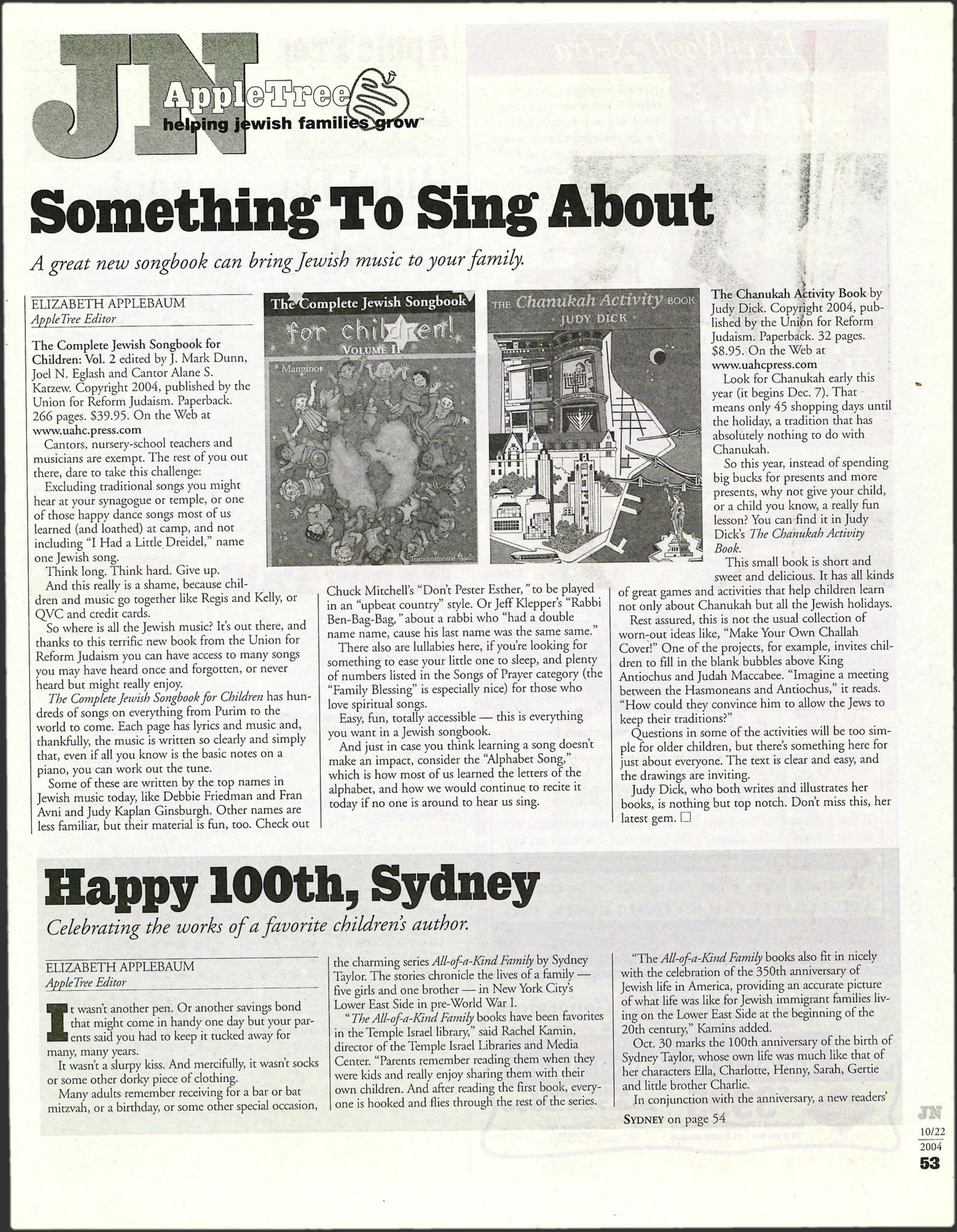
The Chanukah Netivity Book by
Judy Dick. Copyright 2004, pub-
lished by the Uni4. for Reform
Judaism. Paperback. 32 pages.
$8.95. On the Web at
yvww.uahcpress.com
Look for Chanukah early this
year (it begins Dec. 7). That
means only 45 shopping days until
the holiday, a tradition that has
absolutely nothing to do with
Chanukah.
So this year, instead of spending
big bucks for presents and more
presents, why not give your child,
or a child you know, a really fun
lesson? You can find it in Judy
Dick's The Chanukah Activity
The omplete Jewish. Songbook
App leTree Editor
The Complete Jewish Songbook for
Children: Vol. 2 edited by J. Mark Dunn,
Joel N. Eglash and Cantor Alane S.
Katzew. Copyright 2004, published by the
Union for Reform Judaism. Paperback.
266 pages. $39.95. On the Web at
www.uahc.press.corn
Cantors, nursery-school teachers and
musicians are exempt. The rest of you out
there, dare to take this challenge:
Excluding traditional songs you might
hear at your synagogue or temple, or one
of those happy dance songs most of us
learned (and loathed) at camp, and not
including "I Had a Little, Dreidel," name
one Jewish song.
Think long. Think hard. Give up.
And this really is a shame, because chil-
dren and music go together like Regis and Kelly, or
QVC and credit cards.
So where is all the Jewish music? It's out there, and
thanks to this terrific new book from the Union for
Reform Judaism you can have access to many songs
you may have heard once and forgotten, or never
heard but might really enjoy.
The Complete Jewish Songbook for Children has hun-
dreds of songs on everything from Purim to the
world to come. Each page has lyrics and music and,
thankfully, the music is written so clearly and simply
that, even if all you know is the basic notes on a
piano, you can work out the tune.
Some of these are written by the top names in
Jewish music today, like Debbie Friedman and Fran
Avni and Judy Kaplan Ginsburgh. Other names are
less familiar, but their material is fun, too. Check out
Chuck Mitchell's "Don't Pester Esther, to be played
in an "upbeat country" style. Or Jeff Klepper's "Rabbi
Ben-Bag-Bag, "about a rabbi who "had a double
name name, cause his last name was the same same."
There also are lullabies here, if you're looking for
something to ease your little one to sleep, and plenty
of numbers listed in the Songs of Prayer category (the
"Family Blessing" is especially nice) for those who
love spiritual songs.
Easy, fun, totally accessible — this is everything
you want in a Jewish songbook.
And just in case you think learning a song doesn't
make an impact, consider the "Alphabet Song,"
which is how most of us learned the letters of the
alphabet, and how we would continue. to recite it
today if no one is around to hear us sing.
Book.
This small book is short and
sweet and delicious. It has all kinds
of great games and activities that help children learn
not only about Chanukah but all the Jewish holidays.
Rest assured, this is not the usual collection of
worn-out ideas like, "Make Your Own Challah
Cover!" One of the projects, for example, invites chil-
dren to fill in the blank bubbles above King
Antiochus and Judah Maccabee. "Imagine a meeting
between the Hasmoneans and Antiochus," it reads.
"How could they convince him to allow the Jews to
keep their traditions?"
Questions in some of the activities will be too sim-
ple for older children, but there's something here for
just about everyone. The text is clear and easy, and
the drawings are inviting.
Judy Dick, who both writes and illustrates her
books, is nothing but top notch. Don't miss this, her
latest gem.
❑
Happy 100th, Sydney
Celebrating the works of a favorite children's author.
ELIZABETH APPLEBAUM
AppleTree Editor
I
t wasn't another pen. Or another savings bond
that might come in handy one day but your par-
ents said you had to keep it tucked away for
many, many years.
It wasn't a slurpy kiss. And mercifully, it wasn't socks
or some other dorky piece of clothing.
Many adults remember receiving for a bar or bat
mitzvah, or a birthday, or some other special occasion,
the charming series All-of-a-Kind Family by Sydney
Taylor. The stories chronicle the lives of a family —
five girls and one brother — in New York City's
Lower East Side in pre-World War I.
"The All-of-a- Kind Family books have been favorites
in the Temple Israel library," said Rachel Kamin,
director of the Temple Israel Libraries and Media
Center. "Parents remember reading them when they
were kids and really enjoy sharing them with their
own children. And after reading the first book, every-
one is hooked and flies through the rest of the series.
"The All-of-a- Ki nd Family books also fit in nicely
with the celebration of the 350th anniversary of
Jewish life in America, providing an accurate picture
of what life was like for Jewish immigrant families liv-
ing on the Lower East Side at the beginning of the
20th century," Kamins added.
Oct. 30 marks the 100th anniversary of the birth of
Sydney Taylor, whose own life was much like that of
her characters Ella, Charlotte, Henny, Sarah, Gertie
and little brother Charlie.
In conjunction with the anniversary, a new readers'
SYDNEY on page 54
10/22
2004
53