

gjr
wish famili
All About Yom Kippur
ELIZABETH APPLEBAUM
AppleTree Editor
What We Observe: Yom Kippur is
literally the day of atonement (yom in
Hebrew means "day," and kippur
means "atonement").
Ift When We Observe: This year, Yom
Kippur falls on Shabbat. It begins the
evening of Friday, Sept. 24, and ends
the evening of Saturday, Sept. 25.
t Why We Observe: The command-
ment to observe Yom Kippur is in the
Torah in Leviticus 16:29, and Numbers
29:7. Also see Leviticus 16:30-34,
- 23:26 32, and Numbers 29:8-11.
Rites And Rituals: The command-
ment to observe Yom Kippur includes
the directive to "afflict yourselves."
The rabbis interpreted this to mean
five things: no food or drink (includ-
ing smoking), no wearing leather
shoes, no bathing for pleasure, no
marital relations, no anointing with
oils (in ancient times, people used oil
to clean and perfume the skin).
Persons on a regimen of medication
or who are in poor health should con-
sult their rabbi and physician for the
proper procedure for taking medicine.
Like all Jewish holidays, Yom
Kippur includes extra prayers and a
Torah reading. The prayers of Yom
Kippur, however, are the longest of
any day in the year.
A significant feature of the Yom
Kippur liturgy is the vidui, or confes-
sion. This consists of two parts:
Ashamnu ("We have trespassed"), an
alphabetically arranged list of sins; and
Al Cheit ("For the sin"), a long inven-
tory of transgressions, accompanied by
beating of the breast. The confession
is recited at all services of Yom Kippur.
Along with Rosh Hashanah, Yom
Kippur is the only day we prostrate
ourselves in prayer (in a modified
form) as was done in the days of the
Beit HaMikdash, the Holy Temple in
Jerusalem. The prostration, which
consists of kneeling and touching the
forehead to the floor, is done during
the cantor's repetition of the Musaf
service.
Yom Kippur includes two unique
prayer services: Kol Nidrei, which
begins Yom Kippur and in which we
nullify all personal vows for the corn-
ing year, and Neilah, which closes the
holiday. Yom Kippur ends with a blast
of the shofar.
tality, because burial shrouds are
white; it also is a symbol of purity,
because we hope that God will forgive
our sins and restore us to lives of
virtue.
It is customary to greet one another
with the words "GMar chatima tova,"
or, "May your fate be sealed for the
good." Some shorten the greeting to
simply, "G'mar tov."
I Customs Of The Day: It is tradi-
tional on Yom Kippur to wear white.
This serves as a reminder of our mor-
Thematic Significance: Yom Kippur
is the day when God seals the decision
V
8
0
o .
He made on Rosh Hashanah regard-
ing the fate of every person.
On the High Holidays, we consider
the Book of Life, which contains the
name of every man, woman and child.
On Rosh Hashanah, God decides the
fate of each person, and on Yom
Kippur, He seals His decision.
Although it is generally thought that
Yom Kippur (unlike other holidays
such as Pesach, Chanukah and Purim)
does not commemorate a historical
event, traditionally we believe that
Yom Kippur is the anniversary of
God's forgiving the Jewish people their
first disastrous, national sin — the
building of the golden calf.
Moses scolded the people, destroyed
the tablets of the Torah and went back
up the mountain a second time to
pray for God's forgiveness and to
receive new tablets (Exodus 32:30-35).
Moses returned to the people, then
ascended the mountain a third time
(Exodus 34). Moses prayed for God to
grant the Jewish people atonement.
After 40 days, God erased the collec-
tive sin of the Jews and Moses
returned to the people on the 10th of
Tishrei, Yom Kippur.
I On The Web: Want more informa-
tion on Yom Kippur?
Adults may want to check out
www.ou.orgichagim/yonilcippur/
defaulthtm Though affiliated with
the Orthodox Union, this site offers a
variety of voices, for beginners and
advanced readers, as well as an inter-
esting information, ranging from facts
about the High Priest's Temple Service
to customs of erev Yom Kippur. Also
check out the Yom Kippur stories.
Children can visit
www.torahtots.com This site has
great art and even allows you to hear
Kol Nidrei. Parents should note, how-
ever, that this may not be for everyone
as it discusses at length sacrifices in
the Holy Temple and kapporot (a little
observed custom of killing a chicken
in sacrifice for one's sins, then donat-
ing the meat to a poor family.) El
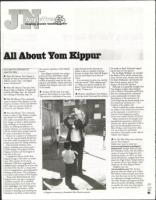
A kapparot ceremony in Jerusalem's Mea Shearim quarter.
JR
9/24
2004
51