
Spirituality
MAKING
Cover Story
Room from page 113
Rabbi Alon Tolwin, Aish's execu-
tive director, said, "The unaffiliated
who only attend High Holiday serv-
ices are not attending to be social or
out of membership loyalty. They are
not looking to be part of a big fash-
ion show with a rabbi who does all
the talking," he said. "They are
looking for a meaningful experience.
They believe — correctly — that
Judaism owes them that."
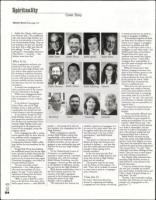
Rabbi Syme
Rabbi Nevins
Rabbi Spolter
Rabbi Klein
Where To Go
4114
9/10
2004
114
Most congregations welcome non-
members in one way or another.
Some sell or give High Holiday tick-
ets; others create special non-mem-
ber services or extend an invitation
to attend Yizkor or youth service at
no cost. Still others may have limit-
ed seats available and may stipulate
the least-busy times for non-member
attendance.
At several area synagogues stu-
dents and those new to the commu-
nity are welcomed at no charge.
While most congregations hope
the non-members will later join
their synagogues, it is not a stipula-
tion.
At the Reform Congregation
Chaye Olam, the cost of High
Holiday tickets is deducted from
membership dues should the indi-
vidual choose to join the synagogue.
At the Reform Temple Kol Ami,
High Holiday tickets are not sold,
but prospective members are given a
free 90-day trial membership, which
includes High Holiday tickets and
participation in all programs and
events of the synagogue, except the
religious school.
A few congregations offer a unique
service geared solely for those who are
not members of the congregation.
For example, Conservative
Congregation Shaarey Zedek is offer-
ing a service for non-members for the
first time.
Temple Beth El has been holding
an unaffiliated service for the last eight
years, spurred by Rabbi Daniel Syme's
memories as leader of an unaffiliated
service at the Conservative Isaac Agree
Downtown Synagogue, even before he
entered rabbinical school.
"Services were held at Ford
Auditorium — for 1,000 people —
who were not 'members of a syna-
gogue," he said. "I never forgot the
experience of being there for those
who had nowhere else to go.
"When I came to Beth El, I said I
have to do this here. Ever since, we've
held a special service — with 400-600
Rabbi Shemtov Rabbi Tolwin
Rosenberg
Usher
people — welcoming those who are
not members of a congregation on the
High Holidays."
While congregations typically
include High Holiday seating with
memberships, a few, mainly those
affiliated with the Orthodox Chasidic
Chabad movement, do not ask con-
gregants to pay membership dues and
therefore do not issue High Holiday
tickets.
"At the Chabad Jewish Center of
Commerce, no membership is
required to attend services," said Estie
Greenberg, who, with her husband,
Rabbi Schneor Greenberg, runs the
synagogue. "Services are free and open
to all regardless of affiliation, during
the year and on the High Holidays."
While formal membership is new at
the Shul-Chabad Lubavitch, the
majority of the 800 congregants
expected at the Orthodox synagogue
during the course of the High
Holidays will be unaffiliated.
"We understand that finances are
Rabbi Silberberg Yamron
Greenberg
Schindler
needed to operate our synagogue, but
we want to be a place where Jews can
be together with other Jews and not
have that stand in the way of their
participation," said Rabbi Kasriel
Shemtov.
"Our goal is to welcome the unaf-
filiated and hope they become more
involved in Judaism — and also that
they feel comfortable and welcomed
enough to keep coming and to
become members."
In the two years since the Shul
opened its doors, Rabbi Shemtov said
many who started as High Holiday-
goers now are members.
"One person came for two years
only for Yizkor on Yom Kippur," he
said. "Then, all of a sudden, he started
to come twice a week as a congregant
and a volunteer."
rome Join Us'
For some, whose lives have been
devoted to organizing and leading
congregations, the concept of wanting
to attend services but not work to
sustain a synagogue is baffling.
"It has always surprised me there
are those who, for whatever reason,
choose not to support a synagogue
and insure its stability and well-
being, yet still expect there to be a
synagogue to serve their needs," said
Rabbi Joseph Klein of the Reform
Temple Emanu-El, where non-
members may attend Yom Kippur
afternoon services. "I don't feel a
synagogue has a responsibility to
serve the needs of people who don't
care if it exists or not."
While the Conservative Adat
Shalom Synagogue welcomes hun-
dreds of non-member guests on the
High Holidays and will make
accommodations for those with dif-
ficulty paying for tickets, Rabbi
Daniel Nevins is frustrated that
there are unaffiliated Jews.
"Most Jews want the services of
synagogue and a rabbi at lifecycle
events and major holidays and feel
better knowing there is a congrega-
tion nearby, even if it is 'the shul I
don't go to,"' he said. "Yet many feel
no inclination to identify with those
institutions and no responsibility to
support them."
Far beyond the institutional con-
cerns are those he feels for Jewish
families.
"Those minimally affiliated Jews
are placing the Jewish identity of
their families in great jeopardy by
staying at the periphery of our com-
munity," Rabbi Nevins said. "The
only way to preserve Jewish identity
is to make it meaningful. And the
only way to make it meaningful is to
give it the spiritual, intellectual and
communal depth that it deserves."
Rabbi Nevins' concerns are that
those who attend only High Holiday
services "want their religion a la carte.
They select the experiences they want
and find the place and the professional
who can provide it," he said. "They
really don't care about ideology all that
much. They just want a warm experi-
ence with minimal commitment."
But Charles Usher maintains that
attending High Holiday services at
Aish Detroit is a step upward in his
Jewish observance.
"I may not attend services during
the year, but I consider my myself a
Jew, and I believe in Jewish tenets, and
I like to think I do good things on a
daily basis," he said.
"Besides, I don't remember reading
anywhere that God says you must be a
member of a congregation to be a
good Jew."
Scanned image of the page. Keyboard directions: use + to zoom in, - to zoom out, arrow keys to pan inside the viewer.
September 10, 2004 - Image 118
- Resource type:
- Text
- Publication:
- The Detroit Jewish News, 2004-09-10
Disclaimer: Computer generated plain text may have errors. Read more about this.