
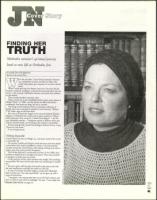

FINDING HER
TRUTH
Methodist minister's spiritual journey
leads to new life as Orthodox Jew.
ELIZABETH APPLEBAUM
Special to the Jewish News
hen she was little, Cecelia Futch dreamed of becom-
ing a Methodist minister, just like her father. She
would help people, give sermons, be an active church
leader.
When Cecelia grew up, her dreams came true. Not only did she
become a minister, working at a church she loved and where she was
loved — she married a Methodist minister and raised three children
in the church.
Then Cecelia decided to become a Jew.
Today, Cecelia sits in her Southfield kitchen where every cabinet is
labeled "Meat" or "Milk," and the shelves are filled with kosher
cookbooks. Her sleeves are long, her hair is covered.
The living room's bookcases hold an impressive collection of
Jewish texts, and a mezuzah is attached to each doorway. "Shalom
rail" reads a sign on the front door.
She came to Detroit last August so her second husband, Richard
Rogow, an Orthodox Jew, could study nuclear medicine at Wayne
State University. Now, at age 51, Cecelia Futch-Rogow — the for-
mer Methodist minister — substitute teaches at Yeshivat Akiva and
Yeshivas Darchei Torah, two Orthodox day schools in Southfield.
By becoming Jewish, Cecelia Futch-Rogow believes she has, at last,
"found my way home."
It was a long journey.
Nothing Impossible
Cecelia Futch was born in Hodge, La., and spent much of her youth
in Louisville, Ky.
Her parents, Ladelle and Patricia, loved adventure and were deeply
curious about the world and different cultures. The Futch family
traveled around the United States, often taking nothing more than a
replica tepee they built and their backpacks.
The Futches believed in community activism. In the 1960s, they
worked on behalf of the civil rights movement. They were involved
in programs to help inner-city youth.
Cecelia said she and her three brothers were taught "that anything
was possible.. We never had the idea there was something we couldn't
do."
She was a quiet, reflective girl who loved to play piano and read;
she read anything she could get her hands on, she says.
At times, her family discussed religion outside their Methodist
faith, Cecelia says, "but only superficially," yet she grew up with a
sense of ecumenism.
"I was given a very strong sense that we are all God's creation and
that we need to treat others accordingly," she says. "I was taught that
FINDING HER TRUTH on page 42
to a
3/5
2004
41