

I N SI D
Mitzvah Day
16
Remember When . . . . 17
New Challenge
Ann Arbor doctor runs for State House on health care platform.
JOANNA BRODER
D
Special to the Jewish News
Ann Arbor
r. Philip Zazove doesn't let anything slow
him down.
As a clinical professor of family medi-
cine at the University of Michigan, he jug-
gles taking care of patients with supervising 11 U-M
ambulatory care sites. Nov, he's decided to tackle a
new goal: running as a Democrat for Michigan House
of Representatives from the 52nd district, an area
encompassing most of Washtenaw County, including
the northeast section of Ann Arbor.
The fact he has a profound, bilateral hearing loss
doesn't faze him. But it might make a challenging pri-
mary race in August for his opponents, Pam Byrnes
and Fran Pontoni.
Dr. Zazove, 52, was the first child with a severe hear-
ing loss "mainstreamed" by the Chicago-area school
systems — against the advice of educators at the time.
He also was among the first five deaf people in the
country to graduate from medical school.
"I'm a firm believer in equal rights, equal opportuni-
ty and anti-discrimination," Dr. Zazove said. "It's made
me who I am today."
Dr. Thomas Schwenk, chair of U-M's Department
of Family Practice, recruited Dr. Zazove after medical
school to train at the University of Utah.
"I have enormous respect for him and his abilities,"
Dr. Schwenk said. "We are thrilled by Dr. Zazove's
decision to run for the House. More physicians should
get involved in the political process and bring their
considerable expertise to bear on difficult problems,
including funding for health care and education."
If he wins the House seat, Dr. Zazove said, "I'm
going to be a bigger advocate for the Americans with
Disabilities Act, I think, than most people.
Although he does hear some sounds, he misses most
words in individual and group conversations. "If you
have normal hearing and [you] lost 10 decibels," he
explained, "you probably wouldn't notice. If I lost 10
decibels, whatever little hearing I have would be gone."
Hearing aids — he only uses one in his left ear on
occasion — are helpful but get in the way of his stetho-
scope, so Dr. Zazove doesn't use them with patients.
There aren't many accommodations Dr. Zazove
would need in the House. He uses vibrating devices for
his phones and alarm, and a vibrating text beeper. He
also relies on staff to inform him when he is being
paged and to take care of most of his professional
phone calls.
For group meetings, Dr.
Zazove would require CART
(computer-assisted real time
captioning), in which some-
one transcribes the group dia-
logue onto a laptop.
Remarkably, and inconsis-
tent with his type of hearing
loss, Dr. Zazove can hear
enough on the phone to com-
municate, although he cannot
hear names or phone num-
bers.
"I'm not too worried," Dr.
Zazove said about his poten-
tial work in the House.
"Everyone can e-mail any-
way," he said.
ciser) for a five-state area.
The current health care situa-
tion prompted him to run for
office.
.
"Very few people are happy
with their health care," Dr.
Zazove said. "The whole system
is doing poorly."
Like No-Fault
He wants to reduce costs by
making malpractice insurance
more closely resemble no-fault
automobile insurance.
"For every dollar awarded in
a malpractice case, only 40
cents goes to the victim," Dr.
Zazove explained. "Other costs
go to the courts, the lawyers ...
No Limitations
If we had no-fault insurance,
Dr. Zazove's deafness was not
we wouldn't owe each other
discovered until he was 4
money, so to speak, and premi-
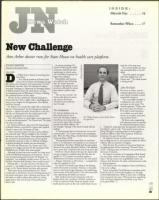
Di: Philip Zazove at one of the clinics
years old. His father realized .
ums could be lower."
he supervises.
something was wrong when his
He favors states negotiating
son became upset when the father
with pharmaceutical companies
turned away while talking. The
for reduced prescription prices.
boy thought "hearing" went hand in hand with lip
"I think it's really great that he's going for this [elect-
reading.
ed office]," said his wife. "He's had the interest for so
"It was fortunate that my hearing loss was not dis-
long. He's great at getting people to work together
covered earlier," Dr. Zazove writes in his autobiogra-
[and] see different sides of the question. [He's] just
phy, When the Phone Rings, My Bed Shakes (Gallaudet
someone who gets things done.
University Press, 1993).
Dr. Zazove's interest in politics dates back 30 years.
"During those first few years when no one knew
As a college junior; he was a precinct captain for Abner
about it, no limitations were placed on me because of
Mikva, who was elected to Congress.
my handicap," he writes. "People had the same expec-
Over the next few months, he has several fund-rais-
tations of me as they did other children. This allowed
ers planned and will be instituting "Doctor's House
me to prove that I could do what any of my peers did." Calls," visiting at least one home in every precinct over
However, it hasn't always been easy. Dr. Zazove did
the next 10 months.
not get accepted to medical school the first time he
Dr. Zazove is member of Congregation Beth Emeth
applied in 1973, despite his excellent grades at
in Ann Arbor, where he often participates in "mitzvah
Northwestern University in Evanston, Ill. One school
days." He has written two unpublished novels: one
— Rutgers University in New Jersey — accepted him
about a deaf detective, the other a drama/romance with
when he reapplied in 1974.
a deaf protagonist.
Dr. Zazove was raised to get along in the hearing
The Zazoves have two daughters, Katie and Rebecca,
world. He learned to read lips. However, in his adult
who are in college.
years, he also learned sign language so he could better
Friend and patient David Romans remembers when
communicate with deaf patients, who often have diffi-
both he and Dr. Zazove had daughters on the high
culty negotiating the health care system.
school basketball team. When it came time to helping
After medical school and meeting his wife, Dr.
raise money for the team, "Phil would start something
Barbara Reed, also a professor of family medicine at
and we'd all get behind him and finish it up. He's a
U-M, he moved to Utah, where he started a rural
very good leader." II
health practice and was the only mohel (ritual circum-
1/ 2
2004
15